3.1.12.1 - Brønsted-Lowry Acid-Base Equilibria
Brønsted-Lowry theory explains acids and bases in a very direct way: by tracking a proton from one species to another. That makes it especially useful in aqueous chemistry, where water often takes part in the proton transfer itself. In this lesson, we will focus on how to identify acids and bases from equations and how acid-base equilibria work in terms of reversible proton transfer.
Acids, bases and proton transfer
Brønsted-Lowry definitions are based on what a substance does to a proton, not on whether the solution happens to have a particular pH. In any acid-base reaction, one species loses a proton and another gains it.
Brønsted-Lowry acid
A Brønsted-Lowry acid is a proton donor.
If a species donates , it is acting as an acid in that reaction. Hydrogen chloride is a familiar example because it can pass a proton to another species.
Brønsted-Lowry base
A Brønsted-Lowry base is a proton acceptor.
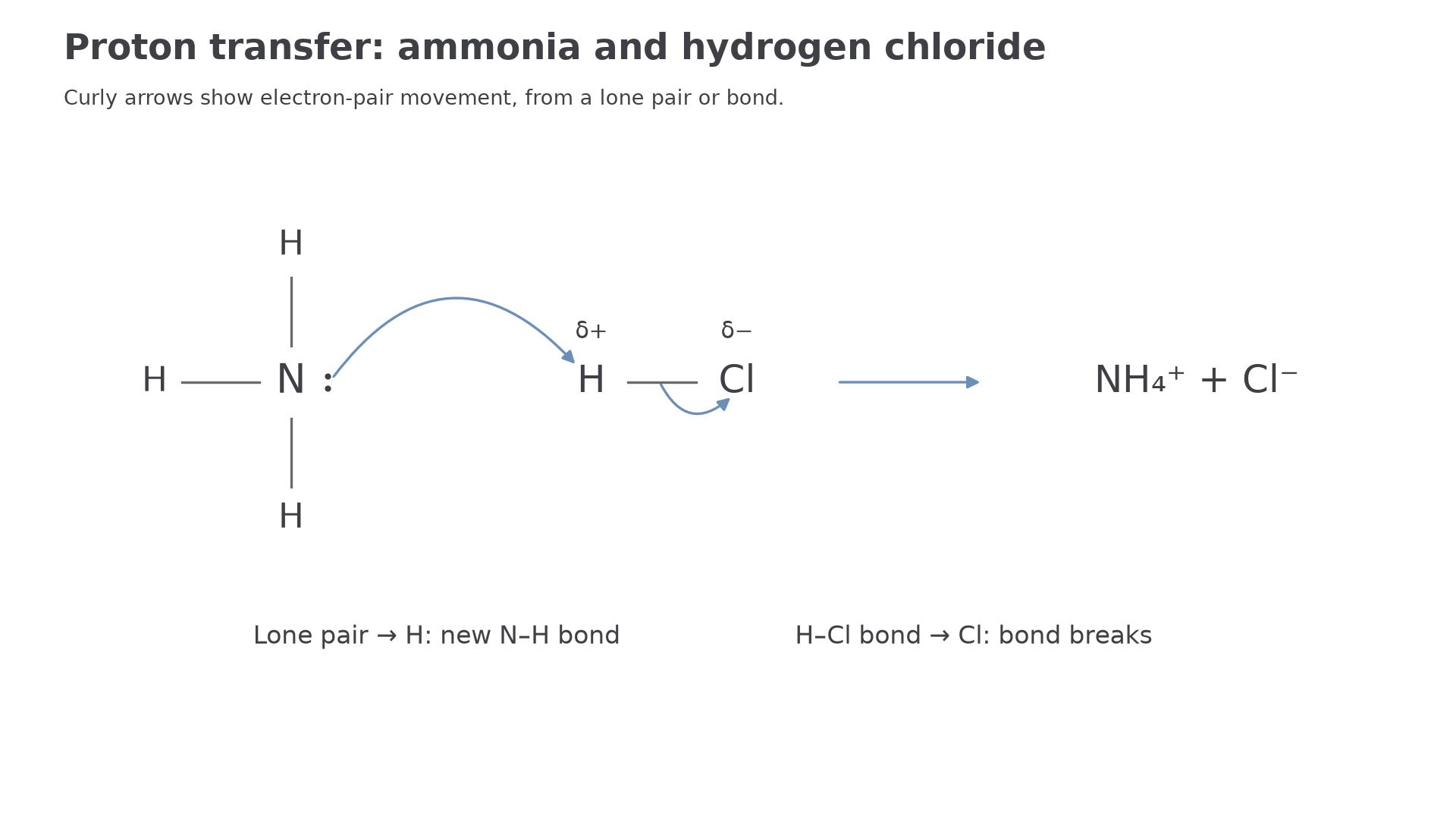
A base must have a way to accept that proton, often by using a lone pair of electrons. In the reaction below, ammonia accepts a proton from hydrogen chloride:
Here, is the acid because it donates a proton. is the base because it accepts that proton to form .
The diagram below shows proton transfer from hydrogen chloride to ammonia, with the lone pair on nitrogen allowing ammonia to accept the proton.
[DIAGRAM: asset_name: 1.12.1 - Bronsted-Lowry Acid-Base Equilibria in Aqueous Solution - Diagram 1; asset_slug: 1.12.1 - Bronsted-Lowry Acid-Base Equilibria in Aqueous Solution - Diagram 1; recommended_method: matplotlib_exact_plot; description: Ammonia-HCl proton-transfer mechanism: lone pair on nitrogen, curly arrow to H, second curly arrow from H-Cl bond to Cl; NH4+ and Cl- products, delta charges.]
A quick reliable way to classify the species is to compare them before and after the reaction. If a substance has lost , it behaved as the acid. If it has gained , it behaved as the base.
Proton transfer in aqueous solution
In aqueous solution, the proton is not present as a bare particle moving around on its own. It is attached to water, so chemists often write as a convenient shorthand for .
When hydrogen chloride dissolves in water, water accepts a proton:
Water is therefore acting as a base in this reaction. That is a good reminder that the label "acid" or "base" depends on the role played in a particular reaction.
Water can also do the opposite and donate a proton. With ammonia:
This time, water behaves as an acid because it loses a proton to . Ammonia is the base because it accepts the proton. The production of follows naturally from water having donated .
A useful habit is to track just one proton. In the first equation, the proton moves from to . In the second, it moves from to . Once you can see that movement, identifying acid and base becomes much more reliable.
Why acid-base reactions can be equilibria
Some proton-transfer reactions are reversible, so the forward and reverse reactions both matter.
Continue this lesson.
You’re previewing NovaLearn without an account. Create a free account to read the rest.
Create free account