3.2.5.5 - Variable Oxidation States
Connect changing oxidation states to vanadium colours, the Tollens test and quantitative redox titrations.
Why Transition Metals Can Show Different Oxidation States
Transition elements can form ions with different oxidation states because the 4s and 3d electrons are close in energy. After the 4s electrons have been lost, different numbers of 3d electrons can also be removed or involved in bonding, so the same metal can appear in several oxidation states instead of just one fixed charge.
Oxidation state
The oxidation state of an element is the charge it would have if the electrons in each bond were assigned to the more electronegative atom.
For simple ions, the oxidation state is the same as the ion charge. For example, in , iron has oxidation state . In more complicated ions such as , you work out the oxidation state from the overall charge and the usual oxidation state of oxygen.
Vanadium is the clearest example in this part of the course because several oxidation states are stable enough to observe directly in solution.
| Vanadium oxidation state | Species in acidic solution | Colour |
|---|---|---|
| +5 | yellow | |
| +4 | blue | |
| +3 | green | |
| +2 | violet |
These colours are not just facts to memorise. They let you follow the redox chemistry with your eyes, which is why vanadium is such a useful teaching example. The observation is most useful when you pair the colour with the oxidation state, for example "blue " rather than just "blue".
Following The Reduction Of Vanadium
Vanadate(V) ions are reduced by zinc in acidic solution step by step. Zinc is the reducing agent because it loses electrons:
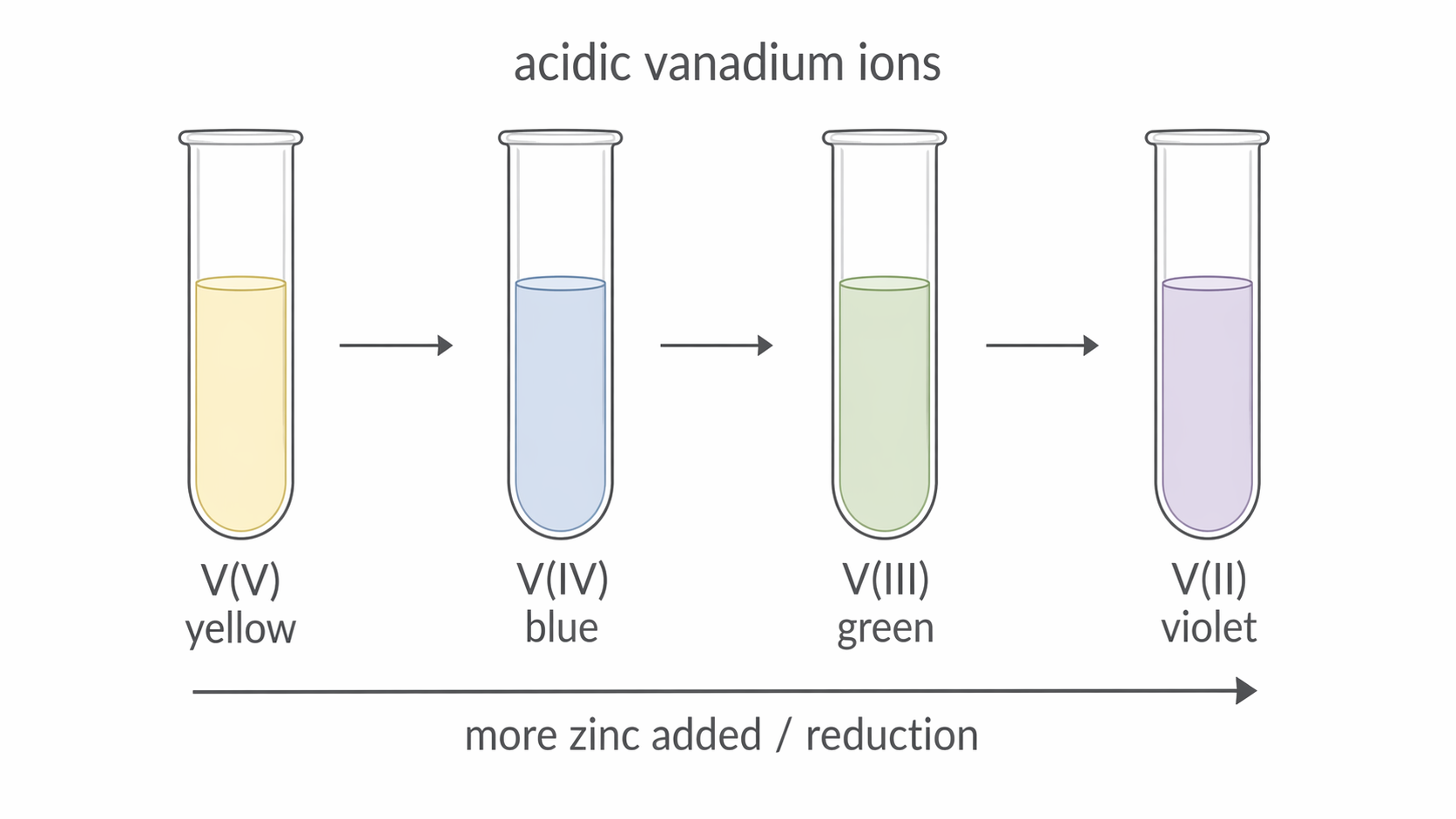
Those electrons reduce vanadium one stage at a time. The colour sequence is:
yellow -> blue -> green -> violet
The diagram below lays out the vanadium sequence in the order produced as zinc reduces the acidic solution.
[DIAGRAM: asset_name: 2.5.5 - Variable Oxidation States - Diagram 1; asset_slug: 2.5.5 - Variable Oxidation States - Diagram 1; recommended_method: retained_png; description: Four labelled test tubes in a row showing the reduction of acidic vanadium ions by zinc. Add a small heading acidic vanadium ions. Tube 1 labelled V(V) and yellow. Tube 2 labelled V(IV) and blue. Tube 3 labelled V(III) and green. Tube 4 labelled V(II) and violet. Underneath, draw a large arrow labelled more zinc added / reduction to show the sequence from +5 to +2.]
The key half equations are:
The acid is not just a background detail. appears on the left-hand side of the first two reduction half equations, so changing the pH changes how favourable those reductions are. That is why pH can change redox potential.
Keep tying the colour changes back to the chemistry: each stage is one further reduction of vanadium, produced by zinc supplying electrons.
Observe each reduction stage as zinc is added to acidified vanadate(V), mixing gently. A temporary green mixture can contain yellow V(V) and blue V(IV), so it is not by itself proof that V(III) has formed. Continued reduction gives the characteristic green V(III), then violet V(II). Air can oxidise V(II) again; record the fresh observation rather than treating an aged sample as a failed reaction.
Why pH And Ligands Change Redox Behaviour
A redox potential tells you how readily a species is reduced compared with another half-cell. It is not a permanently fixed property of a metal ion in all circumstances. If the half equation contains , changing the pH changes the position of the equilibrium and therefore changes how favourable reduction is. More acidic conditions usually make a reduction half equation with on the left more favourable.
Ligands matter for a similar reason. Different ligands stabilise different oxidation states by different amounts. If a ligand makes the higher oxidation state especially stable, reduction becomes less favourable. If it stabilises the lower oxidation state more, reduction becomes more favourable. So changing from water ligands to ammonia ligands can change redox behaviour even when the metal is the same.
One important complex ion in this topic is Tollens' reagent.
Tollens' reagent
Tollens' reagent is the diamminesilver(I) ion, , used as an oxidising agent to test for aldehydes.
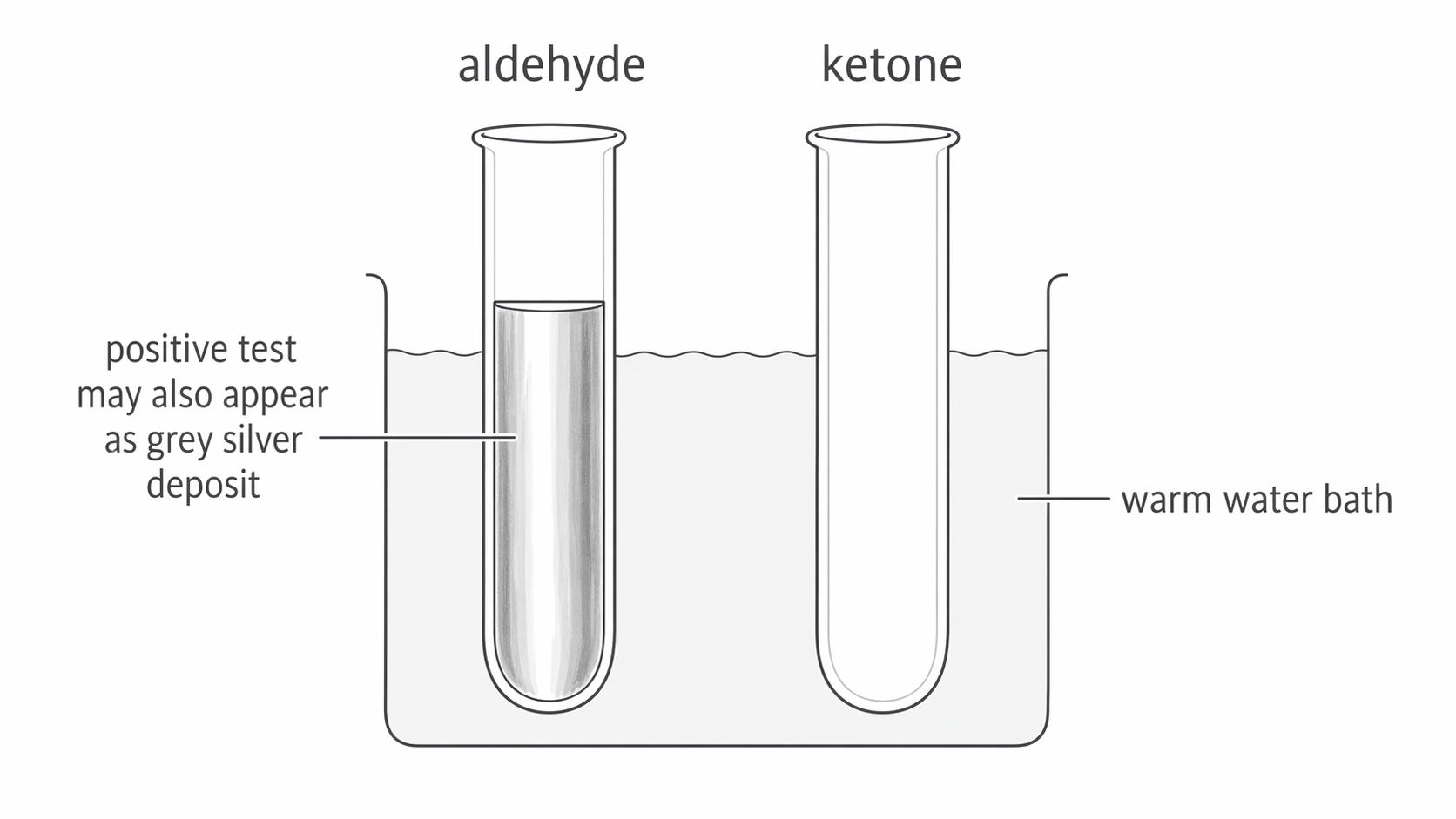
An aldehyde reduces to silver metal, while the aldehyde itself is oxidised to a carboxylate ion. A clean test tube often develops a silver mirror:
Ketones do not normally reduce Tollens' reagent under these conditions, so this reaction distinguishes aldehydes from ketones. The key chemical point is that aldehydes are oxidised by Tollens' reagent, but ketones are not.
The diagram below contrasts the positive aldehyde result with the unchanged ketone sample after warming with Tollens' reagent in a water bath.
[DIAGRAM: asset_name: 2.5.5 - Variable Oxidation States - Diagram 2; asset_slug: 2.5.5 - Variable Oxidation States - Diagram 2; recommended_method: retained_png; description: Two labelled test tubes standing in a warm water bath after adding Tollens' reagent. Left tube labelled aldehyde with a silver mirror coating the inside wall. Right tube labelled ketone with no visible change. Add a note that positive test may also appear as grey silver deposit if the tube is not perfectly clean.]
The deeper idea here is that conditions control feasibility. The same broad redox idea gives you both the vanadium colour changes and the aldehyde test.
Use freshly prepared Tollens’ reagent in clean glassware and warm gently in a water bath. A silver mirror or a grey silver deposit is a positive reduction result. Compare with a control without the aldehyde. The reagent and residues must be disposed of promptly under the laboratory procedure; do not store them or allow silver-containing residues to dry.
Continue this lesson.
You’re previewing NovaLearn without an account. Create a free account to read the rest.
Create free account