3.1.7 - Oxidation, Reduction and Redox Equations
Redox chemistry can look like a set of separate tricks, but the whole topic is really about one idea: electrons move from one species to another. In this lesson, you will learn how to track that electron transfer using definitions, oxidation states, and half-equations. By the end, you should be able to move confidently from a redox reaction to balanced half-equations and then back to the overall equation.
What redox means
In a redox reaction, one species loses electrons and another gains them. Those two processes always happen together because electrons are not created or destroyed in an ordinary chemical reaction. If a metal atom loses electrons, something else in the reaction must accept them.
Oxidation and reduction
Oxidation is loss of electrons. Reduction is gain of electrons.
That definition also tells you what the agents are doing. An oxidising agent causes another species to be oxidised because it accepts electrons itself. A reducing agent causes another species to be reduced because it donates electrons itself. The place students most often get tangled up is mixing what a substance does to another species with what happens to the substance itself:
- the oxidising agent accepts electrons and is reduced
- the reducing agent donates electrons and is oxidised
For example, when magnesium reacts with chlorine:
Magnesium loses electrons, so magnesium is oxidised and acts as the reducing agent. Chlorine gains electrons, so chlorine is reduced and acts as the oxidising agent. The diagram below makes that electron transfer explicit and links it directly to the two agents.
[DIAGRAM: asset_name: 1.7 - Oxidation, Reduction and Redox Equations - Diagram 1; asset_slug: 1.7 - Oxidation, Reduction and Redox Equations - Diagram 1; recommended_method: retained_png; description: Magnesium loses two electrons and chlorine gains them; the diagram identifies oxidation, reduction and the two agents.]
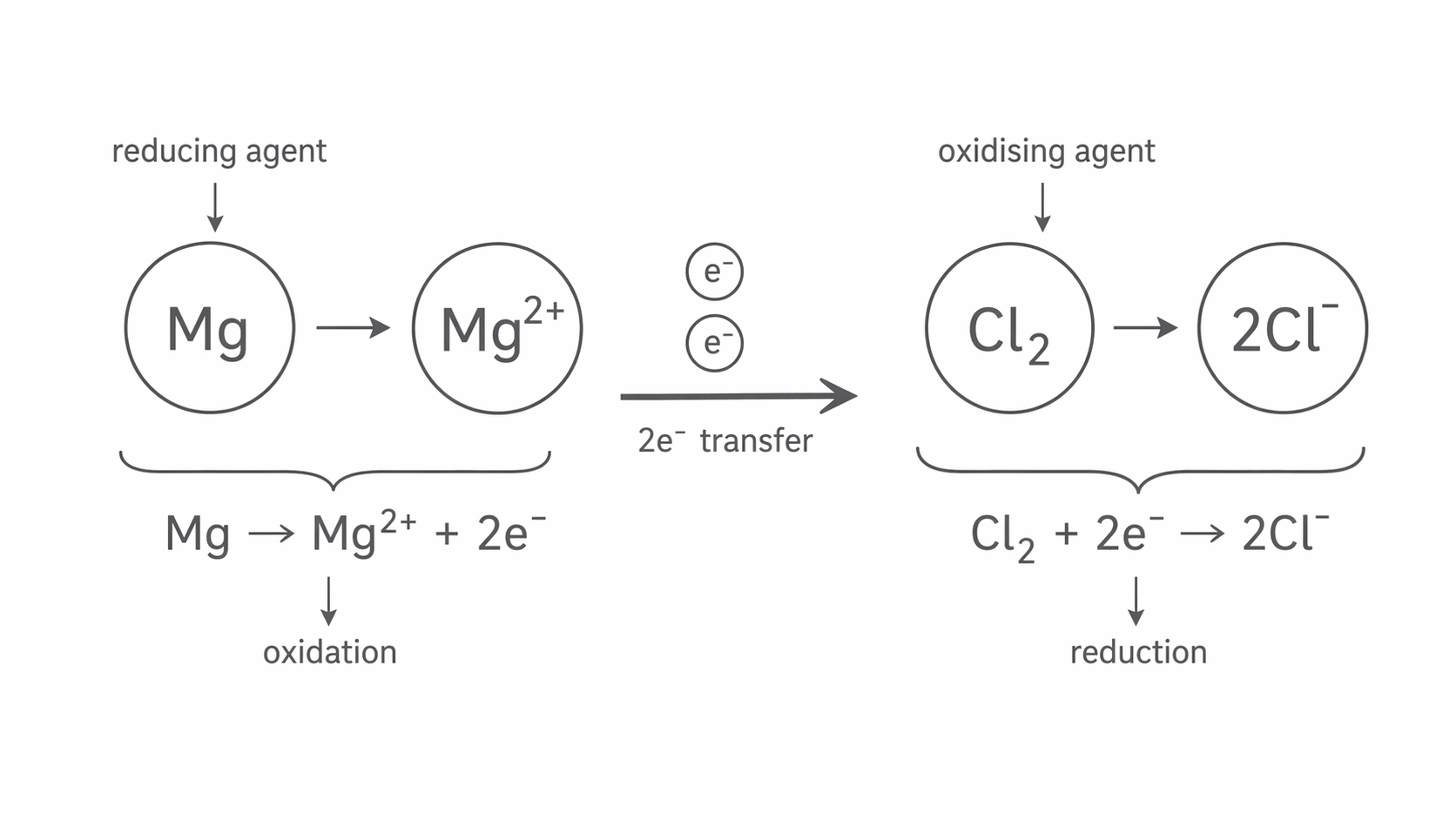
Once you are clear about the direction of electron transfer, the rest of the topic becomes much easier. You can then use charges or oxidation states to decide exactly which species has been oxidised and which has been reduced.
Using oxidation states to track electrons
Charges are helpful for simple ions, but many redox reactions involve molecules or polyatomic ions. That is where oxidation states become useful. Oxidation states are a bookkeeping system for tracking electron movement.
Oxidation state
The oxidation state of an element is the charge it would have if the electrons in a compound were assigned according to a set of standard rules. Oxidation state is also called oxidation number.
For the species in this lesson, these rules do the job:
- An uncombined element has oxidation state .
- The oxidation state of a simple ion is the same as its charge.
- The total oxidation states in a neutral compound add up to .
- The total oxidation states in a polyatomic ion add up to the overall ionic charge.
- Group 1 elements are and Group 2 elements are in their compounds.
- Hydrogen is usually .
- Oxygen is usually .
- Fluorine is , and other halogens are usually in simple compounds.
The word “usually” signals exceptions that can be deduced from the other rules. In , oxygen is −1 because hydrogen is +1 and the molecule is neutral. In , hydrogen is −1 because sodium is +1. In , fluorine is −1 so oxygen is +2. Do not assign every oxygen −2 before checking what it is bonded to.
Roman numerals in names specify oxidation states: iron(II) chloride is , whereas iron(III) chloride is . Sulfur(VI) in means sulfur has oxidation state +6; it does not mean the sulfate ion has charge +6. Oxidation states are bookkeeping values, not necessarily actual ionic charges on atoms in covalent molecules.
Worked example 1: sulfur in
Hydrogen contributes and oxygen contributes .
So:
So sulfur has oxidation state in sulfuric acid.
Worked example 2: nitrogen in
Hydrogen contributes , and the total must add to the ionic charge .
So nitrogen has oxidation state in .
Oxidation states are useful because a rise in oxidation state means oxidation has happened, while a fall in oxidation state means reduction has happened. For example, if copper changes from in a metal to in a compound, its oxidation state rises from to , so copper has been oxidised.
Continue this lesson.
You’re previewing NovaLearn without an account. Create a free account to read the rest.
Create free account