3.3.13.4 - DNA
DNA is the molecule that stores genetic information, but in this chemistry lesson the focus is on structure and bonding. The key idea is that a simple monomer, the nucleotide, can build a long polymer chain and then form a second matching strand through hydrogen bonding. Once you see how the bonding works, complementary base pairing becomes something you can reason out rather than just memorise.
The Building Blocks of DNA
The Chemistry Data Booklet gives the displayed structures of the phosphate ion, 2-deoxyribose, and the four DNA bases. For this specification point, the most important job is to recognise how those pieces combine to make a nucleotide.
Nucleotide
A nucleotide is a molecule made from a phosphate group, a pentose sugar, and a nitrogen-containing base.
In DNA, the sugar is always 2-deoxyribose. The base can be adenine (A), thymine (T), cytosine (C), or guanine (G). That means there are four DNA nucleotides: they all contain the same sugar and phosphate, but they differ in which base is attached.
This is a good place to be precise. A base on its own is not a nucleotide, and the sugar on its own is not a nucleotide either. You only have a nucleotide when all three parts are bonded together. The diagram below shows a single DNA nucleotide with those three components identified.
[DIAGRAM: asset_name: 3.13.4 - DNA - Diagram 1; asset_slug: 3.13.4 - DNA - Diagram 1; recommended_method: code_generated; description: DNA nucleotide schematic with phosphate four oxygen neighbours, numbered 2-deoxyribose carbon positions and a sugar-to-base nitrogen bond.]
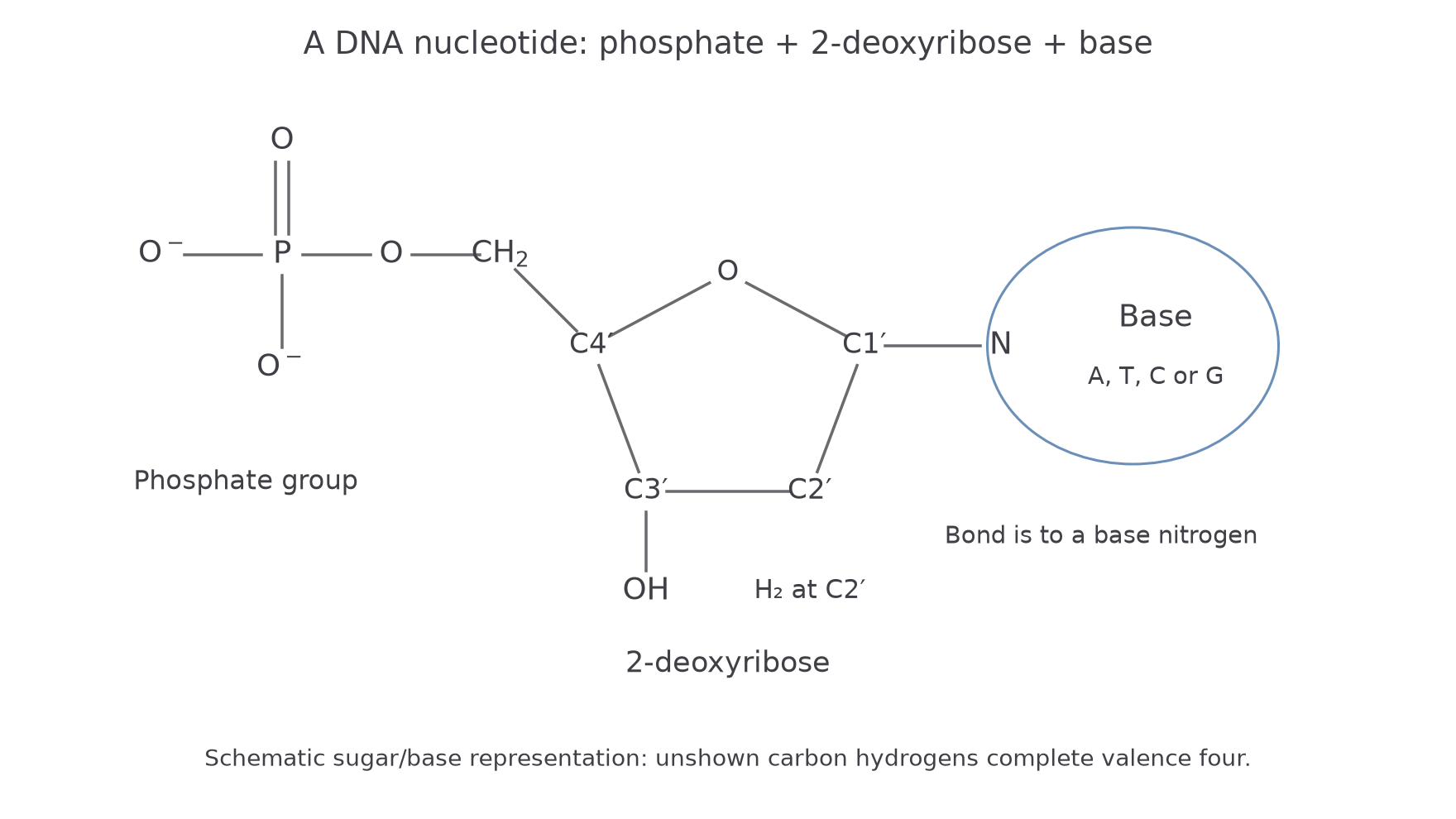
In the Data Booklet, recognise the five-membered sugar ring by its ring oxygen and the absence of an OH group at carbon 2. The phosphate group bonds through an oxygen to the sugar; the base bonds through a nitrogen to sugar carbon 1. The four bases have different patterns of N–H groups, nitrogen lone pairs and carbonyl oxygens. You do not need to memorise their full structures, but you must be able to find those bonding sites in a supplied structure.
Building A Single DNA Strand
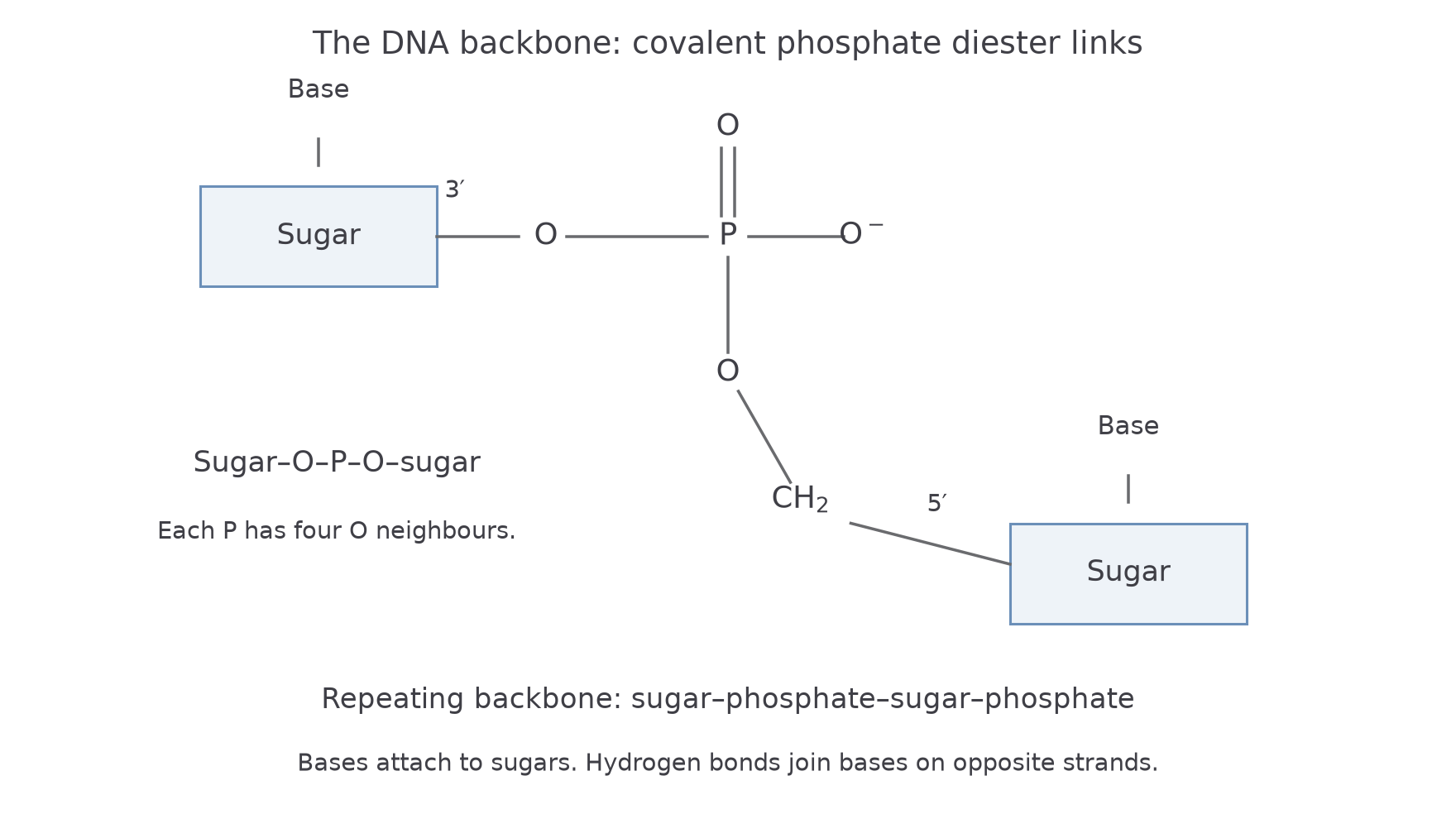
DNA is a polymer of nucleotides. Adjacent nucleotides join when the phosphate group of one nucleotide forms a covalent bond to the 2-deoxyribose of the next nucleotide. The resulting phosphate ester links are covalent. A condensation model shows how these components fit together; biological DNA synthesis uses activated nucleotides and enzymes, rather than simply mixing the free components and removing water.
As more nucleotides join, the repeating pattern along the chain is:
phosphate - sugar - phosphate - sugar
This repeating chain is called the sugar-phosphate backbone. The bases do not form the backbone; instead, each base hangs from its sugar. That matters because the order of the bases can vary from one DNA molecule to another, while the sugar-phosphate pattern stays the same.
So a single strand of DNA is best pictured as a long covalently bonded chain with bases attached along the side. The covalent bonds make the strand itself strong and stable. The diagram below follows a covalent phosphate ester link from one sugar to the next.
[DIAGRAM: asset_name: 3.13.4 - DNA - Diagram 2; asset_slug: 3.13.4 - DNA - Diagram 2; recommended_method: code_generated; description: Explicit sugar–O–P(=O)(O−)–O–CH2–sugar covalent fragment; 3′ and 5′ connections labelled, bases shown on sugars.]
Why The Second Strand Is Complementary
The most important step now is to separate the two types of bonding in DNA. Covalent bonds join nucleotides together within each strand. Hydrogen bonds form between bases on opposite strands.
Complementary Strands
Two DNA strands are complementary when each base on one strand is paired with the specific base that can hydrogen bond with it on the other strand.
The base pairing is specific:
Continue this lesson.
You’re previewing NovaLearn without an account. Create a free account to read the rest.
Create free account