3.1.12.3 - The Ionic Product of Water, Kw
This lesson is about the tiny extent to which water dissociates and why that tiny change still matters in acid-base chemistry. Even pure water is quietly producing a few ions all the time. You will see where comes from, why its value changes with temperature, and how to use it to calculate the pH of a strong base from its concentration.
Water dissociation and the meaning of Kw
Pure water is not made of only uncharged molecules. A very small fraction of water molecules dissociate at any moment, so pure water contains both hydrogen ions and hydroxide ions:
Because this dissociation is only slight, most of the particles are still . That is why water is described as slightly dissociated.
Ionic product of water, Kw
The ionic product of water, , is the equilibrium constant for the dissociation of water after the constant concentration of liquid water has been incorporated into the constant. At a fixed temperature, .
To see where that expression comes from, start with the equilibrium constant for the dissociation of water:
In this equilibrium, water is a pure liquid, so its concentration is effectively constant. Chemists therefore combine with to make a new constant:
Ionic product of water
At 25 °C, the value of is . In pure water, the concentrations of and are equal, so each one must be .
At a fixed temperature this ionic-product relationship applies to acidic and alkaline aqueous solutions as well as pure water. Adding acid raises , so decreases but does not become zero. Neutrality means equal concentrations of these two ions; pH 7 is the neutral value specifically at about .
Why Kw changes with temperature
is not one fixed number for all temperatures. The forward dissociation of water is endothermic, so increasing the temperature favours the forward reaction.
The diagram below summarises how the endothermic forward reaction leads to larger ion concentrations and a larger at higher temperature.
[DIAGRAM: asset_name: 1.12.3 - The Ionic Product of Water, Kw - Diagram 1; asset_slug: 1.12.3 - The Ionic Product of Water, Kw - Diagram 1; recommended_method: matplotlib_exact_plot; description: Neutral water at10,25,40 Celsius; Kw2.93e-15,1e-14,2.92e-14; neutral pH7.27,7.00,6.77; equal-ion neutrality and temperature effect.]
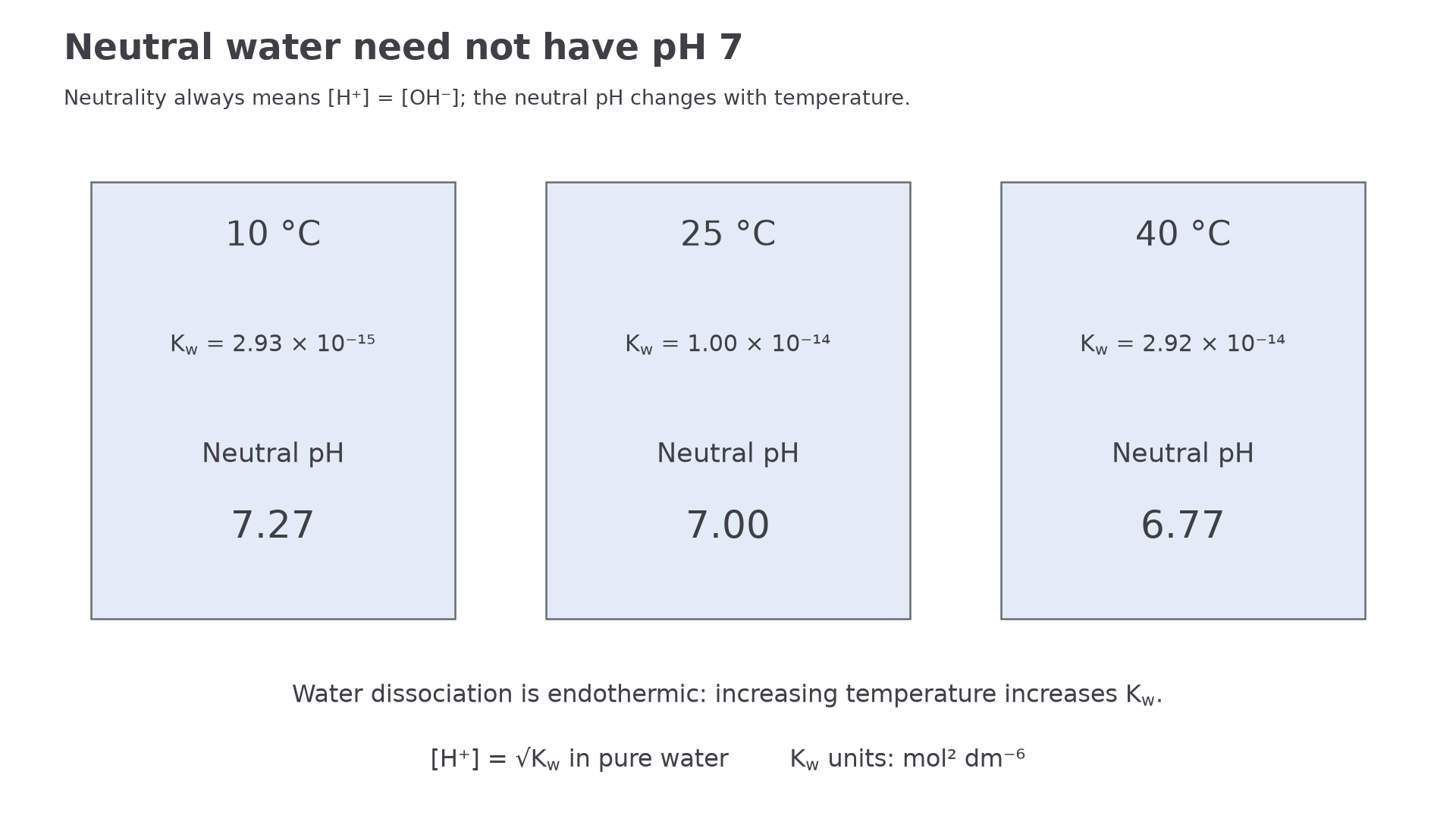
That means both and increase as temperature rises, so the product increases too. Therefore increases when temperature increases.
Neutral
A neutral solution has equal concentrations of ions and ions.
Hotter pure water does not become acidic. In pure water, the concentrations of and increase together, so they remain equal. The pH of neutral water becomes lower than 7 at higher temperature, but the water is still neutral because .
Continue this lesson.
You’re previewing NovaLearn without an account. Create a free account to read the rest.
Create free account