3.3.5.2 - Oxidation of Alcohols
Oxidation of alcohols is one of those topics where a small change in structure leads to a very different reaction outcome. In this lesson, you will classify alcohols, choose the correct oxidation product, and see why the method changes the product for a primary alcohol. You will also recognise how aldehydes and ketones behave differently with Tollens' reagent and Fehling's solution.
Oxidation Patterns for the Three Alcohol Types
The first thing to check is the type of alcohol. A primary alcohol has the carbon bonded to the - group attached to one other carbon (methanol is also treated as primary), a secondary alcohol has it attached to two other carbons, and a tertiary alcohol has it attached to three other carbons. That structural detail determines whether oxidation can happen easily.
Oxidation
In organic chemistry, oxidation usually means gain of oxygen or loss of hydrogen.
The usual oxidising agent for alcohols is acidified potassium dichromate(VI). It starts orange because it contains dichromate(VI) ions and turns green as chromium((III)) ions form, so that colour change is a useful sign that oxidation has taken place.
The oxidation patterns are:
- Primary alcohol → aldehyde → carboxylic acid
- Secondary alcohol → ketone
- Tertiary alcohol → no easy oxidation under these conditions
Useful equations using are:
- Primary alcohol to aldehyde: + → +
- Primary alcohol to carboxylic acid: + 2 → +
- Secondary alcohol to ketone: + → +
For example:
- + → +
- + 2 → +
- + → +
The diagram below summarises the oxidation pathway for each alcohol class under acidified potassium dichromate(VI) conditions.
[DIAGRAM: asset_name: 3.5.2 - Oxidation of Alcohols - Diagram 1; asset_slug: 3.5.2 - Oxidation of Alcohols - Diagram 1; recommended_method: retained_png; description: Three-pathway oxidation flow chart with acidified potassium dichromate(VI) labelled above the arrows and orange -> green shown beside the reagent. Top pathway: primary alcohol -> aldehyde -> carboxylic acid. Middle pathway: secondary alcohol -> ketone. Bottom pathway: tertiary alcohol -> no reaction under normal conditions.]
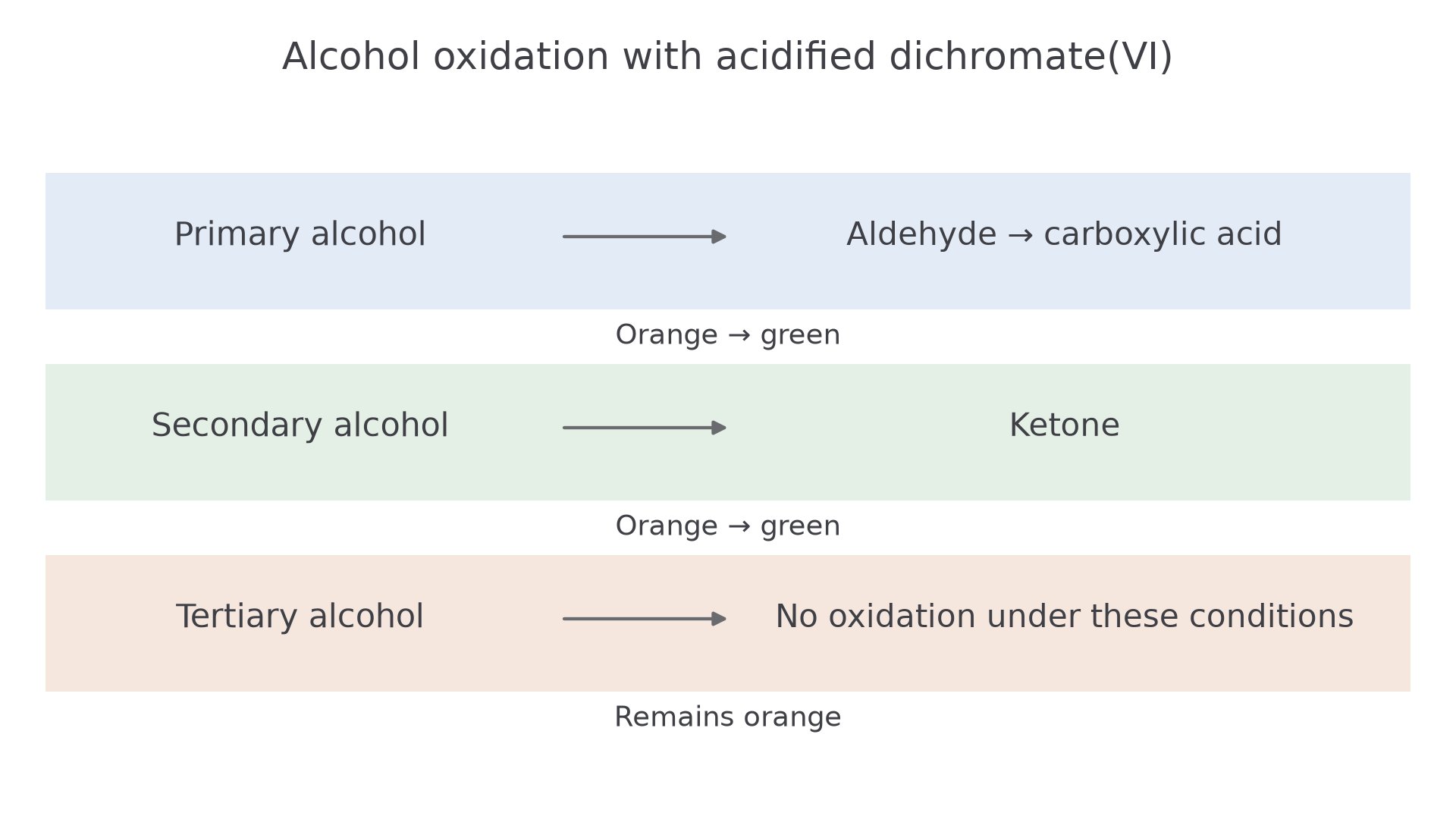
Track what changes around the carbon attached to the - group. The first oxidation of a primary alcohol removes hydrogen from the carbon bearing - and from the bond to form an aldehyde. Further oxidation adds oxygen to the aldehyde to form a carboxylic acid. In a secondary alcohol, there is only one available hydrogen on that carbon, so oxidation stops at the ketone stage.
Unlike a secondary alcohol, a primary alcohol can stop at an aldehyde or continue to a carboxylic acid depending on how the reaction is carried out.
Why Distillation and Reflux Give Different Products
For primary alcohols, the method matters because the aldehyde product is easier to oxidise than a ketone. If you allow the aldehyde to stay in the reaction mixture with the oxidising agent, it will usually keep reacting and form a carboxylic acid.
Distillation
Distillation is a method that boils off a volatile product and then condenses it so it can be collected separately.
To make an aldehyde from a primary alcohol, the mixture is heated gently and the aldehyde is distilled off as soon as it forms. This removes it from the oxidising agent before it can be oxidised again. In practice, the aldehyde has a lower boiling point than the carboxylic acid, so it leaves the flask more easily.
Reflux
Reflux is heating a reaction while a condenser returns vapours to the flask so that reactants and products stay in the hot reaction mixture.
To make the carboxylic acid, the primary alcohol is heated under reflux with excess acidified potassium dichromate(VI). Because vapours condense and drip back into the flask, the aldehyde is not removed. It remains in contact with the oxidising agent and is oxidised further to the carboxylic acid.
The equations differ because the primary alcohol can be oxidised in one stage or two. Ethanol to ethanal uses one :
+ → +
Ethanol to ethanoic acid uses two because the alcohol is oxidised further:
+ 2 → +
Use electrical heating for flammable organic liquids. Add anti-bumping granules before heating and keep the apparatus open to the atmosphere. In a distillation, place the thermometer bulb at the sidearm and run cooling water from the lower to the upper condenser connection. In reflux, mount the condenser vertically so condensed liquid returns to the flask; do not stopper its top. Acidified dichromate(VI) is hazardous: use the instructed small quantities, eye protection and designated chromium-waste collection.
Continue this lesson.
You’re previewing NovaLearn without an account. Create a free account to read the rest.
Create free account