Statistics 3.1 - Mutually exclusive and independent events
Does “one event tells you nothing about another” mean that they cannot happen together? You will distinguish independence from mutual exclusivity, calculate probabilities using regions and paths, and connect the same event language to discrete and continuous distributions.
Events as regions
Can two events happen together and still be independent? Start with one fair die: let mean “even” and mean “a multiple of three”. They share the outcome . We will return to whether that overlap rules out independence.
You already know
A probability lies between and . For equally likely outcomes, divide the number of favourable outcomes by the total number of outcomes.
The sample space contains every possible outcome. An event is a subset of that space. Here the overlap contains one outcome, while the union contains four: .
Event notation
means both events occur; means at least one occurs, including both; means that does not occur. The empty event is , and .
Adding the probabilities of two events counts their overlap twice. Subtract it once to count each outcome once.
Addition rule
For any two events,
In the formula booklet.
A region described as “ but not ” is ; remove the overlap from all of .
Worked example 1: union and one exclusive region
Question. Given , and , find and .
Plan. Subtract the overlap once from the sum, then subtract it from alone.
Why subtract ? Those outcomes have already been included in both event totals.
Answer. The probabilities are and .
Check. The separate regions are , and , which sum to .
Change only the overlap to . The individual event totals stay fixed, so a larger overlap makes the union smaller.
Worked example 2: a larger overlap
Question. Given , and , find and .
Plan. Use the same two subtractions with the new overlap.
Why keep both event totals unchanged? The changed overlap redistributes their regions; it does not change those given totals.
Answer. The probabilities are and .
Check. , and the outside region is .
Now move the overlap again and keep track of the two distinct requested regions.
Mutually exclusive events
On one die roll, “even” and “odd” cannot both happen. By contrast, “even” and “multiple of three” can both happen when the die shows .
Mutually exclusive events
Events are mutually exclusive when they have no shared outcomes: . Their intersection therefore has probability .
In finite equally likely models, a zero overlap probability means there is no overlap. With continuous models, a nonempty event can have probability zero, so “no shared outcomes” is the underlying meaning. The addition rule now has nothing to subtract.
Mutually exclusive addition
If and are mutually exclusive,
Not in the formula booklet: learn it.
This is the supplied addition rule with . Mutual exclusivity does not say that one event must happen: there may be outcomes outside both. Events are exhaustive when their union is the whole sample space.
Worked example 3: two subjects with no overlap
Question. In a year group, no student studies both Further Mathematics and Drama. A randomly selected student studies Further Mathematics with probability and Drama with probability . Find the probability of studying either subject and the probability of studying neither.
Plan. Add the disjoint event probabilities, then take the complement.
Why is addition valid here? The “no student studies both” condition makes the events mutually exclusive.
Answer. Either subject has probability ; neither has probability .
Check. .
Change only the Drama probability to , keeping the no-overlap condition.
Worked example 4: a changed disjoint region
Question. No student studies both subjects, with and . Find the probabilities of either subject and neither subject.
Plan. Add the mutually exclusive events and subtract their union from .
Why is “neither” a complement? Every student is either in the union or outside it.
Answer. Both requested probabilities are .
Check. The three separate categories sum to .
The word “or” includes both in ordinary probability notation. Here both is impossible, so that distinction creates no extra region.
Watch out
Mutually exclusive does not mean exhaustive. Writing from “no overlap” alone is wrong; only the sum is guaranteed.
Use a fresh Drama probability to find the outside region.
Independent events
Return to the fair die. Half of all outcomes are even. Among the multiples of three, , half are also even. Knowing that a multiple of three occurred has not changed the probability of an even outcome, despite the shared outcome .
Independent events
Events and are independent when occurrence of one does not change the probability of the other. Thus and , whenever those conditional probabilities are defined.
The vertical line means “given that”. The product condition below also covers zero-probability events without dividing by zero.
Independence condition
Events and are independent if and only if
In the formula booklet.
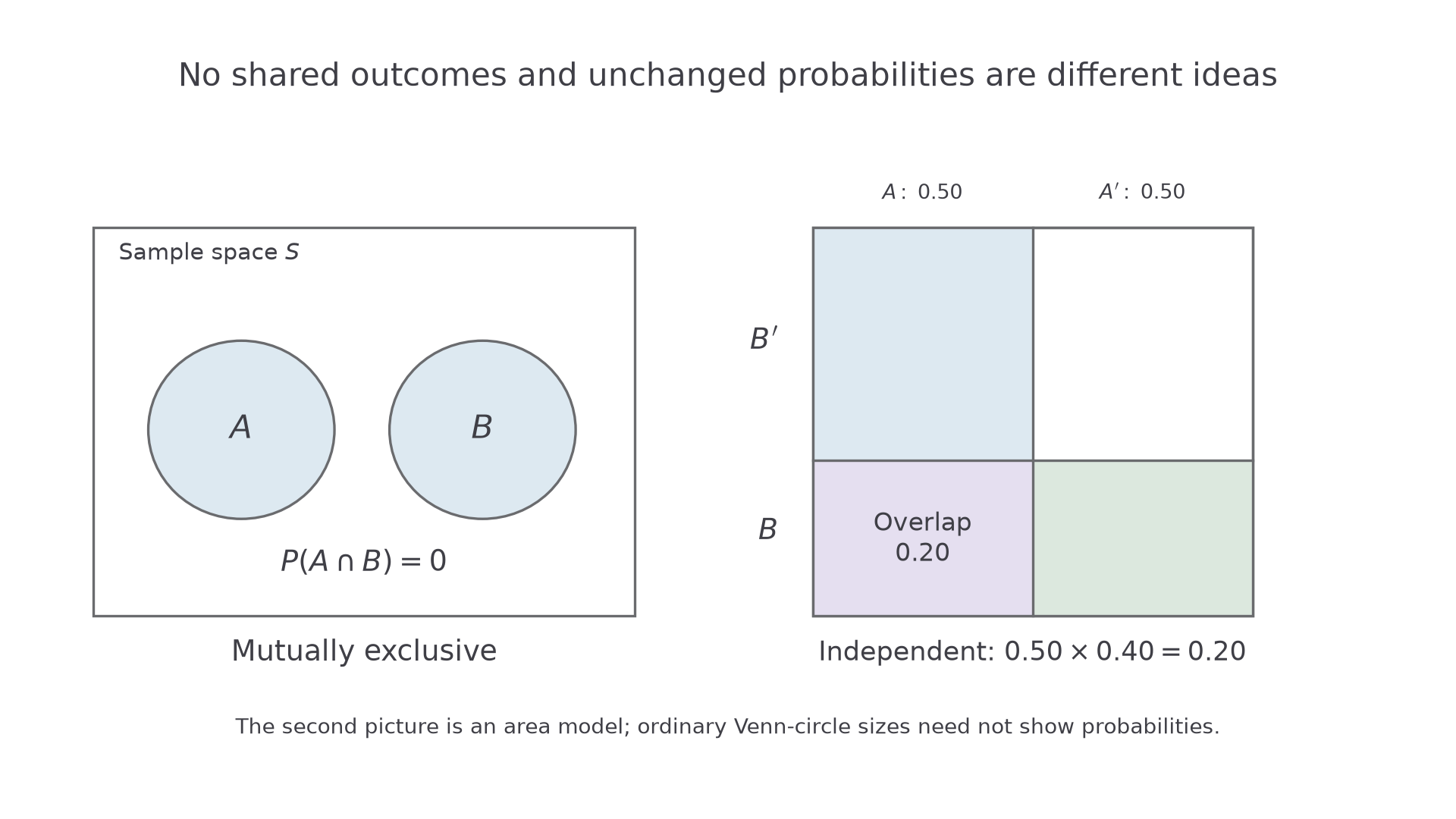
In the opening die example, . That proves the independence claim. The picture below contrasts no overlap with an overlap of precisely the size independence requires.
[DIAGRAM: asset_slug: p3_3_1_understand_and_use_mutually_exclusive_and_independent_events_in_probability__diagram_01; asset_name: Statistics 3.1 - Mutually exclusive and independent events - diagram 01; caption: Mutual exclusivity removes the overlap; independence fixes its probability; description: Separate event circles on the left; on the right a unit-square model has A probability 0.50, B probability 0.40 and overlap probability 0.20.]
Worked example 5: testing independence
Question. Events have , and . Determine whether they are independent.
Plan. Compare the actual intersection probability with the product of the event totals.
Why compare these two quantities? Equality is the test for independence, rather than the mere presence of an overlap.
Answer. The events are independent.
Check. .
Change only the intersection probability to . This makes the events mutually exclusive and changes the independence decision.
Worked example 6: testing zero overlap
Question. Events have , and . Determine whether they are independent.
Plan. Compare zero with the product of the two positive event probabilities.
Why does the product stay positive? Both events have positive probability; multiplying them cannot give zero.
Answer. They are not independent. In fact, knowing occurred makes impossible.
Check. , which differs from .
Two positive-probability mutually exclusive events are therefore dependent. If one event has probability zero, the product condition can hold; do not drop the positive-probability qualification.
Key idea
Independence means unchanged probability, while mutual exclusivity means no shared outcomes.
Make the comparison again with a different overlap.
Continue this lesson.
You’re previewing NovaLearn without an account. Create a free account to read the rest.
Create free account