Pure 4.3 - Sigma notation
Sigma notation writes a whole sum by specifying its terms and its endpoints. You will read, expand and construct finite sums, count their terms, and use the notation to express totals accurately. The aim is to see the addition hiding behind the symbol.
Read the sigma symbol
Does mean one calculation, three calculations or four? The endpoints look only three steps apart, yet the sum includes four terms. This small counting decision is the heart of sigma notation.
You already know
A sequence lists terms, while a series adds them. Substituting into gives ; substituting gives .
The full sum uses , producing . Its index visits both endpoints.
Sigma notation
The symbol , capital Greek sigma, means sum. In
is the index, is the lower limit, is the upper limit, and is the summand. For integer bounds , substitute every integer from to , inclusive, and add the resulting values.
The limits are index values, not necessarily term values. The upper limit produces the last term in our example.
[DIAGRAM: asset_slug: p1_4_3_understand_and_use_sigma_notation_for_sums_of_series__diagram_01; asset_name: Pure 4.3 - Sigma notation - diagram 01; recommended_method: drawn_math; description: The sum from r=2 to 5 of 3r-1 is labelled by upper limit, lower limit and summand, expanded as 5+8+11+14=38, and compared with n copies of one.]
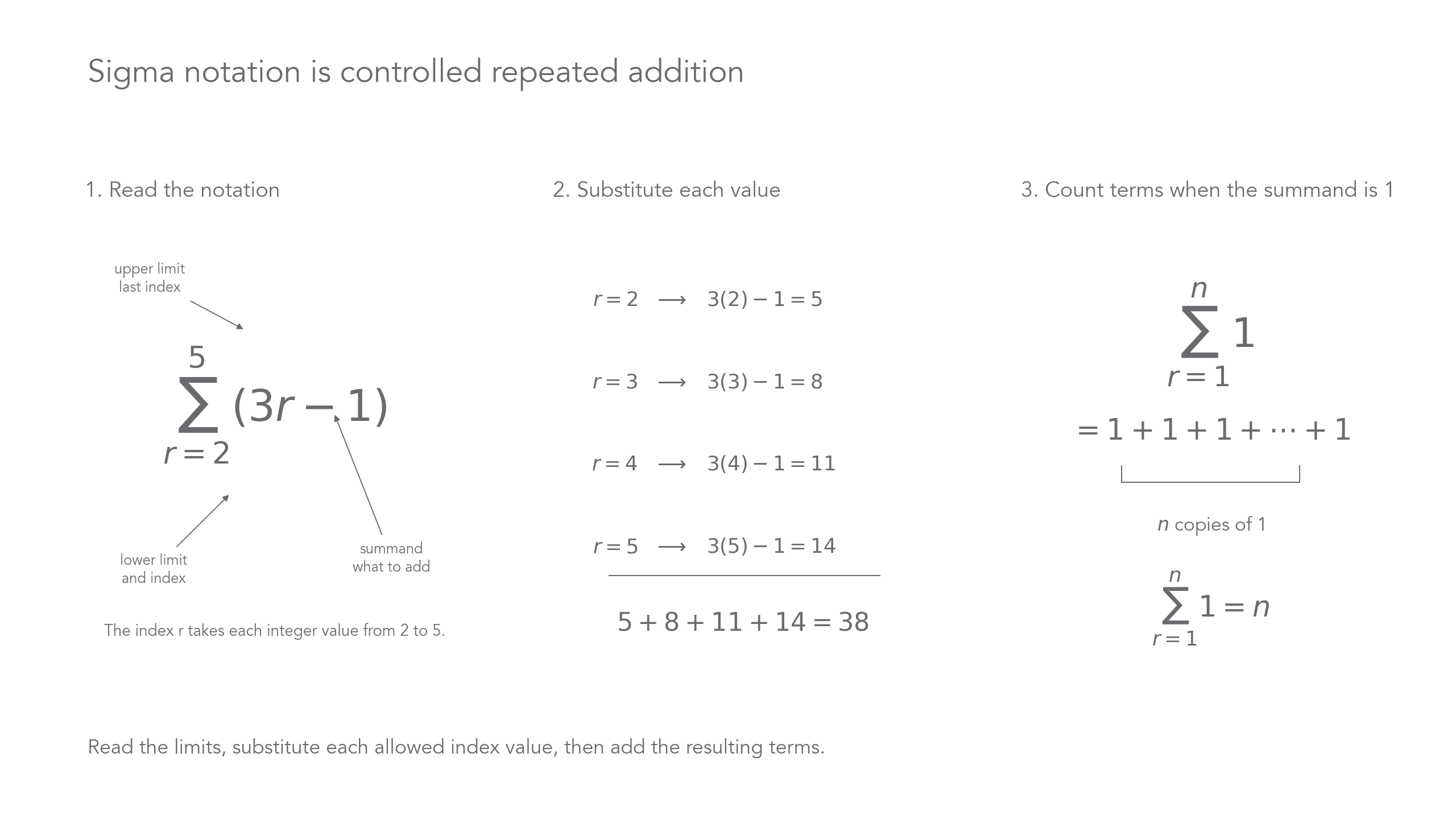
An index is a dummy variable: replacing by everywhere inside the same sum changes no values. Thus . By contrast, a letter such as in stays fixed while changes.
Key idea
A sigma expression is an instruction to add all the specified terms, not an instruction to substitute only the upper limit.
Check which expansion respects both endpoints.
Expand and evaluate finite sums
For a short finite sum, write the allowed index values before calculating. This works for any supplied summand, including squares, reciprocals and alternating signs; no special summation formula is needed.
Worked example 1: expanding before adding
Question. Evaluate .
Plan. Substitute the four consecutive index values, then add.
Why this step? Starting at avoids adding a term outside the requested range.
Answer. .
Check. Pairing and gives .
Change only the limits, moving the four-term window one position to the right. Each included term should increase by .
Worked example 2: shifting the summation window
Question. Evaluate .
Plan. Keep the summand and substitute the new bounds.
Why this step? A shift in the limits changes the terms even when the summand is unchanged.
Answer. .
Check. Compared with Example 1, the sum loses and gains , increasing by .
A nonlinear summand follows exactly the same substitution principle. For example, ; it does not mean .
Watch out
The line gives only the final term. Expand every allowed index value before adding.
Move the summation window again.
Count terms and use the sum of ones
There is a useful surprise in : the summand does not change at all, but the sum still depends on . Sigma counts how many copies to add.
Constant finite sums
For ,
More generally, for integer and constant ,
There are included index values.
Not in the formula booklet: learn it.
For example, positions contain seven values, even though the distance between the endpoints is six. The extra accounts for the first included value.
Worked example 3: a constant summand
Question. Simplify , where .
Plan. Count copies rather than substitute into a variable expression.
Why this step? The summand is , not ; the index only controls the number of copies.
Answer. .
Check. For , the sum is .
Change only the limits. The summand is still , but the count is no longer the upper limit.
Worked example 4: a non-unit lower limit
Question. Evaluate .
Plan. Count the integers from through .
Why this step? The upper limit is the last index, not the number of terms.
Answer. .
Check. Listing confirms seven indices.
You can also combine sums with the same limits term by term. Subtracting from leaves copies of , hence . This uses ordinary distributive arithmetic, not a new formula for summing powers.
Watch out
omits one endpoint. The correct count is .
Try a new constant and a different interval.
Write sums in sigma notation
Writing sigma notation reverses the process: choose a summand and limits that reproduce every intended term. Checking only the last term is not enough; several wrong starting points can still end at the correct value.
Worked example 5: encoding a finite series
Question. Write in sigma notation.
Plan. Use a linear expression that gives at index , then stop at the fifth term.
Why this step? The constant makes the formula start at , rather than at .
Answer. .
Check. The alternative produces the same five terms. A different dummy index can encode the same sum.
Change only how many terms are included, keeping the initial term and step fixed.
Worked example 6: extending the upper limit
Question. Write in sigma notation.
Plan. Retain , then find the index giving .
Why this step? The final term value is , but the upper index is .
Answer. .
Check. The count matches the seven listed terms.
Changing the index letter is harmless only if every occurrence of that index changes too. In , remains a constant and must not be renamed along with .
Watch out
does not stop at the term . It stops at index , producing final term .
Construct a summand for another short linear pattern.
Use sigma notation in exam work
A total over part of a sequence needs its actual starting index. If is a monthly payment, then includes month through month , rather than the first months.
For , removing the early months gives the identity
The removed total stops at , leaving month in the answer. This identity follows by cancelling identical early terms and is not printed in the formula booklet.
Worked example 7: expressing and evaluating a payment total
Question. The payment in month is pounds. Write the total from month to month in sigma notation, and evaluate it for .
Plan. Sum the monthly expression over the stated month numbers.
Why this step? The formula already uses month for the first payment, so the lower index is .
Answer. ; the first four payments total .
Check. Each of the four terms lies between and , so the sum lies between and .
Change only the interval of months. The monthly payment rule remains unchanged.
Worked example 8: a total that starts later
Question. For the same payment rule, write the total from month to month , where , and evaluate it for .
Plan. Start the sigma at , then include four consecutive payments.
Why this step? There are payments, even though the last month is numbered .
Answer. ; for , the total is .
Check. The first six payments total ; removing months and , worth , leaves .
This resolves the opening puzzle: a sigma sum includes both endpoints, so positions through give four calculations and total .
Exam tip
Check the first term, final term and number of terms in a proposed sigma expression. An equivalent reindexed form is valid if it produces exactly the intended terms.
Use a fresh payment rule over a later four-month window.
Quick Recap
- Sigma notation states the summand, index and inclusive limits.
- Expand a short sum by substituting every included index value.
- ; from index to , there are terms.
- To construct a sum, check its first term, last term and count; reindexing is allowed.
The opening sum has four terms: .