Mechanics 8.3 - Weight and motion under gravity
Use weight and gravitational acceleration in straight-line motion. You will distinguish kilograms from newtons, choose signs for vertical motion, find greatest heights and impact speeds, and judge the accuracy and limits of a constant-gravity model.
Weight as a force
If one freely falling ball has twice the mass of another, must it accelerate twice as fast? A ball has weight , while a ball has weight . The force doubles, but so does the mass that must be accelerated. We will find what that means for their motion.
You already know
Newton's second law is . Mass is measured in , force in , and acceleration in .
Keep the mass and the force due to gravity separate, even when everyday speech calls both “weight”.
Mass and weight
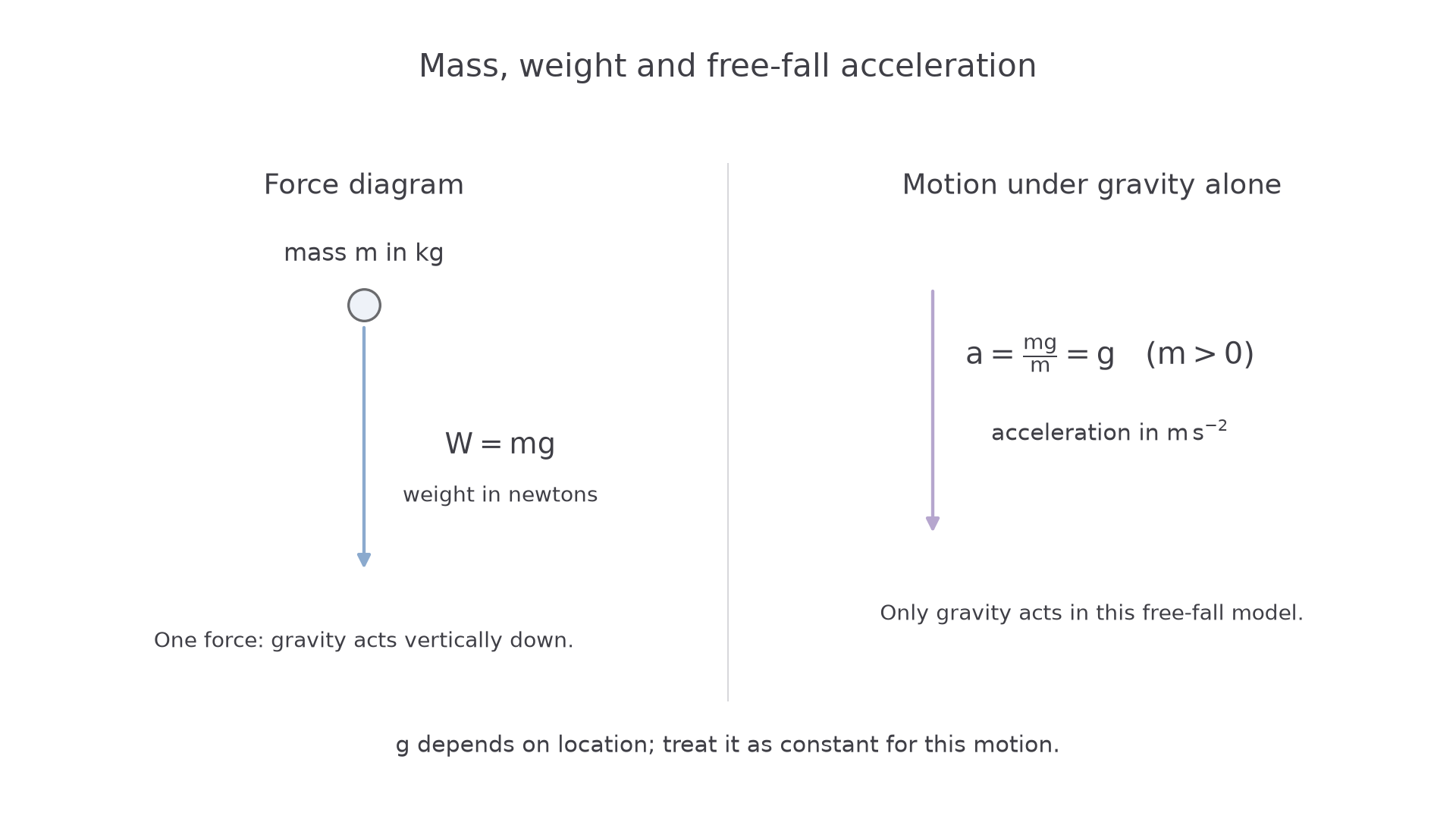
Mass is the quantity that relates a body's resultant force to its acceleration. Weight is the gravitational force on the body, vertically downwards near Earth's surface. For example, is a mass; is a weight, not a mass.
The magnitude of gravitational acceleration is written . Its value is a positive magnitude; the sign of its component depends on our axis.
Weight
For mass in a region where gravitational acceleration has magnitude ,
Use in Edexcel Mathematics unless another value is stated. Not in the formula booklet: learn it.
A force arrow labelled is not an acceleration arrow labelled .
[DIAGRAM: asset_slug: p3_8_3_understand_and_use_weight_and_motion_in_a_straight_line_under_gravity__diagram_01; asset_name: Mass weight and free-fall acceleration; recommended_method: drawn_math; caption: Weight is a force on a mass; free-fall acceleration is force divided by mass; description: Two separated panels. The left panel shows a particle of mass m kg with one downward force arrow W equals mg in newtons. The right panel shows downward free-fall acceleration g in metres per second squared and the equation a equals mg divided by m equals g for positive mass. Text states that only gravity acts in free fall and that g depends on location but is treated as constant in this model.]
Use the default value of in both examples.
Worked example 1: mass to weight
Question. A parcel has mass . Find its weight.
Plan. Multiply the mass by , then round the force at the end.
Why multiply by ? Kilograms describe mass; newtons describe the resulting gravitational force.
Answer. , to significant figures, vertically downwards.
Check. Since is close to , the weight should be close to .
Change the information given: now the weight is known and the mass is required. The relationship stays the same.
Worked example 2: weight to mass
Question. A particle has weight . Find its mass.
Plan. Rearrange before substituting.
Why divide? Weight already contains the factor ; multiplying would apply gravity twice.
Answer. The mass is .
Check. .
Mass and weight also respond differently to a change of location: the same body's mass stays the same while its weight changes if changes.
Watch out
A mass does not have weight . Use ; keep the units attached to the quantity you have calculated.
Find the weight of this new mass.
Gravity and signs
An upward-thrown ball has downward acceleration while travelling both up and down. At its highest point its velocity is zero for an instant, but gravity has not switched off.
[DIAGRAM: asset_slug: p3_8_3_understand_and_use_weight_and_motion_in_a_straight_line_under_gravity__diagram_02; asset_name: Mechanics 8.3 - Weight and motion under gravity - diagram 02; recommended_method: drawn_math; description: Draw a vertical straight-line motion diagram on a 16:9 white canvas. Show an upward positive axis from launch point O, an object projected upward with initial velocity u, a highest point T where v = 0, and a downward acceleration arrow labelled a = -g when upward is positive. Include a lower ground/impact level with a note that velocity just before impact is not generally zero. Use spacious labels and no clutter.]
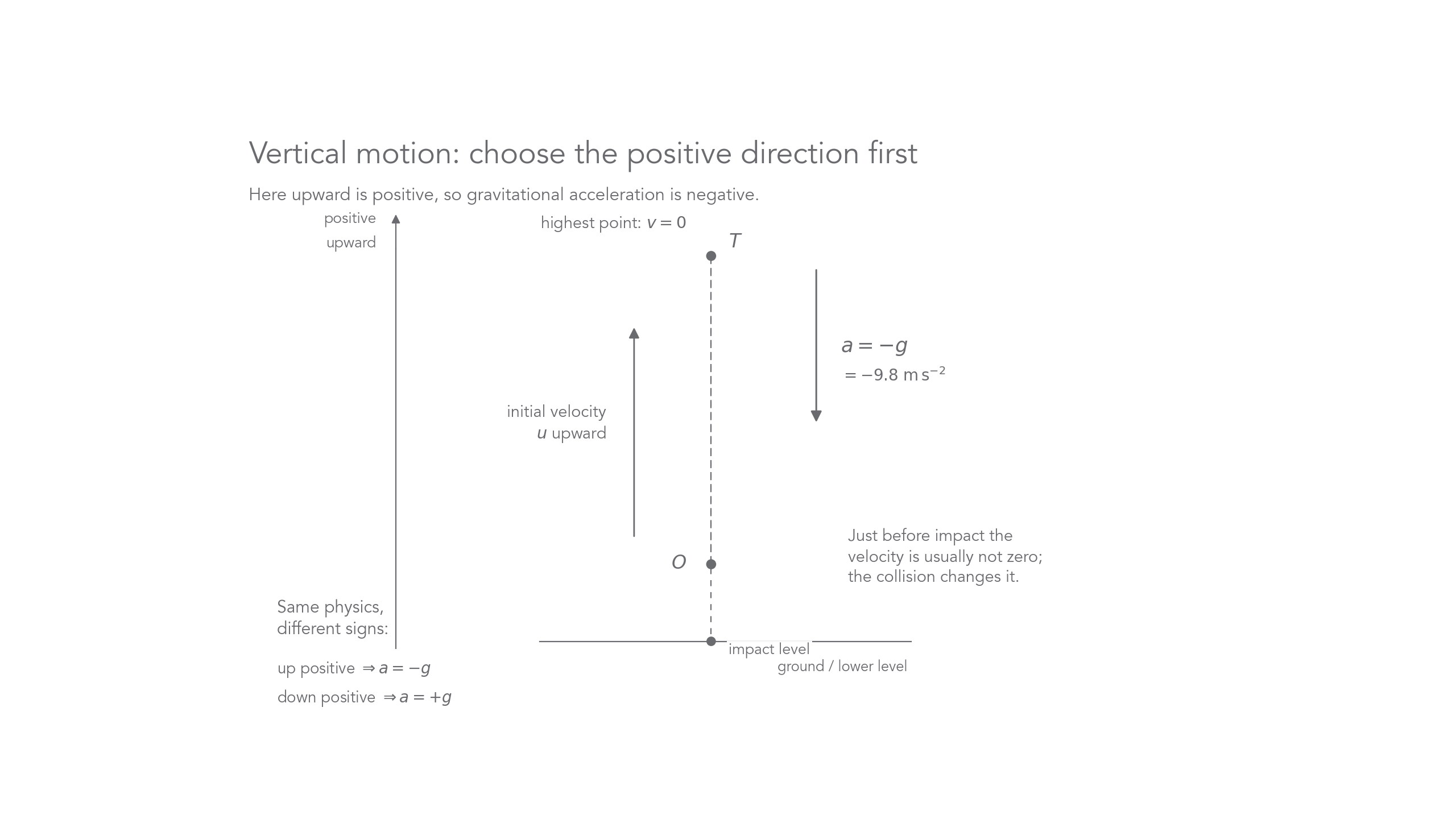
Choose the axis once for the whole flight, rather than reversing it when the ball starts falling.
Signed gravitational acceleration
For free vertical motion with constant downward gravitational acceleration,
The magnitude stays positive. These sign choices are not printed as a rule in the booklet. Not in the formula booklet: learn it.
With upward positive, use negative velocity for downward motion. The constant-acceleration equation is in the formula booklet.
Worked example 3: while the ball is rising
Question. A ball is projected vertically upwards at . Find its velocity after , using .
Plan. Take upward positive, so and .
Why use a negative acceleration? Gravity points down while our axis points up.
Answer. upwards.
Check. The positive velocity is smaller than the initial , so the rising ball is slowing.
Change only the observation time. Keep the same axis even after the highest point.
Worked example 4: after the ball turns
Question. Find the velocity of the same ball after .
Plan. Use the same initial velocity and acceleration at the later time.
Why retain the minus sign? It identifies downward velocity; the speed is the magnitude.
Answer. The velocity is with upward positive, or downwards.
Check. The turning time is , earlier than , so downward motion is consistent.
A dropped particle follows the same sign rule: its zero initial velocity does not make its acceleration zero.
Watch out
“At the highest point, ” is wrong. The velocity is zero there; the acceleration is still with upward positive.
Interpret the sign in another upward launch.
Free vertical motion with SUVAT
In free motion under gravity, ignore air resistance and treat the particle as moving with constant acceleration downwards. A particle launched upwards at reaches a point where its vertical velocity is zero. That gives the missing information needed to calculate its greatest height.
Constant-acceleration equations
For motion along one fixed axis with constant signed acceleration,
Here is displacement from the initial point, not total distance. In the formula booklet.
Choose an equation that omits the quantity you do not need. For greatest height without a time, is direct.
Worked example 5: greatest height
Question. A particle is projected vertically upwards from at . Find its greatest height above , using .
Plan. Take up positive and set at the greatest height.
Why use ? The particle changes from rising to falling at that instant.
Answer. The greatest height above is , to significant figures.
Check. The time to the top is ; substituting it into gives the same height.
Change only the launch speed to . The method is unchanged, but the height does not grow in direct proportion to speed.
Worked example 6: a faster launch
Question. A particle is projected vertically upwards from at . Find its greatest height above .
Plan. Use , upward positive and the same gravitational acceleration.
Why square the speed? The equation relates a change of squared velocity to displacement.
Answer. , to significant figures.
Check. The ratio of heights is , the square of the speed ratio .
With downward positive, example 5 instead gives , and . The height above the launch point is still positive .
Key idea
At the top, set vertical velocity to zero; keep gravitational acceleration. Use displacement from the stated initial point, with one consistent axis.
Find a new greatest height.
Continue this lesson.
You’re previewing NovaLearn without an account. Create a free account to read the rest.
Create free account