Pure 6.3 - Logarithms and natural logarithms
A logarithm finds a missing exponent. Learn its definition and restrictions, read the graph of the natural logarithm, and use inverse operations to solve exponential and logarithmic equations exactly.
What a logarithm asks
How can you find from without guessing? We need an operation that undoes an exponential. Begin with a power whose answer you already know: . Read backwards, the power of that makes is . That is what says.
You already know
For a fixed positive base other than , is one-to-one and has range . An inverse function reverses input and output: the point becomes .
The base, argument and answer have different jobs. In , the base is , the argument is , and the answer is an exponent.
Logarithm to base \(a\)
For , , and , is the unique real number such that . For example, because . Not an example: is undefined, since no real power of is zero.
The inverse definition is not in the formula booklet: learn it. It also gives , since . You are changing the question being asked, rather than changing the underlying fact.
[DIAGRAM: asset_slug: p1_6_3_know_and_use_the_definition_of_log_a_x_and_ln_x__diagram_01; asset_name: Exponential and logarithmic inverse graphs; caption: A logarithm reverses exponent and value; description: Two panels show y equals 2 to the power x through (3,8) and y equals log base 2 of x through (8,3). Their swapped coordinates show the inverse relationship.]
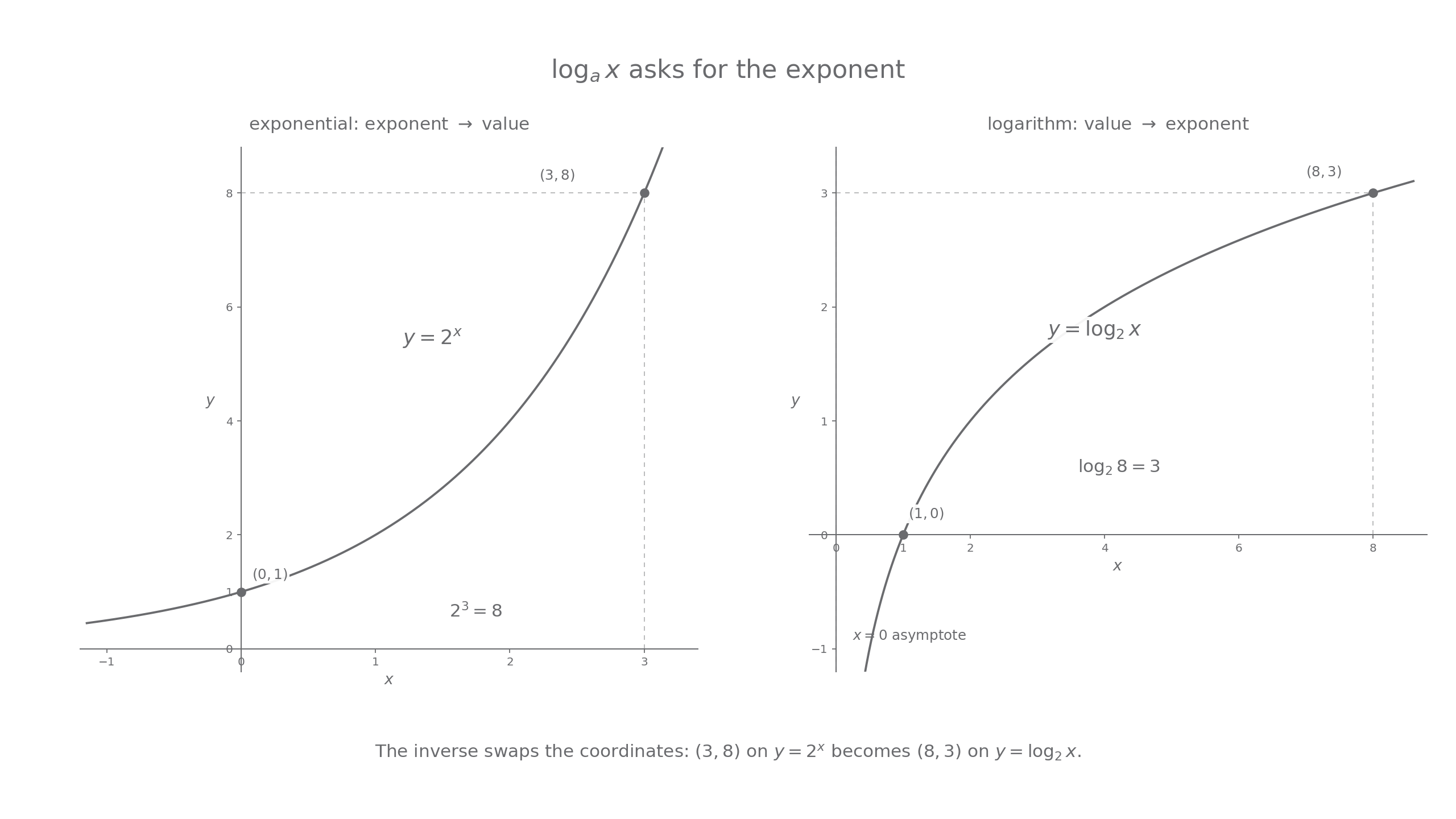
The restrictions ensure that reversal works. If , every power gives , so the output cannot identify one exponent. If , we do not have this positive real exponential function for all real exponents. A valid positive base can never produce a zero or negative output.
Key idea
asks “which exponent of gives ?” Its argument must be strictly positive, although the answer may be negative or zero.
Try a negative exponent in the inverse definition.
Using the definition
To evaluate a logarithm, find its exponent; to find its argument, calculate the corresponding power. For instance, , , , and . Check each by raising the base to the proposed answer.
Two equivalent forms
For , and ,
In particular, and .
Not in the formula booklet: learn it.
When the unknown is the argument, reverse the definition before doing arithmetic.
Worked example 1: finding an argument
Question. Find if .
Plan. Write the equation in exponential form.
Why this step? The logarithm's answer is an exponent, not a multiplier of .
Answer. .
Check. , so the argument is valid.
Change only the base to its reciprocal. A base below still has a valid logarithm.
Worked example 2: a base below one
Question. Find if .
Plan. Use exactly the same definition with base .
Why this step? The base must be positive and different from ; it does not have to exceed .
Answer. .
Check. The answer is the reciprocal of the first example's argument, as expected.
For the same reason, gives . A logarithm with base below is decreasing, but its inverse definition does not change.
Watch out
Wrong: , found by division. Right: , because . Logarithms find powers; they do not divide the argument by the base.
Use two different signs of exponent in your own calculations.
The natural logarithm and its graph
The inverse of the particularly useful exponential has its own name and calculator key: .
Natural logarithm
, for . Thus means . For example, , while .
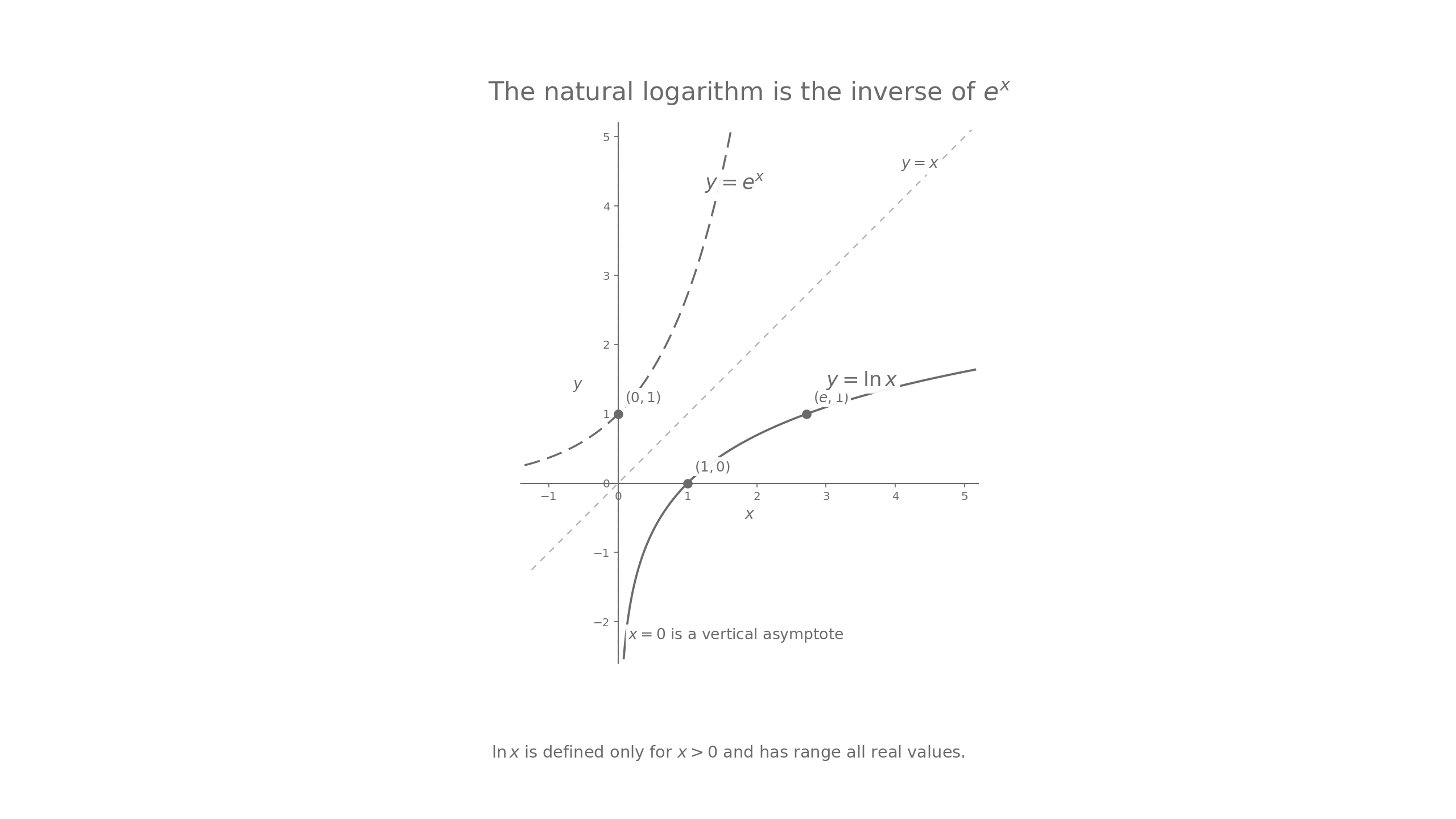
Reflect the graph of in . Its horizontal asymptote becomes a vertical one, and its positive output restriction becomes the logarithm's positive input restriction.
[DIAGRAM: asset_slug: p1_6_3_know_and_use_the_definition_of_log_a_x_and_ln_x__diagram_02; asset_name: Natural logarithm as the inverse of the exponential; caption: Reflection swaps the domain and range; description: Equal-scale axes show y equals exp(x), y equals ln(x) and the reflection line y equals x. Marked points include (0,1), (1,0) and (e,1). The logarithm has vertical asymptote x equals 0 and domain x greater than 0.]
| Feature of | Reason |
|---|---|
| Domain | a real exponential always outputs a positive number |
| Range all real values | every real exponent is allowed in |
| Increasing | a larger exponent gives a larger value of |
| -intercept | |
| Point | |
| Vertical asymptote | as |
The logarithm has no -intercept: is outside its domain. Its graph is negative on , zero at , and positive on . These graph facts are not in the formula booklet: learn them.
Inverse identities
Not in the formula booklet: learn it.
Continue this lesson.
You’re previewing NovaLearn without an account. Create a free account to read the rest.
Create free account