Pure 8.1 - Fundamental Theorem of Calculus
Can a gradient function tell you exactly where a curve is? The Fundamental Theorem of Calculus links differentiation to accumulation, and integration recovers a function from its derivative. You will see why a constant is needed, use a point to find one particular curve, and evaluate definite integrals by subtracting endpoint values.
The inverse link
If every point on a curve has gradient , can you recover the curve? Start with . Differentiation gives , but so do and . You can recover the shape, yet its height remains unknown.
You already know
, and a constant differentiates to zero. Differentiation acts term by term on a sum.
Running these derivative facts backwards is the starting point for integration. For example, , so is one answer to “what differentiates to ?”
Antiderivative
An antiderivative of on an interval is a function such that throughout that interval. For example, and are antiderivatives of . Not an example: differentiates to .
The whole family is written using an arbitrary real constant . On a connected interval, any two antiderivatives of the same function differ by a constant: their difference has derivative zero.
Indefinite integration
If on an interval, then
where is an arbitrary constant on that interval.
Not in the formula booklet: learn it.
The integral sign names the reverse process; an indefinite integral describes a family rather than a single number. The picture makes the missing information visible.
[DIAGRAM: asset_slug: p1_8_1_know_and_use_the_fundamental_theorem_of_calculus__diagram_01; asset_name: Antiderivatives share gradients; caption: Vertical shifts change the height but preserve the gradient at each x-value; description: Two panels connect F(x)=x squared over two plus C with derivative x, and show three vertically shifted parabolas with parallel tangent segments at x=1]
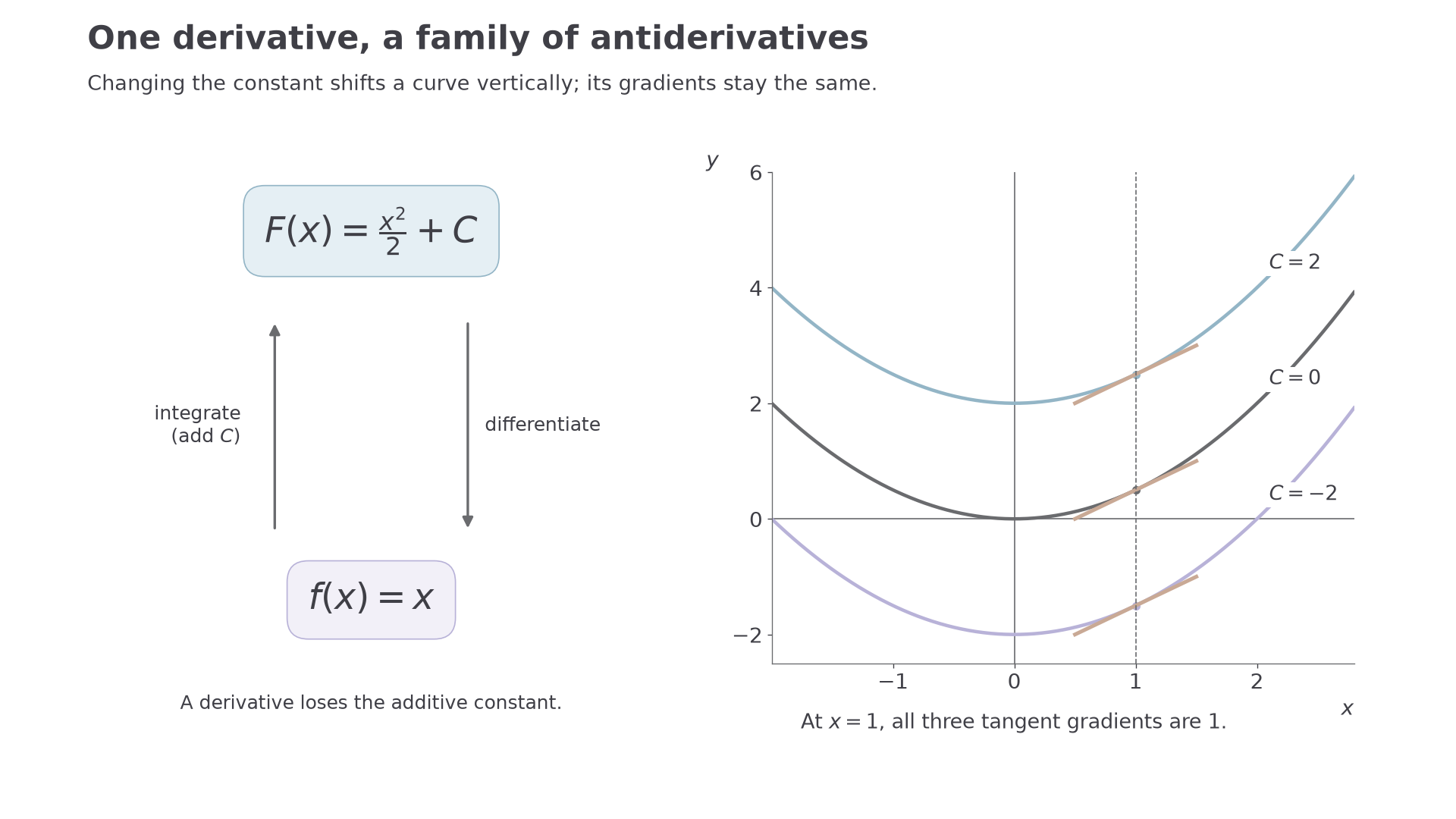
A surprising consequence is that a complete list of gradients still cannot distinguish curves separated vertically by a million units. One height measurement can do what all those gradients cannot.
Key idea
Differentiation loses an additive constant; indefinite integration records that missing information as .
Try distinguishing a family of answers from a single incorrect reversal.
Why plus C matters
The three functions , and all differentiate to . The complete answer to integrating must therefore be .
For now, choose terms by reversing familiar derivative facts. The next lesson develops the general power rule.
Worked example 1: reversing two derivative facts
Question. Find .
Plan. Find a term whose derivative is , do the same for , then add the missing constant.
Why this step? is a constant gradient, so its antiderivative is , not another constant.
Answer. .
Check. Differentiating gives , exactly the integrand.
Change just the coefficient of the power term, from to . The constant-gradient term and the need for stay the same.
Worked example 2: changing one coefficient
Question. Find .
Plan. Reverse each derivative, allowing for the changed coefficient.
Why this step? The coefficient must be , because differentiating the fifth power multiplies it by .
Answer. .
Check. .
Writing a complete family matters even when you have found a correct individual antiderivative.
Watch out
Wrong: as a complete indefinite integral. Right: . The expression without is only one member of the family.
Try another coefficient; include the constant in the final expression.
Notation and variable
In , the tells you to integrate with respect to . Since differentiating gives , the answer is . Renaming the variable does not change the reverse process.
Integrand and integration variable
In , is the integrand and is the integration variable. The differential identifies that variable. An integral without endpoint limits is indefinite.
Term-by-term reversal works in any named variable. For example,
Differentiating each line with respect to its own variable checks every coefficient. These term-by-term rules are not in the formula booklet: learn them.
Continue this lesson.
You’re previewing NovaLearn without an account. Create a free account to read the rest.
Create free account