Pure 10.3 - Vector addition and scalar multiplication
Vector addition combines directed movements, while scalar multiplication changes a vector's length and sometimes its direction. You will connect triangle and parallelogram diagrams to component calculations, combine scaled vectors, and establish when two vectors are parallel. The diagram chooses the operation; the components carry it out.
Addition as a Resultant Journey
Can two nonzero journeys add to no movement at all? Walk three units right, then three left. You have travelled six units, but the direct vector from start to finish is the zero vector. Vector addition keeps the direction information that a sum of distances loses.
You already know
A vector can be translated without changing it. Reversing an arrow reverses every component, so the reverse of is .
Following one movement and then another gives their resultant: the single vector from the first start to the final finish.
[DIAGRAM: asset_slug: p1_10_3_add_vectors_and_multiply_by_scalars_understand_geometric_interpretations__diagram_01; asset_name: Triangle and parallelogram addition; caption: Both constructions give the same resultant; description: A head-to-tail triangle with a followed by b and resultant a plus b, alongside the same two vectors drawn from a common tail with a parallelogram diagonal a plus b]
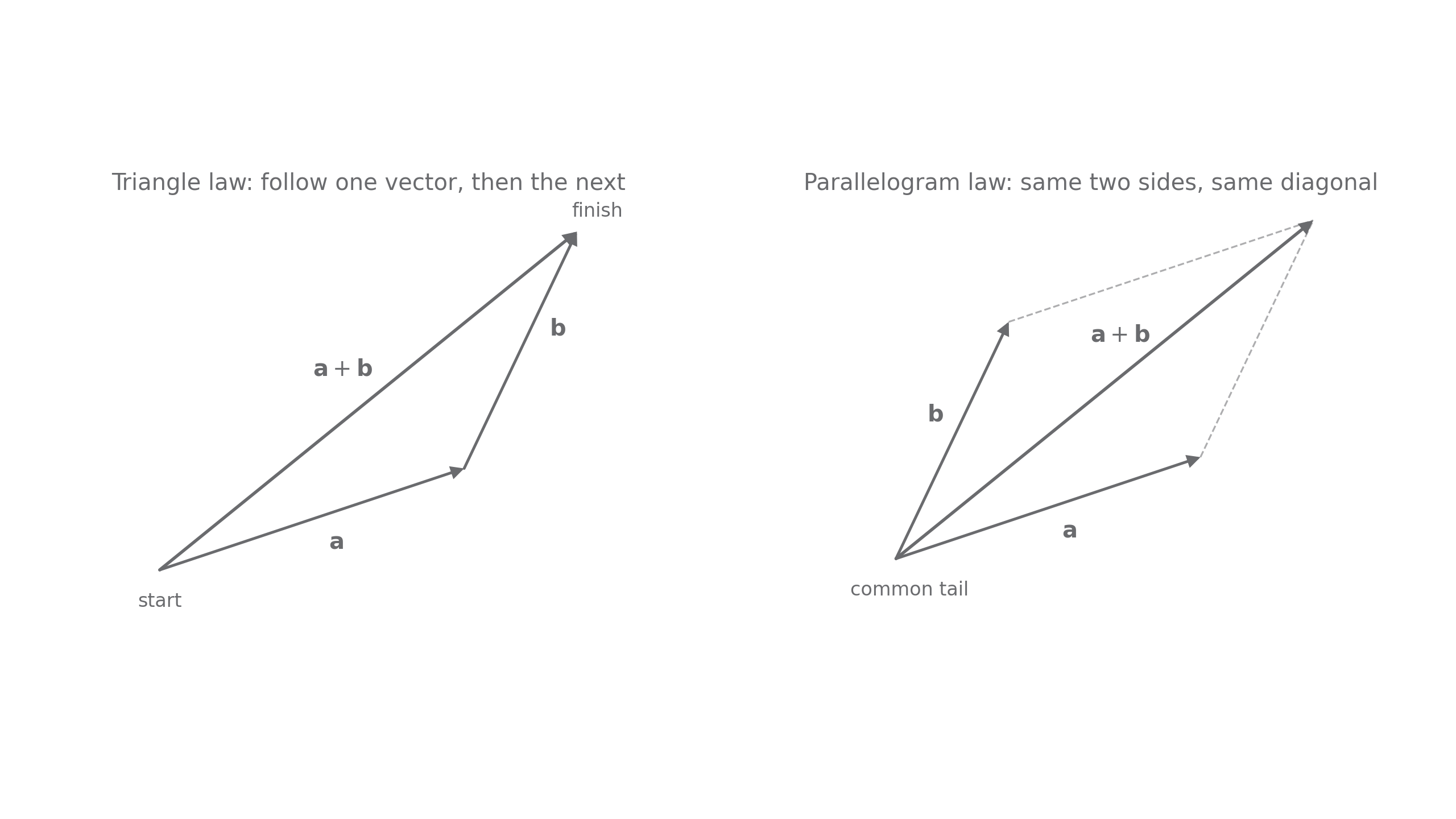
The two pictures use the same movements. They differ only in where copies of the arrows are placed.
Triangle and parallelogram laws
Triangle law: put the tail of at the head of ; the vector from the first tail to the final head is .
Parallelogram law: draw and from a common tail and complete the parallelogram. Its diagonal from that tail is .
Doing the two journeys in the reverse order reaches the same final point, so . This is why both constructions agree. In particular, : the opening puzzle has an exact algebraic answer.
Worked example 1: following a triangle route
Question. In triangle , and . Find .
Plan. Follow the connected route from through to .
Why this step? The finish of is the start of , so adding those directed journeys gives .
Answer. .
Check. Reversing the complete route gives .
Change only the direction of the given second arrow: it is now , rather than .
Worked example 2: reversing an arrow before adding
Question. In triangle , and . Find .
Plan. Reverse so that the two pieces form a connected route.
Why this step? Adding to directly would try to join two arrows whose heads both end at .
Answer. .
Check. Adding to this answer gives .
The letters on the arrow matter as much as the vector's coefficients.
Watch out
Wrong: . Right: . Reverse the second arrow to make the route connect.
Use a new triangle and a scaled second arrow.
Adding Components Algebraically
A movement of three units right followed by five left produces a net horizontal change of minus two. The vertical and third-direction changes combine independently in exactly the same way.
Component addition
For vectors expressed relative to the same axes,
In two dimensions omit the third row from each vector.
Not in the formula booklet: learn it.
The unit-vector notation makes these into familiar collections of like terms.
Worked example 3: adding three-dimensional components
Question. Given and , find .
Plan. Add the coefficients of each unit vector separately.
Why this step? The -component contributes to movement along , so it cannot be combined with a -component.
Answer. .
Check. Subtracting from the answer gives .
Change only the sign of the final component of . Only the final component of the sum can change.
Worked example 4: changing one component
Question. Given and , find .
Plan. Repeat the component sums with the revised -coefficient.
Why this step? Changing to increases that component by two; the other components are unaffected.
Answer. .
Check. The difference between the two resultants is , exactly the change to the input vector.
Vector magnitudes do not generally add. Perpendicular vectors and have magnitudes three and four, but their sum has magnitude five.
Watch out
Wrong: for every pair. Right: add the vectors first, then calculate the resultant's magnitude if it is needed.
Now combine a new pair of spatial movements.
Multiplying by a Scalar
Multiplying a movement by two doubles each component, so the resulting arrow has twice the length in the same direction. Multiplying by a negative number also reverses its direction.
Scalar
A scalar is a number with no direction. Multiplying a vector by a real scalar gives a vector, rather than a scalar.
The diagrams show a stretch, a shortening and a reversal of one reference vector.
[DIAGRAM: asset_slug: p1_10_3_add_vectors_and_multiply_by_scalars_understand_geometric_interpretations__diagram_02; asset_name: Positive and negative vector scalings; caption: Positive scalars preserve direction and negative scalars reverse it; description: Three panels compare a reference vector a with 2a, one half a and minus a, with lengths and directions drawn consistently]
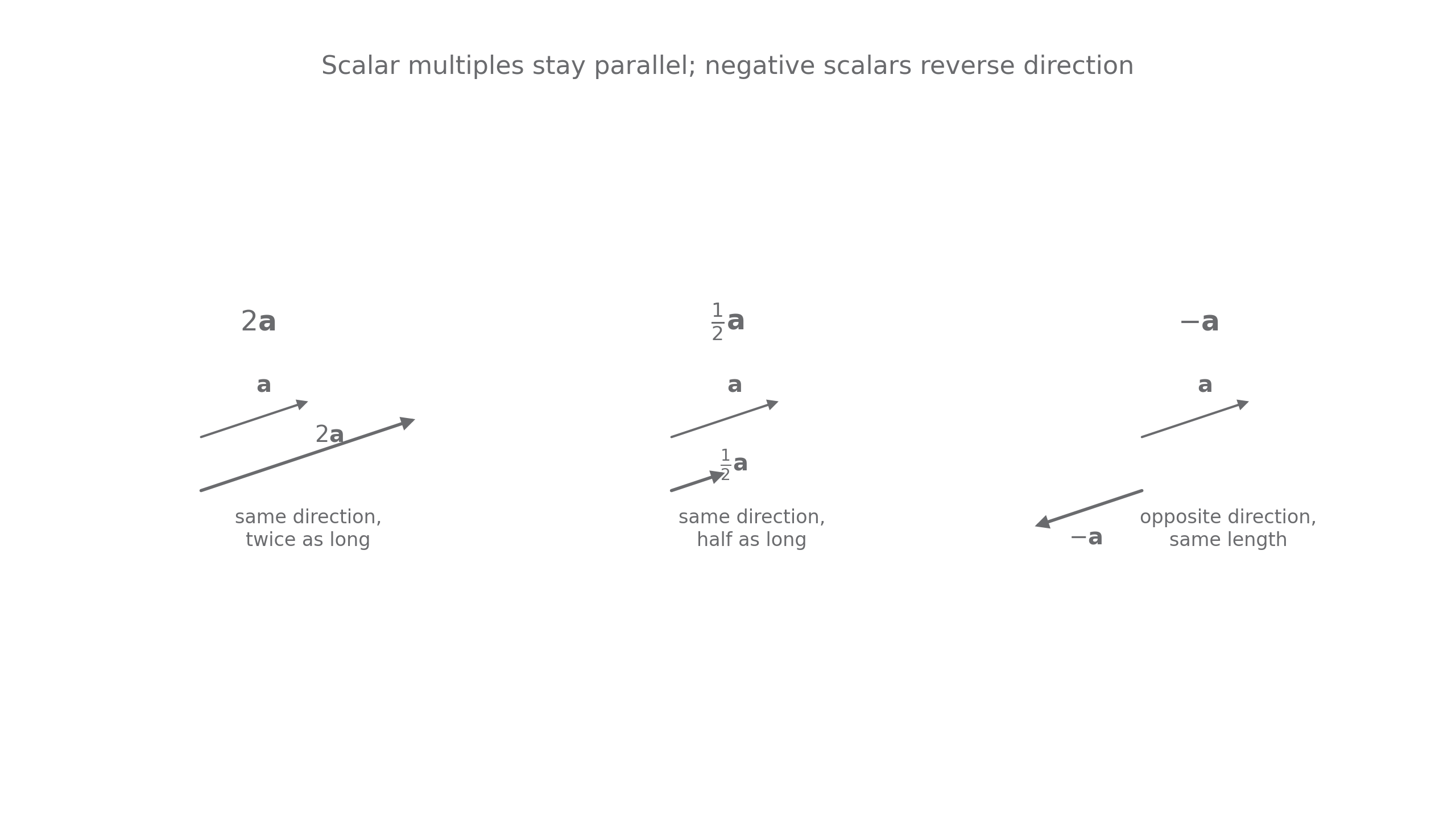
Length depends on the absolute value of the scalar.
Scaling a vector
For a real scalar ,
For nonzero , a positive scalar preserves direction, a negative scalar reverses it, and zero gives .
Not in the formula booklet: learn it.
In particular, shortens a nonzero vector, while lengthens it.
Continue this lesson.
You’re previewing NovaLearn without an account. Create a free account to read the rest.
Create free account