Pure 3.4 - Parametric equations in modelling
Parametric models keep time, position and the order of a journey together. You will build constant-velocity models from observations, use their valid intervals, and model shapes with an angle while explaining what each simplification assumes.
The parameter as part of the model
Two vehicles follow the same straight segment. Must they meet each checkpoint at the same time? Take the segment from to . One possible rule is
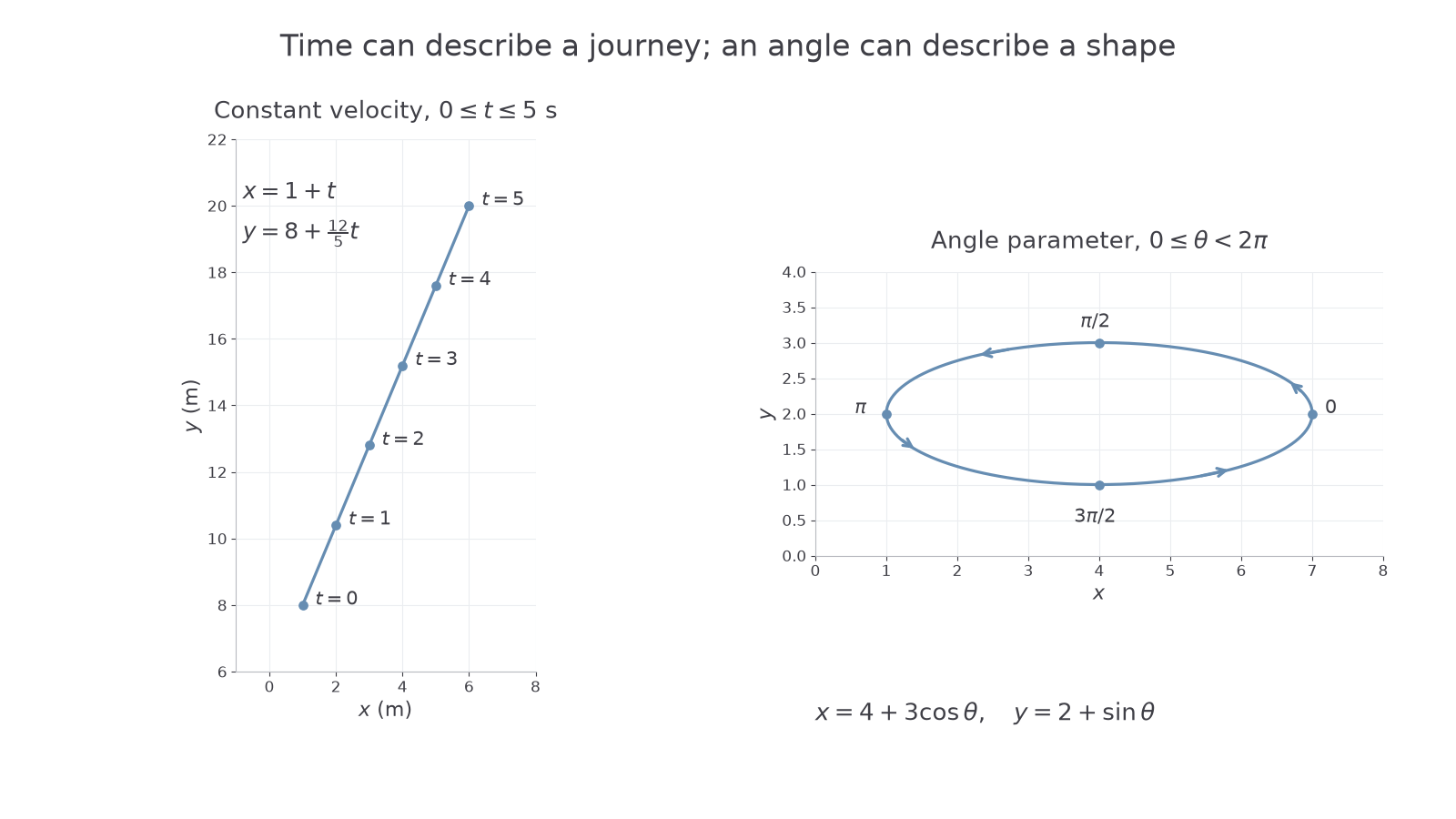
At it gives ; at it gives . Equal time steps give equal coordinate changes. We will return to a different rule for the same segment at the end.
You already know
A shared parameter generates both coordinates. Eliminating it gives a Cartesian relationship, but the parameter interval still restricts the allowed points. A constant rate produces a linear equation.
In a model, attach meaning and units to the parameter before using it. Here can mean elapsed seconds and , can be coordinates in metres. For a decorative shape, the parameter might instead be an angle with no clock attached.
[DIAGRAM: asset_slug: p1_3_4_use_parametric_equations_in_modelling__diagram_01; asset_name: Motion and shape parameters; caption: Time controls a journey while an angle can generate a boundary; description: Left panel shows equal-time positions from (1, 8) to (6, 20) for x equals 1 plus t and y equals 8 plus 12t over 5, right panel shows the oval x equals 4 plus 3 cos theta and y equals 2 plus sin theta]
Parametric model
A parametric model represents a situation using coordinate rules with a shared parameter, its meaning, units and valid domain. A path equation alone does not specify when a moving object reaches each point.
Eliminating from the motion above gives , with . This describes its segment but loses the timing. Similarly, , says that the coordinates change by and units per second when is time in seconds. A negative component means motion in the decreasing coordinate direction; it does not mean negative speed.
Key idea
A contextual model needs a parameter with meaning and a valid interval as well as equations that fit a path.
Distinguish that extra information from what a Cartesian line supplies.
Building a constant-velocity motion model
From to in seconds, the coordinate changes are and metres. Assuming each change happens at a constant rate gives and metres per second.
Constant velocity in the plane
Constant velocity means both coordinate rates remain constant, with fixed coordinate axes. The path is straight unless both rates are zero, when the point is stationary. Constant speed alone does not imply constant velocity: a point can turn while maintaining its speed.
A non-zero starting time needs care. Measure elapsed time from the known observation, rather than silently treating that observation as .
Constant-velocity parametric motion
For a point at when , with constant coordinate rates and ,
Use a stated valid time interval and consistent units. Not in the formula booklet: learn it.
Find each rate by dividing its coordinate change by the same elapsed time.
Worked example 1: starting at time zero
Question. A point moves with constant velocity from at to at . Find a model for that journey.
Plan. Find both constant rates, then attach them to the starting coordinates.
Why this step? Both coordinates belong to the same journey, so both changes must use the same elapsed time.
Answer. , , .
Check. At , the point is ; at , it is .
Change only the clock labels: the journey now starts at and ends at . The elapsed duration and coordinate rates stay unchanged.
Worked example 2: a non-zero starting time
Question. A point moves with constant velocity from at to at . Find a model for the journey.
Plan. Keep the rates but use elapsed time .
Why this step? At the starting observation , so both changes must vanish.
Answer. , , .
Check. At , , and at , .
The two observed positions justify fitting this model, but do not establish constant velocity between them. That remains an assumption about the motion.
Watch out
Wrong: using when the point is at at . It predicts there. Right: use .
Use the same non-zero starting-time method with a new journey.
Using a parametric model
A drone model gives , , , with coordinates in metres and time in seconds. To find its height at a specified horizontal coordinate, first find the time. That same time must then produce the height.
You already know
Solve a linear equation by undoing its operations, then substitute the result into the other equation. Check the parameter against its domain before interpreting the coordinate as a model prediction.
A valid algebraic continuation is not automatically a valid prediction during the stated journey.
Worked example 3: a position inside the interval
Question. Use the drone model to find its height when .
Plan. Solve the horizontal equation for time, check it, then use the height equation.
Why this step? Substituting directly for would confuse a distance with a time.
Answer. The model predicts height at .
Check. Substitution into the horizontal rule returns .
Change only the requested horizontal coordinate to . The same algebra now produces a time outside the model.
Worked example 4: a position outside the interval
Question. Does the drone model predict a height when during the stated journey?
Plan. Solve for time, then decide whether the model permits it.
Why this step? , so the continued line does not describe an allowed time in this model.
Answer. No. The continuation gives , but the model makes no such prediction during .
Check. The largest modelled horizontal coordinate is , less than .
Likewise, for , , , requesting gives , . Those values solve the extended equations but lie outside the modelled interval.
Watch out
Wrong: “The drone is at height when .” Right: that height belongs to an extrapolated continuation; the stated model only reaches .
Change the requested coordinate once more and state the consequence of the interval.
Modelling a shape with a parameter
A design can be generated by an angle without modelling any motion. The equations , , , describe an oval centred at , with and .
At , its points are , , , . Increasing the angle traces the outline anticlockwise. The parameter is in radians; it is not automatically elapsed time or distance travelled.
Shape model
A shape model uses coordinate rules and an allowed parameter interval to represent a boundary or part of it. Unequal horizontal and vertical amplitudes can produce an oval; equal positive amplitudes in sine and cosine produce a circle.
A restricted angle interval can pick out an arch rather than the whole outline. Use the trigonometric values that are actually attained on that interval.
Worked example 5: modelling an upper arch
Question. An arch is modelled by , , , with coordinates in metres. Find its horizontal range and greatest height.
Plan. Use cosine's range on the interval and the attained maximum of sine.
Why this step? on this interval, so this is the upper half of the oval, not the whole boundary.
Answer. , greatest height .
Check. The endpoints are , , and the highest point is .
Change only the angle interval to . The maximum height remains, but only half of the arch is present.
Worked example 6: restricting a design to a quarter
Question. Find the horizontal range and greatest height for the same equations on .
Plan. Use the restricted cosine and sine ranges, checking the endpoints.
Why this step? The value is impossible on this interval, so the old leftmost coordinate must be removed.
Answer. , greatest height , on the upper-right quarter.
Check. gives ; gives . Both endpoints are included.
For the full shape , , , the centre is , with , . These bounds come directly from the supplied model; its particular equations are not formula-booklet results to recall.
Watch out
Wrong: “A full range applies to every angle interval.” Right: on . Check whether each claimed extreme is actually reached.
Use a new design and the upper-left quarter rather than the upper-right.
Assumptions and limitations
A model earns trust by stating the simplifications that make its predictions possible. For constant-velocity motion, both coordinate rates must remain constant throughout the stated interval. A turn, a stop or a changing current can invalidate that assumption.
Assumption and limitation
An assumption is a simplification taken to hold when constructing a model. A limitation describes where that simplification restricts the model's usefulness. “The vehicle maintains constant velocity” is an assumption; “the model cannot represent its turn at the corner” is a connected limitation.
For a shape, the assumed outline might be exactly oval even though a real boundary has straight sections or irregularities. Its centre, amplitudes and interval must match the intended dimensions and section. Saying “the model is inaccurate” alone explains no cause or consequence.
| Model | Assumption | Consequence if it fails |
|---|---|---|
| A straight journey | Both coordinate rates are constant | Timing or path predictions fail during braking or turning |
| An oval boundary | The ideal equations match the outline | Local clearances or widths may differ from the real object |
| A restricted journey or arc | Only the stated parameter interval applies | Extended coordinates need not describe the intended situation |
Now answer the opening question. A second possible journey over is
It has the same start and finish as the constant-velocity model, and eliminating again gives , . Yet at it is at , rather than . At it is at , rather than . Its equal-time changes are different, so it is not constant-velocity motion.
Here is the surprising part: the same path, start time, finish time and endpoints still do not fix the intervening motion. The shared parameter contains information the Cartesian segment does not.
Key idea
Connect a limitation to the assumption it challenges and explain which prediction becomes unreliable.
Explain the modelling distinction using a fresh situation, rather than just repeating the equations above.
Quick Recap
- Define the parameter's meaning, units and interval alongside the coordinate equations.
- Divide each coordinate change by the same elapsed time to fit constant-velocity motion.
- Solve through the parameter and check its domain before interpreting a prediction.
- Angle intervals select the intended portion of a shape; limitations explain what the model's assumptions leave out.
Two vehicles on the opening segment need not reach checkpoints together: their paths may agree while their time-to-position rules differ.