Pure 10.4 - Position vectors and distance between points
A position vector locates a point relative to a chosen origin. You will subtract positions to find a directed displacement, calculate distances in two and three dimensions, and use a distance condition to find an unknown coordinate. Keeping vector and length notation distinct also explains why changing the origin cannot change a distance.
Position vectors
If you move the origin, does the distance between two fixed points change? Take and . Choosing a new origin ten units to the right changes their coordinates to and , but the points themselves have not moved. We will see the cancellation that protects their separation.
You already know
Coordinates name a point relative to axes and an origin. A vector gives signed component changes; its magnitude is the square root of the sum of squared components.
An arrow starting at the chosen origin and ending at a point is that point's position vector.
Position vector
The position vector of , relative to a fixed origin , is . For , it is . For example, has position vector ; the point and its vector are related but are different kinds of object.
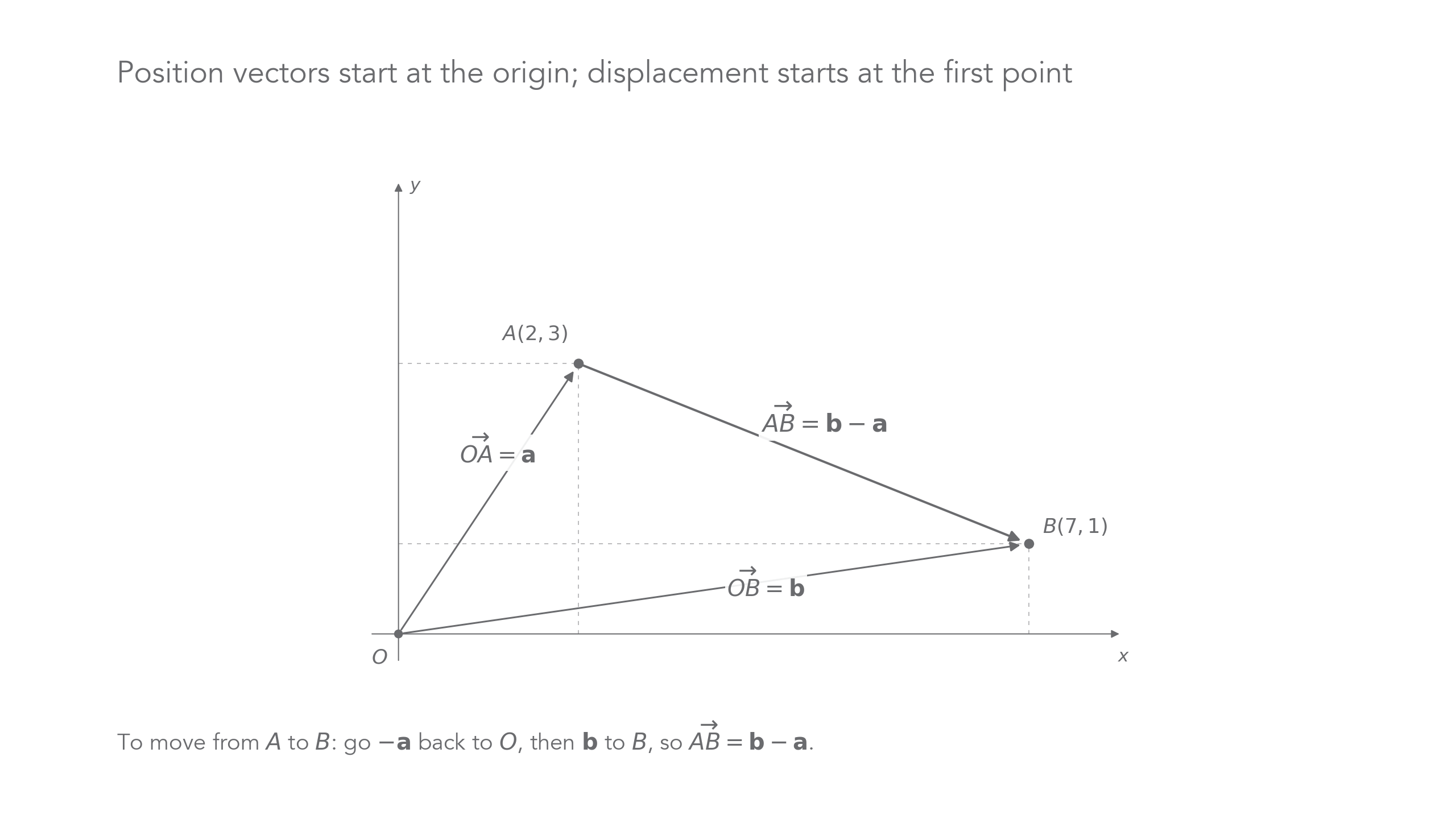
The origin matters for a position vector. A general displacement arrow need not begin there.
[DIAGRAM: asset_slug: p1_10_4_understand_and_use_position_vectors_and_calculate_the_distance_between_two_points__diagram_01; asset_name: Positions and displacement between two points; caption: Both position vectors start at O but the displacement starts at A; description: Cartesian axes showing A at (2, 3), B at (7, 1), arrows OA and OB from O, and the directed arrow AB labelled b minus a]
In three dimensions, gives ; the zero third term may be omitted. Conversely, a point with position vector has coordinates , including the missing -coordinate.
Key idea
A position vector answers “where is the point relative to this origin?”; a displacement answers “how do I move from one point to another?”
Check which arrow is actually attached to the chosen origin.
Head minus tail
To travel from to , you can go back from to , then out from to . With position vectors and , that route is .
Displacement from positions
Relative to one fixed origin,
Read this as finish minus start, or head minus tail.
Not in the formula booklet: learn it.
Do not subtract in the order in which the question happens to print the data. The arrow's name determines the order.
Worked example 1: displacement from A to B
Question. Points and have position vectors and . Find .
Plan. Subtract the start position from the finish position.
Why this step? Subtracting adds , since the return from to the origin reverses that component.
Answer. .
Check. Adding this displacement to gives , the position of .
Change only the requested direction: now travel from to .
Worked example 2: reversing the displacement
Question. With the same positions and , find .
Plan. Reverse the start and finish in the subtraction.
Why this step? Reversing a directed journey reverses every component, rather than changing its length.
Answer. .
Check. , as it must.
This is also a quick way to detect a direction error in a longer problem.
Watch out
Wrong: . That is . Right: .
Find the reversed displacement for a new pair of points.
Distance in two dimensions
Once the displacement is known, its magnitude is the direct distance between the points. A displacement of six units horizontally and four vertically has length .
Two-dimensional distance
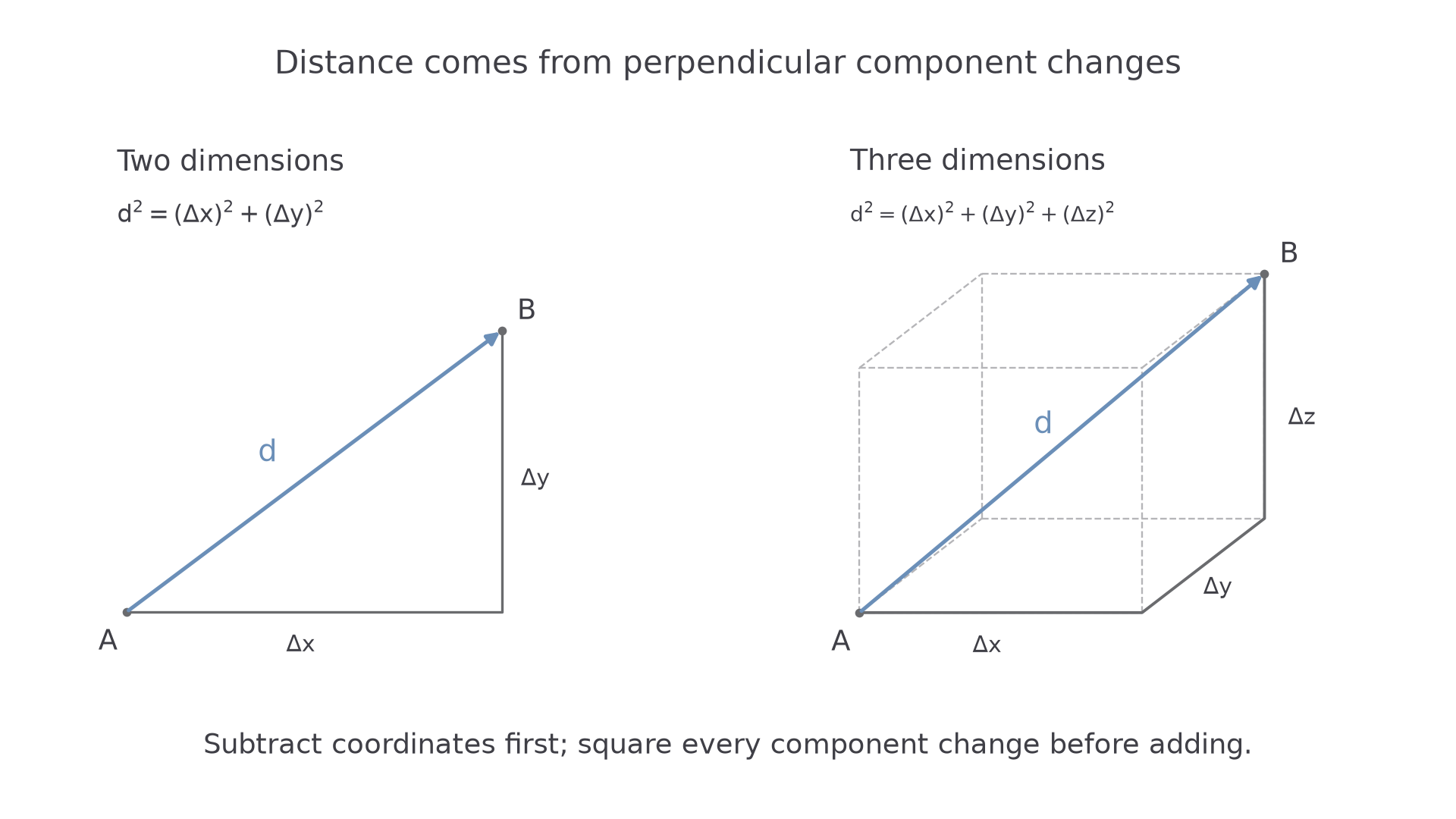
For and ,
The non-negative square root gives the distance.
Not in the formula booklet: learn it.
Each squared difference is a perpendicular contribution to Pythagoras' theorem.
[DIAGRAM: asset_slug: p1_10_4_understand_and_use_position_vectors_and_calculate_the_distance_between_two_points__diagram_02; asset_name: Distance from perpendicular component differences; caption: Two dimensions use two squared differences and three dimensions use three; description: A two-dimensional right triangle with component differences delta x and delta y and diagonal d, alongside a projected cuboid with three component differences and body diagonal d; the projected diagonal avoids intermediate vertices]
Use exact surds unless a decimal is requested.
Worked example 3: a distance as a simplified surd
Question. Given and , find the exact distance .
Plan. Find , then take its magnitude.
Why this step? The question asks for a distance, so the directed vector is an intermediate result rather than the final answer.
Answer. .
Check. The distance exceeds each individual component length, and , but is less than their sum .
Change only the horizontal coordinate of into an unknown, keeping the same distance. A sign condition identifies the appropriate position.
Continue this lesson.
You’re previewing NovaLearn without an account. Create a free account to read the rest.
Create free account