Pure 2.4 - Simultaneous equations by elimination and substitution
Simultaneous equations ask for values that satisfy both equations together. You will choose elimination or substitution, solve linear and quadratic systems, and return every matching coordinate pair with checks in the original equations.
What a solution pair means
Can two different pairs solve the same two equations? For and , the pair works: both right-hand sides give . But works too. A pair must pass both equations, and a system need not have just one pair.
You already know
An ordered pair records the input first and output second. Substituting a value means replacing every occurrence of that variable, including inside squares and brackets.
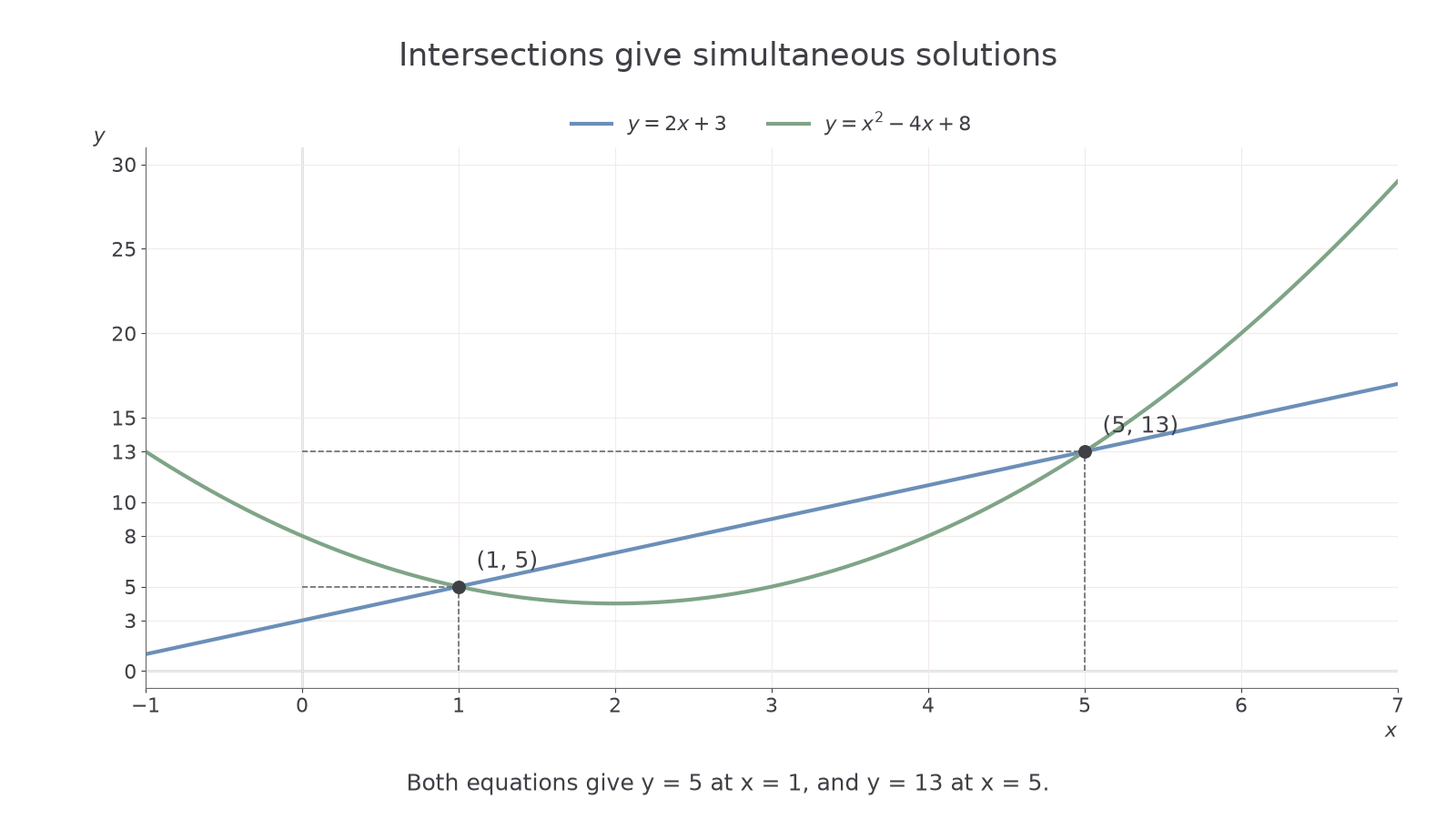
Each equation describes a graph. Their common points describe the simultaneous solutions. A graph gives the meaning of a solution, while algebra can find its exact coordinates.
[DIAGRAM: asset_slug: p1_2_4_solve_simultaneous_equations_in_two_variables_by_elimination_and_by_substitution__diagram_01; asset_name: Intersections give simultaneous solutions; caption: The line and parabola meet at two solution pairs; description: The line y equals 2x plus 3 meets the parabola y equals x squared minus 4x plus 8 at (1, 5) and (5, 13). Guides link both coordinates to the axes.]
Simultaneous solution
A simultaneous solution is an ordered pair making every equation in a system true at the same time. For example, satisfies and . The reversed pair does not.
For a line and a parabola, substitution produces a quadratic: there may be two, one or no real intersection points. Two distinct straight lines meet once unless they are parallel; coincident equations describe the same whole line.
Key idea
A list of separate -values and -values is not enough: preserve which coordinates belong together.
Check the ordered pair in each original equation before choosing.
Elimination for two linear equations
Elimination combines whole equations so one variable disappears. If you add equations, add both left-hand sides and both right-hand sides. Opposite coefficients cancel on addition; equal coefficients cancel on subtraction.
Worked example 1: opposite coefficients
Question. Solve , .
Plan. Add to eliminate , then substitute back.
Why this step? The opposite -coefficients remove one unknown without changing the common solution.
Answer. .
Check. , and .
Change only the second equation's -coefficient from to . Now multiply the whole first equation by before adding.
Worked example 2: matching coefficients first
Question. Solve , .
Plan. Double the first equation to make opposite -coefficients.
Why this step? Multiplying just the -term would change the equation; the constant and -term must also double.
Answer. .
Check. The equations give and .
Substitution is an alternative even for two linear equations. For , , write , giving . Thus , ; both original equations check. Choose whichever route removes an unknown most cleanly.
Watch out
Wrong: subtracting as . Subtract the whole bracket: .
Try another system with coefficients that already cancel.
Substitution for one linear and one quadratic equation
A linear equation gives a simple expression for one variable. Replace that variable in the quadratic equation, keeping brackets around the complete substituted expression. If both equations already say , just equate their right-hand sides.
Worked example 3: two intersections
Question. Solve , .
Plan. Equate the expressions for , solve the quadratic, then pair each root with its output.
Why this step? Using the linear equation for back-substitution keeps the coordinate pairing simple.
Answer. and .
Check. The quadratic gives and , matching the line.
Change only the parabola's constant from to . Two crossings merge into one touching point.
Worked example 4: a repeated solution
Question. Solve , .
Plan. Equate outputs and solve the resulting square.
Why this step? The repeated quadratic root gives one coordinate pair, not two different points.
Answer. .
Check. , and .
The opening puzzle has two solutions because its substituted quadratic has two distinct roots. The graph and algebra tell the same story.
Exam tip
After finding the roots, write each complete pair. An unpaired list can lose the final accuracy mark even after correct quadratic solving.
A new line and parabola give another repeated-root case.
When squared terms appear in both variables
Squared terms in both variables do not change the main strategy. Use the linear relation to replace one variable everywhere, including inside its square. For , the square is , so multiply the substituted equation by to clear denominators.
Worked example 5: a difference of squares
Question. Solve , .
Plan. Substitute , clear denominators, solve and pair.
Why this step? Clearing all denominators together prevents the squared denominator from being overlooked.
Answer. and .
Check. For the fractional pair, , and . The first pair gives , .
Change only the quadratic's right-hand side from to . Fractional answers can still be exact solutions.
Worked example 6: a changed level
Question. Solve , .
Plan. Use the same substitution and recompute the constant term.
Why this step? The new constant cancels, so factoring out retains the solution ; dividing by would lose it.
Answer. and .
Check. The first gives ; the second gives . Both satisfy the linear equation.
For a sum of squares, the same replacement works: gives , so use . Do not split the square into .
Watch out
Wrong: . Right: . The middle product often decides the roots.
This check changes the squared expression to a sum while keeping substitution as the main move.
Choose the method and check the result
You can often decide whether solutions exist without finding their coordinates. Substitute first, then inspect the discriminant or completed square. This also catches a graph window that hides an intersection: a missing point on a calculator screen is not proof of no solution.
Worked example 7: proving no intersections
Question. Determine whether and have real simultaneous solutions.
Plan. Equate the outputs and count the quadratic's real roots.
Why this step? Every intersection would give a real root of this quadratic, and there are none.
Answer. There are no real simultaneous solutions.
Check. The vertical gap is : the parabola is always above the line.
Change only the parabola's constant to . The same test now predicts two intersections.
Worked example 8: counting and checking two pairs
Question. Determine the real solutions of , .
Plan. Substitute, factorise, then check the two pairs.
Why this step? Checking the original quadratic verifies both the algebra and the coordinate pairing.
Answer. and .
Check. The quadratic outputs are and .
Here is a useful surprise about the earlier sum-of-squares example: knowing and also determines , because , giving . The individual coordinates can swap while both these symmetric quantities stay unchanged. Such checks are useful in later algebraic proofs.
Exam tip
For “determine whether”, finish with the conclusion about the original system. A discriminant value alone leaves the requested decision unstated. Elimination, substitution and discriminant tests are not supplied as recipes in the formula booklet.
Use the same existence test with a new line and parabola.
Quick Recap
- A simultaneous solution is a coordinate pair satisfying both original equations.
- Eliminate matched coefficients for linear systems; substitution works whenever one variable has a convenient expression.
- Substitute into every squared term, keep brackets, and retain every real root.
- Back-substitute, pair and check; a negative discriminant can prove no real intersections.
The opening system has two pairs, and , because the line meets the parabola twice.