Pure 7.6 - Constructing simple differential equations
Turn a statement about a changing quantity into a differential equation. Choose the correct derivative, translate proportionality, find a constant from a measured rate, and check that the resulting equation matches the words, signs and units.
Differential equations as rate models
A mint's radius decreases at a rate inversely proportional to the square of its radius. Does it shrink more slowly or more quickly as it gets smaller? If the radius halves, its square becomes one quarter, so the reciprocal becomes four times as large. The smaller mint has the faster radius decrease in this model. An equation will make both the sign and the factor precise.
You already know
A derivative is an instantaneous rate. measures radius change per unit time; measures demand change per unit price. A negative derivative means the quantity decreases as the independent variable increases.
A rate equation describes how a quantity changes, rather than directly giving its value at every instant. For example, says a model population grows by times its current size per unit time. At , its instantaneous growth rate is .
Differential equation
A differential equation is an equation involving a derivative of an unknown function, such as . An equation such as gives the function directly instead.
“Construct” means form the rate equation from the information given. The unknown function may later be found by solving it, but the model can already be checked without solving.
[DIAGRAM: asset_slug: p1_7_6_construct_simple_differential_equations__diagram_01; asset_name: From a rate statement to an equation; caption: Identify the variables, dependence and sign before using numerical information; description: A spacious four-step flow diagram shows radius r and time t, the derivative dr/dt, inverse-square dependence k/r squared, and decreasing sign giving dr/dt=-k/r squared with r and k positive.]
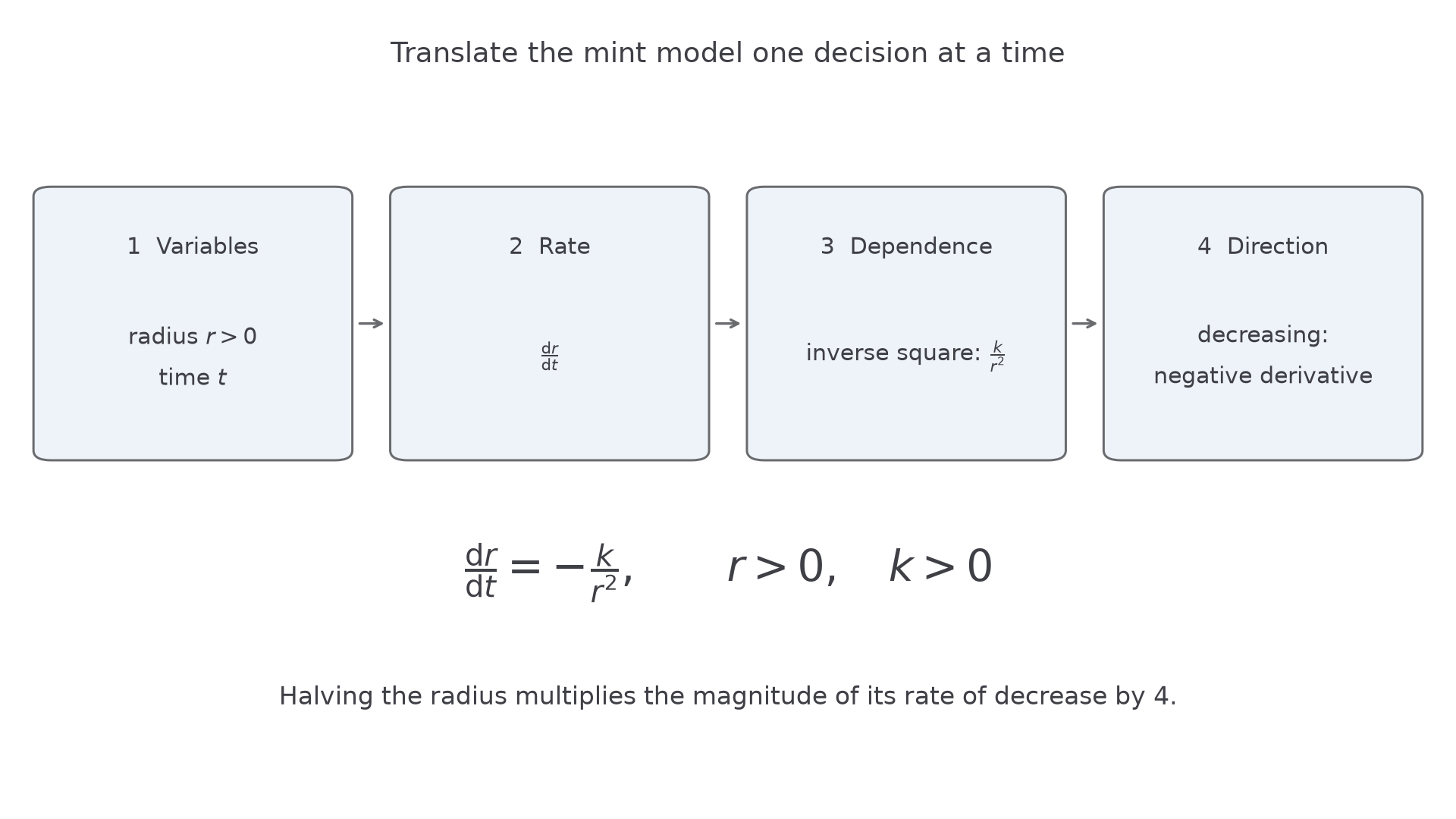
No universal formula in the booklet translates a context for you; the derivative, dependence and sign must come from the statement.
Key idea
The derivative's numerator says what changes; its denominator says what it changes with respect to. The right-hand side states what controls that rate.
Keep a rate distinct from the quantity itself.
Translating proportionality statements
“Proportional to” needs an unknown constant: doubling the controlling expression doubles the rate, but the actual scale is not yet known. When a positive quantity is said to decrease, write a negative sign explicitly and take .
Direct and inverse proportionality
Here is constant, and any denominator must be non-zero. Its sign follows the context; a decreasing rate may be written with an explicit minus sign and .
Not in the formula booklet: learn it.
A proportionality symbol is a useful first note, but the completed differential equation needs an equals sign.
Worked example 1: population growth
Question. A positive population grows at a rate proportional to its current size. Construct a differential equation in time .
Plan. Write the population's time derivative and multiply the controlling quantity by a constant.
Why this step? The words describe the rate of , not itself.
Answer. , with , .
Check. Doubling doubles the positive growth rate.
Change only the direction from growth to decline.
Worked example 2: population decline
Question. A positive population decreases at a rate proportional to its current size. Construct its rate equation.
Plan. Keep the direct dependence on , but make its signed time derivative negative.
The magnitude of the decrease is , while the derivative is .
Why this step? A rate of decrease is stated as a positive magnitude; a derivative records its negative direction.
Answer. .
Check. The derivative is negative for every positive , and doubling doubles the magnitude.
Inverse dependence needs a denominator instead. Compare a pair with the same geometric quantity.
Worked example 3: an increasing inverse-square radius
Question. A positive radius increases at a rate inversely proportional to . Construct its equation in time .
Plan. Use a positive derivative proportional to .
Why this step? “Inverse square” puts the square of the radius in the denominator, not the radius itself.
Answer. .
Check. At radius , the derivative is , one quarter of its previous value.
Change only the direction, giving the mint from the opening question.
Worked example 4: a shrinking mint
Question. A mint's positive radius decreases at a rate inversely proportional to the square of its radius. Construct its equation.
Plan. Use the same inverse-square magnitude with a negative derivative.
Why this step? The denominator states how the rate depends on size; the minus sign separately states its direction.
Answer. .
Check. Halving multiplies the magnitude by , so the radius decreases faster as the mint becomes smaller.
This equation is a model for positive radius; it is undefined at , where the assumed relationship cannot simply be continued. A different dependence changes the power: a positive mass decreasing at a rate proportional to gives .
Watch out
Wrong: “inversely proportional to the square” gives . That is direct-square dependence. The correct inverse-square model is , for .
Change the power in the mint's stated dependence.
Using an instantaneous rate to find k
A measured rate is a value of the derivative, not automatically the proportionality constant. Substitute both the rate and the simultaneous value of the controlling quantity.
Worked example 5: calibrating an inverse-root model
Question. A bubble's radius centimetres increases at a rate inversely proportional to . When , its rate is . Construct its differential equation.
Plan. Write the model with , then use the instantaneous information to determine .
Why this step? The number is the whole rate at this instant, not alone.
Answer. , for , with in seconds and in centimetres.
Check. At , , reproducing the stated measurement.
Continue this lesson.
You’re previewing NovaLearn without an account. Create a free account to read the rest.
Create free account