Pure 9.1 - Locating roots by sign changes
Trap an awkward root inside an interval without finding its exact value. You will use signs and continuity to justify roots and rounded answers, then recognise the two traps: missed crossings and breaks in a graph.
What a sign change means
Can two calculator readings prove that an equation has a solution, even when neither reading is zero? For , the readings and already tell a useful story: a continuous graph must get from below the axis to above it.
You already know
A positive function value puts a point above the -axis; a negative value puts it below. Polynomials and exponential functions are continuous on the whole real line.
The solution is an input, rather than the function value produced by that input.
Root
A root of is an input with . Its graph point is . For example, is a root of ; is not.
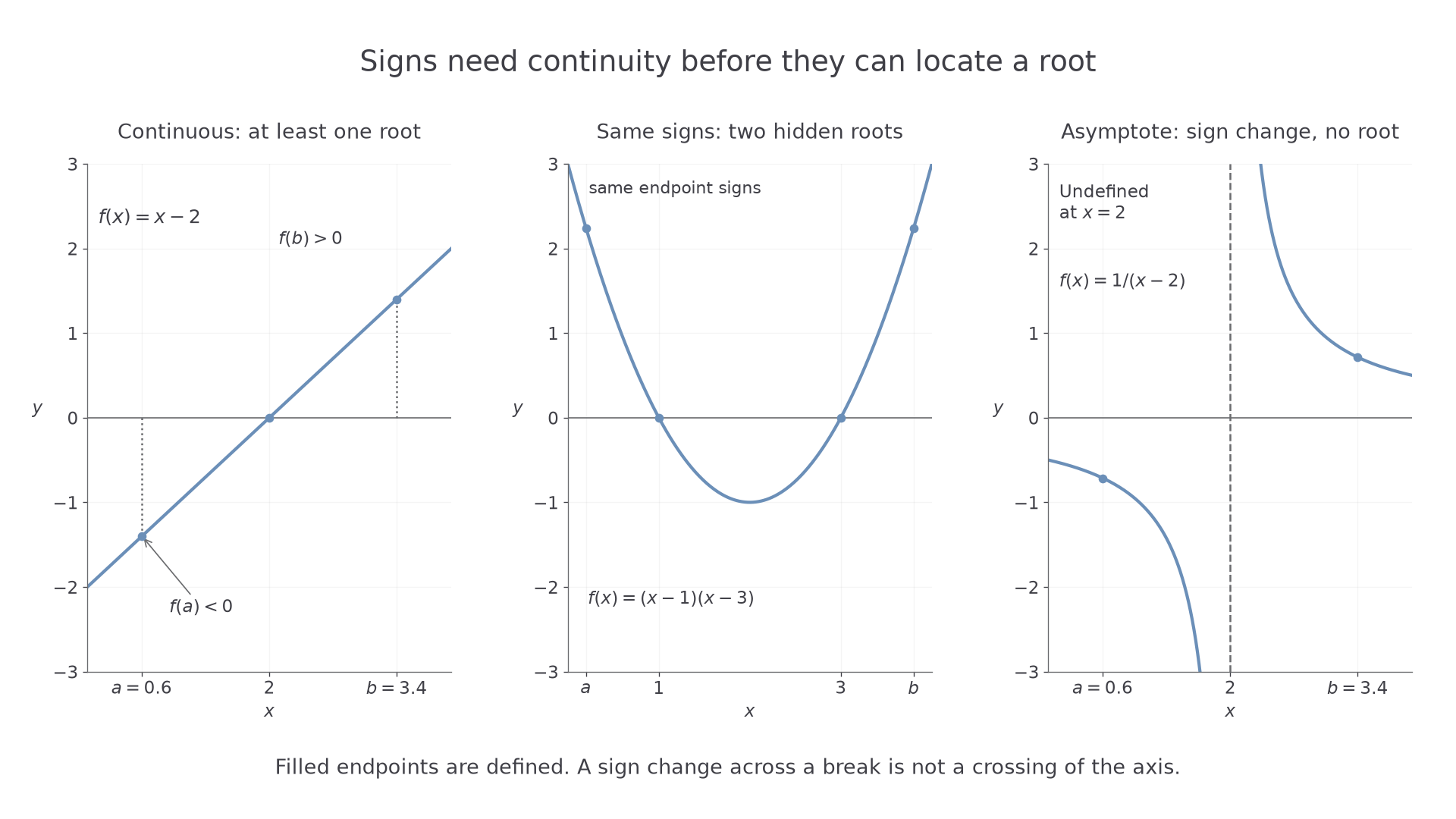
A continuous graph has no break on the interval being examined. It cannot switch sides of the axis without meeting it.
Sign-change test
If is continuous on , where , and
then has at least one root in .
Not in the formula booklet: learn it.
The signs may change in either direction. They establish existence, rather than uniqueness.
[DIAGRAM: asset_slug: p1_9_1_locate_roots_by_considering_changes_of_sign_of_f_x__diagram_01; asset_name: Three sign-change possibilities; caption: A crossing, two hidden crossings and an asymptote give different conclusions; description: Three exact panels show x minus 2 crossing zero, (x minus 1)(x minus 3) crossing twice, and 1/(x minus 2) changing sign across an asymptote without a root. Defined endpoints are filled.]
Worked example 1: a polynomial crossing
Question. Show that has a root between and .
Plan. Evaluate the polynomial at both endpoints, then use continuity.
Why this step? Opposite signs place the continuous graph on opposite sides of the axis.
Answer. Since and is continuous on , there is at least one root in .
Check. The endpoints are not roots, so the root really is strictly between them.
Change only the constant term in the polynomial. The reasoning stays the same, although the endpoint values change.
Worked example 2: the same test with a new constant
Question. Show that has a root between and .
Plan. Repeat the endpoint calculation for the new function.
Why this step? The sign test belongs to the current function; values for the earlier cubic cannot be reused.
Answer. There is a sign change, and a polynomial is continuous, so there is a root in .
Check. places the crossing in the upper half of that interval, consistently with the conclusion.
An exponential can be tested in exactly the same way once you have checked its continuity. For example, is continuous and has values at and at , proving a root between them.
Watch out
Wrong: “The signs differ, so there is exactly one root.” Right: “There is at least one root.” A uniqueness claim needs extra information, such as strict monotonicity.
For your turn, change the cubic's constant once more, keeping its tested interval fixed.
Writing the exam conclusion
Make the logical bridge visible: endpoint signs, continuity of the function, then a root in the interval. Continuity is a property you check independently; a sign change does not establish it.
For , the domain is . Both endpoints of , and every point between them, lie in that domain. Therefore the logarithm creates no break there.
Worked example 3: a logarithmic conclusion
Question. Given , show that a root lies in .
Plan. Calculate the signs and explain why the logarithm is continuous throughout this interval.
Why this step? The argument stays positive throughout , so the logarithm is defined and continuous there.
Answer. The signs differ and is continuous on , hence has a root in .
Check. lies between and , safely away from the logarithm's boundary at zero.
Change only the constant inside the logarithm. You must check the new domain before giving the same form of conclusion.
Worked example 4: checking the domain again
Question. Show that has a root in .
Plan. Find the endpoint signs and check positivity of .
Why this step? Here the valid domain is , and it contains the entire tested interval.
Answer. Since is continuous on and changes sign, a root lies in .
Check. At , , consistent with a crossing further to the right.
Pearson rewards the complete argument, even when the calculation itself is short.
Exam tip
Write “the function is continuous”, followed by the root conclusion. “The interval is continuous” and “the root is continuous” do not state the required property.
For example, supplied readings , , together with continuity on , would prove a root in . For your turn, instead change only the logarithm's constant from to .
Continue this lesson.
You’re previewing NovaLearn without an account. Create a free account to read the rest.
Create free account