Pure 9.5 - Numerical methods in context
Turn a model into a numerical target, then interpret the result with its units and limits. You will find a model's maximum by iteration, estimate totals from rate readings and separate calculation accuracy from confidence in the model.
From context to numerical target
When does a vehicle reach its greatest speed between two stops? For the model , with in seconds and , the answer needs more than a calculator root: we must choose the right equation and explain what its root means.
At and , the model gives zero speed. At , it gives about . The greatest speed occurs somewhere between the stops. We will find its time shortly.
You already know
A threshold asks for a root of “model minus target”. An interior maximum or minimum is a candidate where the derivative is zero. Integrating a rate gives an accumulated quantity, with units of rate multiplied by time.
Choose the mathematical target before choosing a numerical method.
| Context asks for | Mathematical target | Appropriate numerical approach |
|---|---|---|
| Time a value is reached | Solve | Root-finding or a suggested iteration |
| Greatest or least value | Solve the derivative equation and check candidates | Iteration or Newton-Raphson if needed |
| Total from rate readings | Estimate an integral | Trapezium rule |
| Proof of rounded root | Trap it inside rounding boundaries | Sign change and continuity |
The same model can lead to different targets. Here is a pressure example where differentiation would answer the wrong question.
Worked example 1: a threshold target
Question. A cabin pressure is modelled by psi, where is hours and . Form a numerical target for the first time .
Plan. Equate the model to the required pressure, then move the target to the left.
Why this step? A time of reaching a level is a root problem; a stationary pressure would instead involve a derivative.
Answer. Find the smallest root of in , using radians. Report the time in hours after take-off.
Check. , so take-off is not the requested threshold time. A root outside the stated interval would not answer the model's question.
Change only the threshold from to psi. The model and variable remain the same.
Worked example 2: a changed threshold
Question. Form the corresponding numerical target for the first time .
Plan. Subtract the new target from the model.
Why this step? The residual must vanish at the target pressure, rather than at the old threshold.
Answer. Seek the smallest root of in , again using radians and hours.
Check. At a root, the rearranged equation gives , as required.
A numerical routine may find a later crossing. Use a sketch or small-interval search to locate the first relevant crossing before refining it.
Watch out
Wrong: a converged root is automatically the requested time. Right: check the domain, the variable's meaning and whether the question asks for the first crossing.
Now recognise a different target from its units.
Iteration for contextual equations
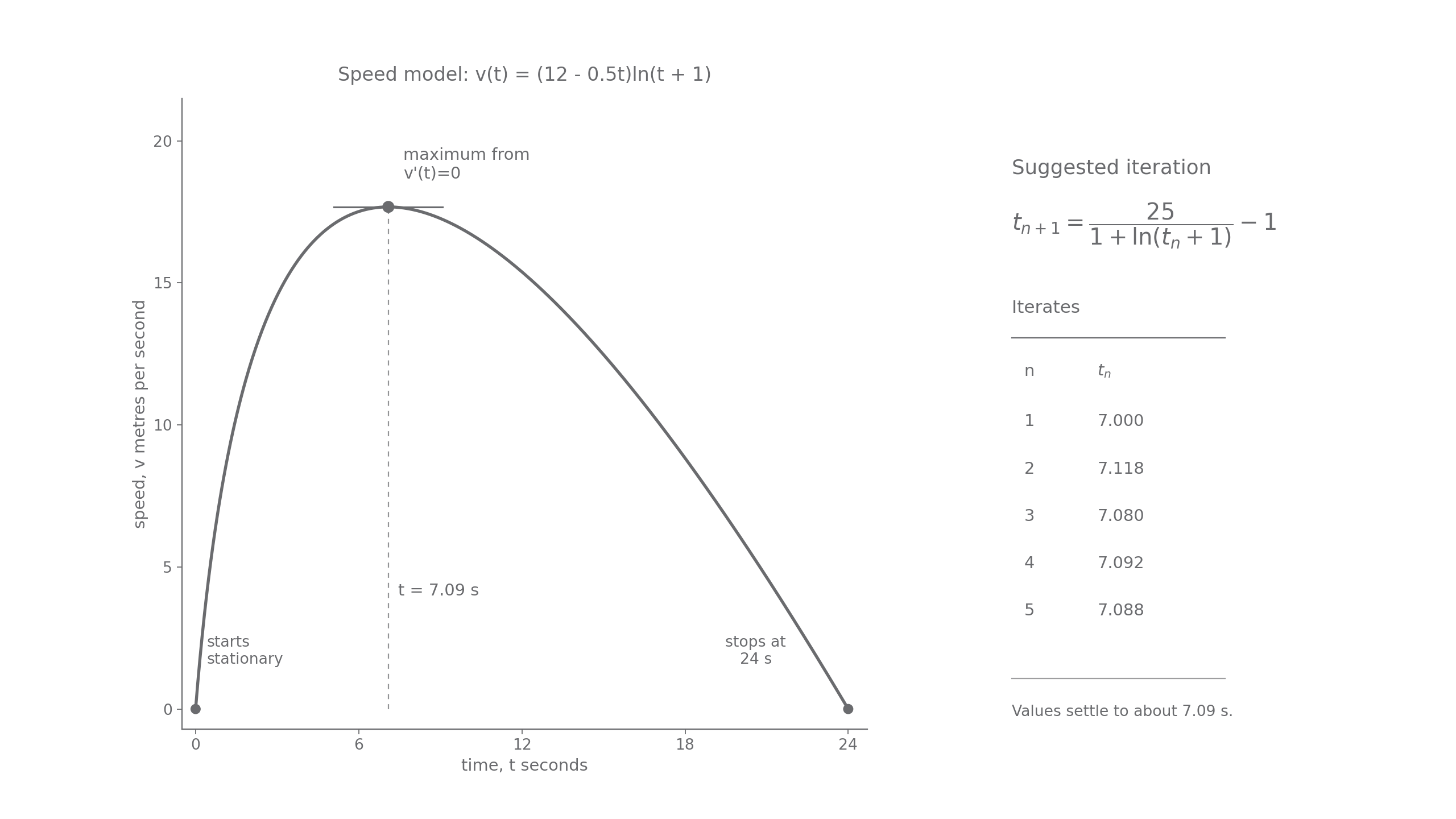
Return to the vehicle. To locate its greatest speed, differentiate the model first. The resulting equation mixes a logarithm and an algebraic expression, so a suggested iteration is useful.
[DIAGRAM: asset_slug: p1_9_5_use_numerical_methods_to_solve_problems_in_context__diagram_01; asset_name: Maximum speed found by iteration; caption: The model's greatest speed occurs about 7.09 seconds after departure; description: Exact speed v=(12-0.5t)ln(t+1) on 0 to 24 seconds, with stationary endpoints and the unique maximum at t approximately 7.08922. A separate small table gives the first five iterates from t1=7 without covering the curve.]
Worked example 3: the time of maximum speed
Question. Find by iteration when , , is greatest. Start with .
Plan. Set the derivative to zero, rearrange as a fixed-point equation and iterate.
Starting at , the next values are , , , , , eventually approaching .
Why this step? Differentiation finds the stationary-time equation; iterating the speed formula itself would solve a different problem.
Answer. The model predicts greatest speed after , to three significant figures.
Check. Throughout ,
so the derivative decreases through zero once. Together with zero endpoint speeds and positive interior speeds, this establishes the unique global maximum.
Change only the initial coefficient to . The stop time becomes seconds to keep the same physical interpretation.
Worked example 4: changing the vehicle model
Question. For , , derive a similar iteration and estimate the maximum-speed time. Start with .
Plan. Apply the same derivative and rearrangement to the changed coefficient.
The iterates are , , , , eventually .
Why this step? The changed model alters the numerator of the recurrence; the earlier value must become .
Answer. The greatest speed occurs after approximately , to three significant figures.
Check. The analogous second derivative is negative on , and the speed is zero at both ends, so the stationary point is the unique maximum.
The numerical answer is a prediction under the stated speed model. Its digits do not establish that a real vehicle follows the model perfectly.
Exam tip
Give the requested iterate to the requested accuracy, then state a contextual limiting answer with units. Three decimal places and three significant figures are different instructions.
Use a supplied recurrence with a fresh coefficient.
Trapezium rule in context
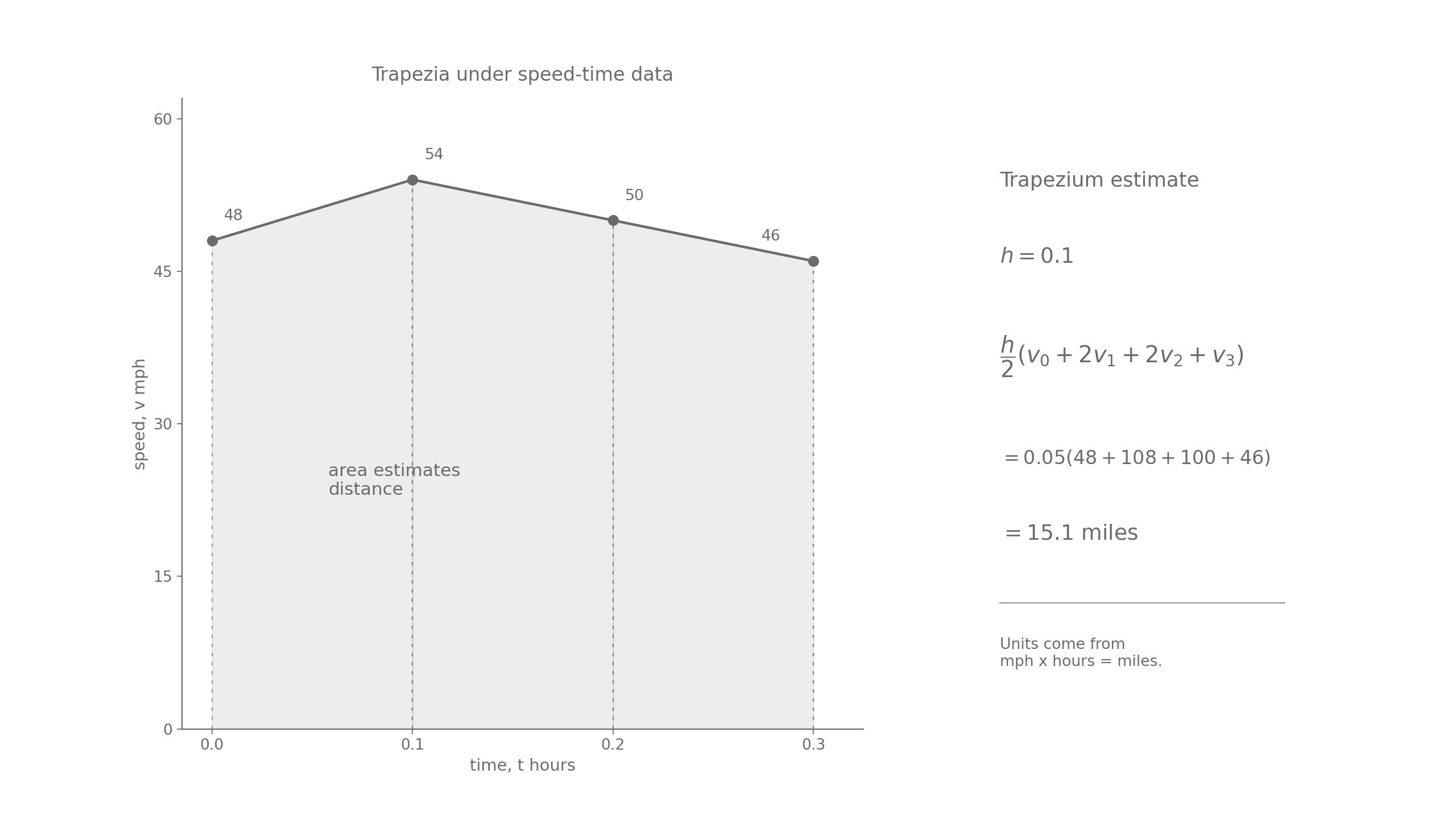
A rate table asks for accumulation rather than a root. Multiply rate units by the time units before calculating, converting units first when needed. Speed in miles per hour and time in hours produce distance in miles.
[DIAGRAM: asset_slug: p1_9_5_use_numerical_methods_to_solve_problems_in_context__diagram_02; asset_name: Estimating distance from speed readings; caption: The three trapezia estimate the distance travelled during 0.3 hours; description: Recorded speeds of 48,54,50,46 miles per hour at times 0,0.1,0.2,0.3 hours are joined by straight segments. Shaded trapezia show distance as the area under the speed-time graph.]
Continue this lesson.
You’re previewing NovaLearn without an account. Create a free account to read the rest.
Create free account