Pure 5.4 - Reciprocal and inverse trigonometric functions
Distinguish a reciprocal value from an inverse-function angle, then use domains, ranges and graphs to choose valid answers. You will calculate exact values of secant, cosecant and cotangent, interpret principal inverse functions and use their ranges to decide signs.
Reciprocal definitions
If , can you find exactly without first finding the angle? The answer depends on which quadrant the inverse function chooses. Begin by separating two easily confused operations: taking a reciprocal and finding an angle.
You already know
, so its reciprocal is . Inverse cosine instead takes the input and returns an angle, . The same numbers appear, but the input and output roles differ.
The reciprocal functions have short names because they occur frequently in identities and calculus.
Reciprocal trigonometric functions
For real ,
Also wherever tangent is defined and non-zero. At , cotangent is even though tangent is undefined. These definitions are not in the formula booklet: learn them.
Use as the full definition of cotangent, so that its valid zero values are kept.
Worked example 1: reciprocal values in radians
Question. Find , and exactly.
Plan. Rewrite each function in sine and cosine, then use exact values.
Why this step? Converting to known functions exposes both the value and the denominator restriction.
Answer. , , , respectively.
Check. Each secant or cosecant value has magnitude at least ; cotangent has the expected quadrant-II negative sign.
Change only the angle unit: equivalent degree inputs must give the same values.
Worked example 2: the same angles in degrees
Question. Find , and exactly.
Plan. Use the equivalent exact sine and cosine values in degrees.
Why this step? Degree and radian measures describe the same angles; changing units should not change a trigonometric value.
Answer. , , .
Check. , , , so both examples agree.
Inverse notation needs special care: means , whereas means . Parentheses change the operation.
Watch out
Wrong: . Correct: ; is an angle whose cosine is .
Evaluate another set of degree inputs.
Graphs of reciprocal functions
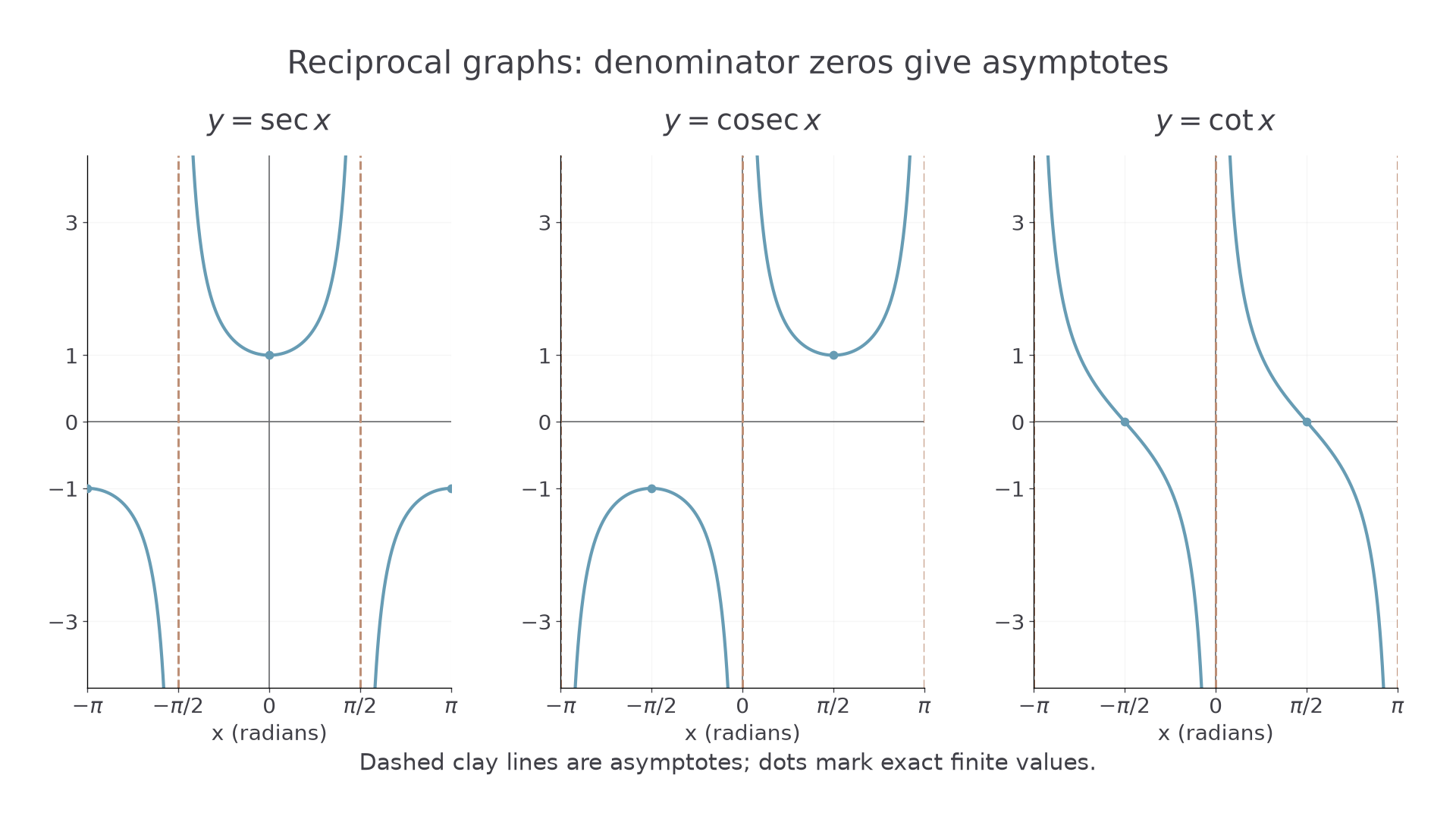
At , secant is , but cosecant and cotangent are undefined. At , secant is undefined, cosecant is , and cotangent is . The denominator predicts the breaks before you draw a curve.
[DIAGRAM: asset_slug: p1_5_4_understand_and_use_the_definitions_of_secant_cosecant_and_cotangent_and_of_arcsin_arccos_and_arctan__diagram_01; asset_name: Reciprocal trigonometric graphs; caption: Zeros of the denominator become vertical asymptotes; description: Separate secant, cosecant and cotangent graphs show their branches and vertical asymptotes on radian axes. Secant and cosecant never enter the band between minus 1 and 1; cotangent crosses zero between its asymptotes.]
Vertical asymptote
A vertical asymptote is a line approached as the function becomes unbounded on at least one side of . For these reciprocal graphs it occurs when the denominator tends to zero while the numerator does not. It is not a vertical piece of the curve.
Since a non-zero sine or cosine has magnitude at most , its reciprocal has magnitude at least . This explains the gap in the secant and cosecant ranges. Cotangent's numerator can be zero, so cotangent can equal zero and takes every real value.
| Function | Excluded inputs, | Range | Fundamental period |
|---|---|---|---|
| , or | , or | ||
| , or | , or | ||
| , or | , or |
Each domain consists of all real inputs except those listed; the excluded inputs are also the asymptotes. Cotangent's zeros are . Secant is even; cosecant and cotangent are odd, following the symmetries of their defining ratios. These graph features are not supplied in the formula booklet: learn them.
Key idea
A reciprocal cannot equal zero, but a ratio such as can: inspect the numerator and denominator separately.
This is also why using blindly can hide cotangent's zeros.
Principal inverse trigonometric functions
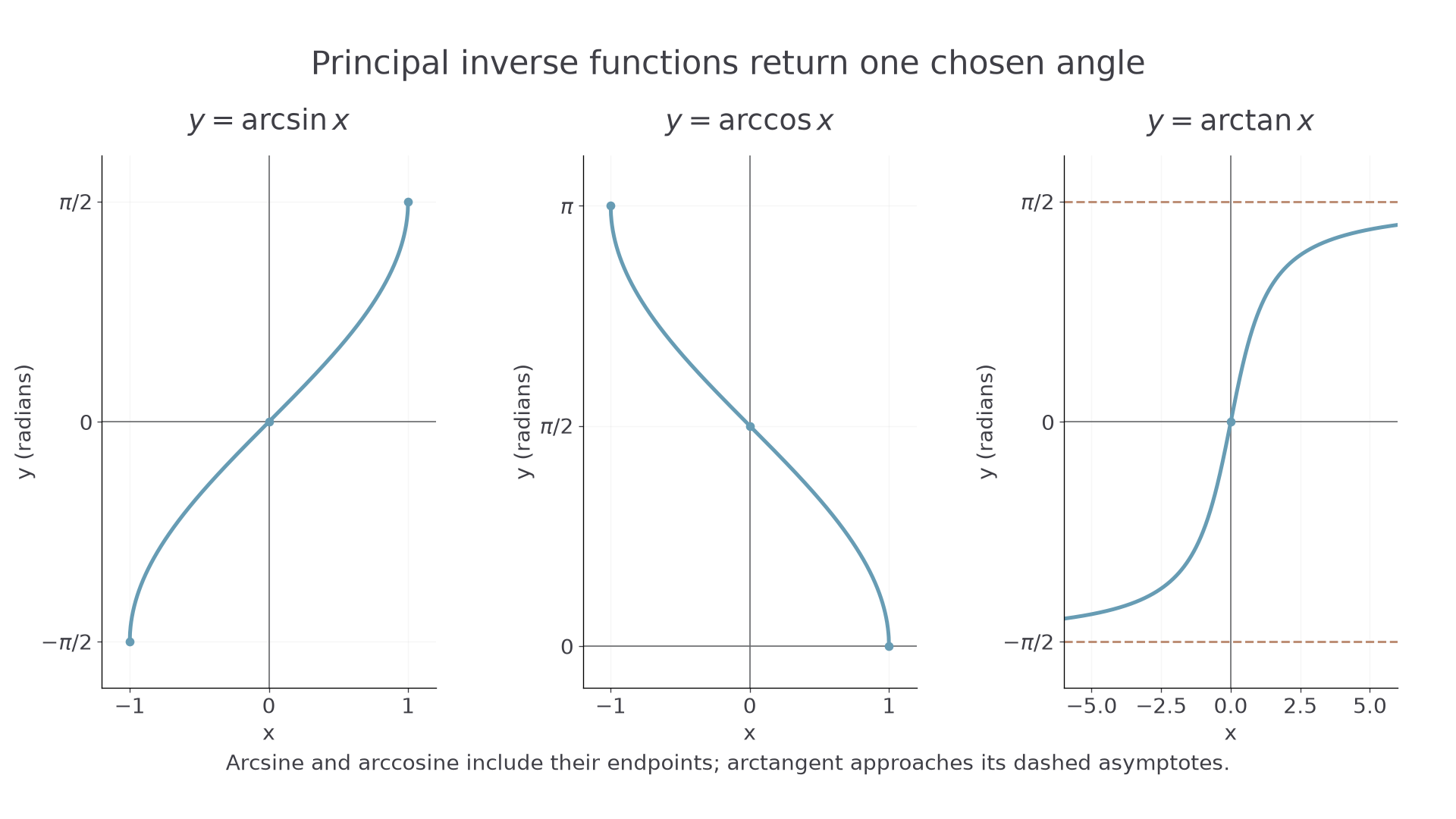
Both and have sine . An inverse function must return one output, so the full sine graph cannot be inverted as a function. Restrict it to a one-to-one interval first, then reflect that branch in .
Principal inverse trigonometric functions
means with .
means with .
means with .
These chosen outputs are principal values. They are also written , , ; they do not mean reciprocals.
Inverse functions swap inputs and outputs, so each restricted branch's range becomes its inverse's domain.
| Function | Domain | Principal range in radians | Principal range in degrees |
|---|---|---|---|
The arctangent endpoints are excluded because tangent cannot take a finite value there. Arcsine and arccosine include their endpoints. These ranges and definitions are not in the formula booklet: learn them.
[DIAGRAM: asset_slug: p1_5_4_understand_and_use_the_definitions_of_secant_cosecant_and_cotangent_and_of_arcsin_arccos_and_arctan__diagram_02; asset_name: Principal inverse graphs; caption: Inverse functions return angles in their chosen principal ranges; description: Arcsine and arccosine have domains from minus 1 to 1 and included endpoints. Arctangent has every real input and horizontal asymptotes at plus and minus pi over 2.]
Continue this lesson.
You’re previewing NovaLearn without an account. Create a free account to read the rest.
Create free account