Pure 2.3 - Quadratic functions and graphs
A quadratic's graph, roots and minimum or maximum are different views of the same expression. You will complete the square, interpret the discriminant, solve quadratic equations and recognise quadratics hidden inside powers, exponentials, trigonometric functions and logarithms.
Quadratic graph features
Can ever be negative? At it is , and at it is , but checking a few values cannot settle what happens for every real input. We need the shape and the algebra to agree.
You already know
A square is non-negative: for every real . A root of an equation is an input making it true; factorisation can turn an equation into a zero product.
The notation means the output at input ; it does not mean multiplied by . The function , with , is quadratic, and its graph is a parabola. The coefficient decides whether it opens upwards, with a minimum, or downwards, with a maximum.
Root and intercept
A real root of gives an -intercept . The -intercept is , since . A turning point is where the parabola changes from decreasing to increasing, or conversely.
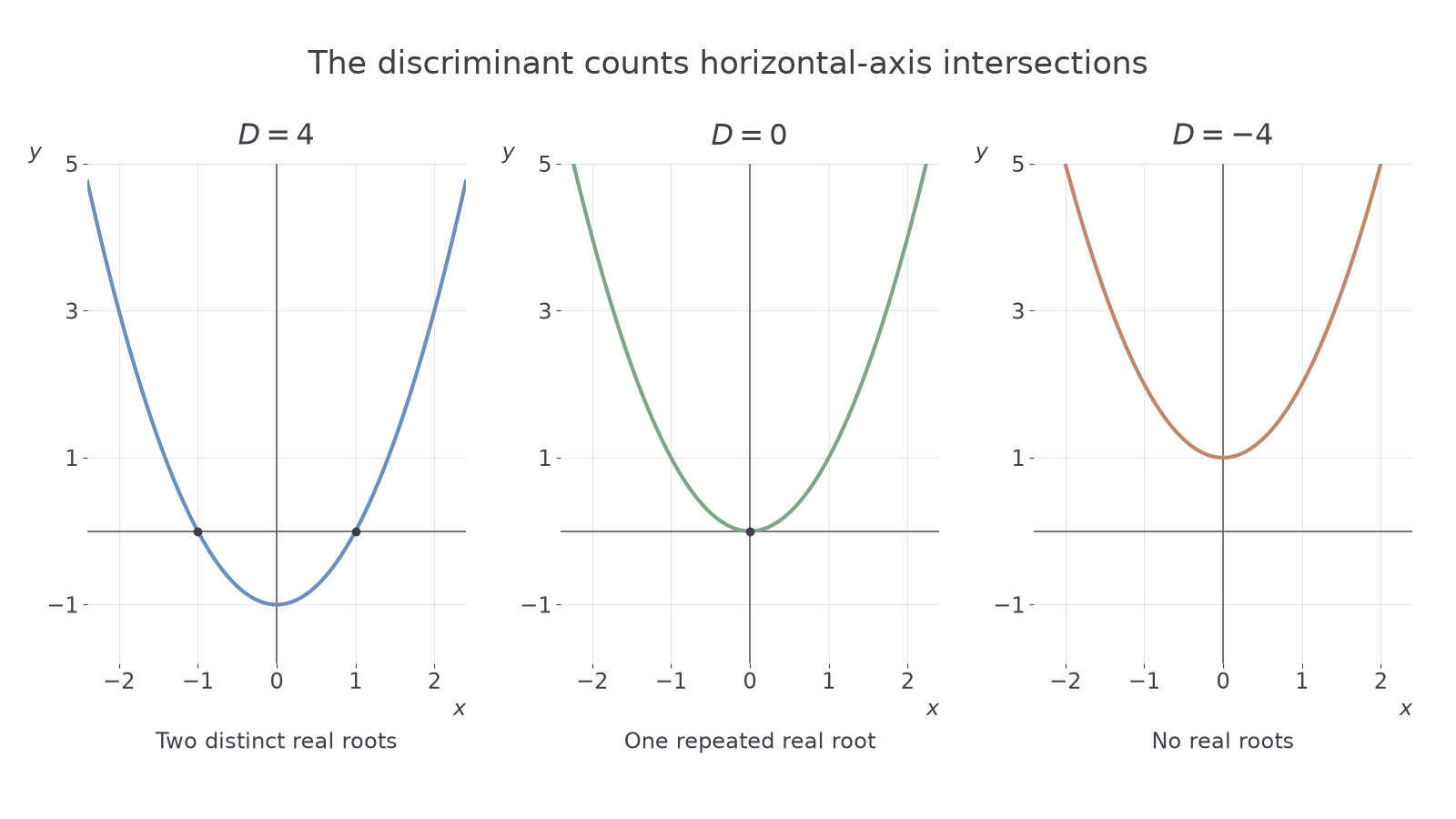
The parabola can cross the horizontal axis twice, touch it once, or miss it entirely. A touching point represents a repeated root, counted twice algebraically but appearing at only one coordinate. A quadratic needs : is linear.
Key idea
Roots locate horizontal-axis intersections; the turning point locates the minimum or maximum. They answer different questions.
Use the coefficient and constant to read the following features without solving an equation.
Completing the square
Start with . Since , subtracting restores the expression: . Completing the square makes a quadratic's symmetry visible.
Completed-square form
For ,
In the form , the turning point is and the axis of symmetry is .
Not in the formula booklet: learn it.
When , factor it from the quadratic and linear terms before halving the inner coefficient. Any correction made inside that bracket is multiplied by .
Worked example 1: a non-unit leading coefficient
Question. Complete the square for , and state its turning point.
Plan. Factor out , complete the inner square, then collect constants.
Why this step? Subtracting inside the bracket subtracts from the whole expression.
Answer. , with minimum turning point .
Check. Expansion gives .
[DIAGRAM: asset_slug: p1_2_3_work_with_quadratic_functions_and_their_graphs__diagram_02; asset_name: Completed square and turning point; caption: Completing the square exposes the axis and minimum; description: The graph y equals 2 times x minus 2 squared minus 5 has turning point (2, minus 5), symmetry axis x equals 2 and y-intercept (0, 3). Its roots are approximately 0.419 and 3.58.]
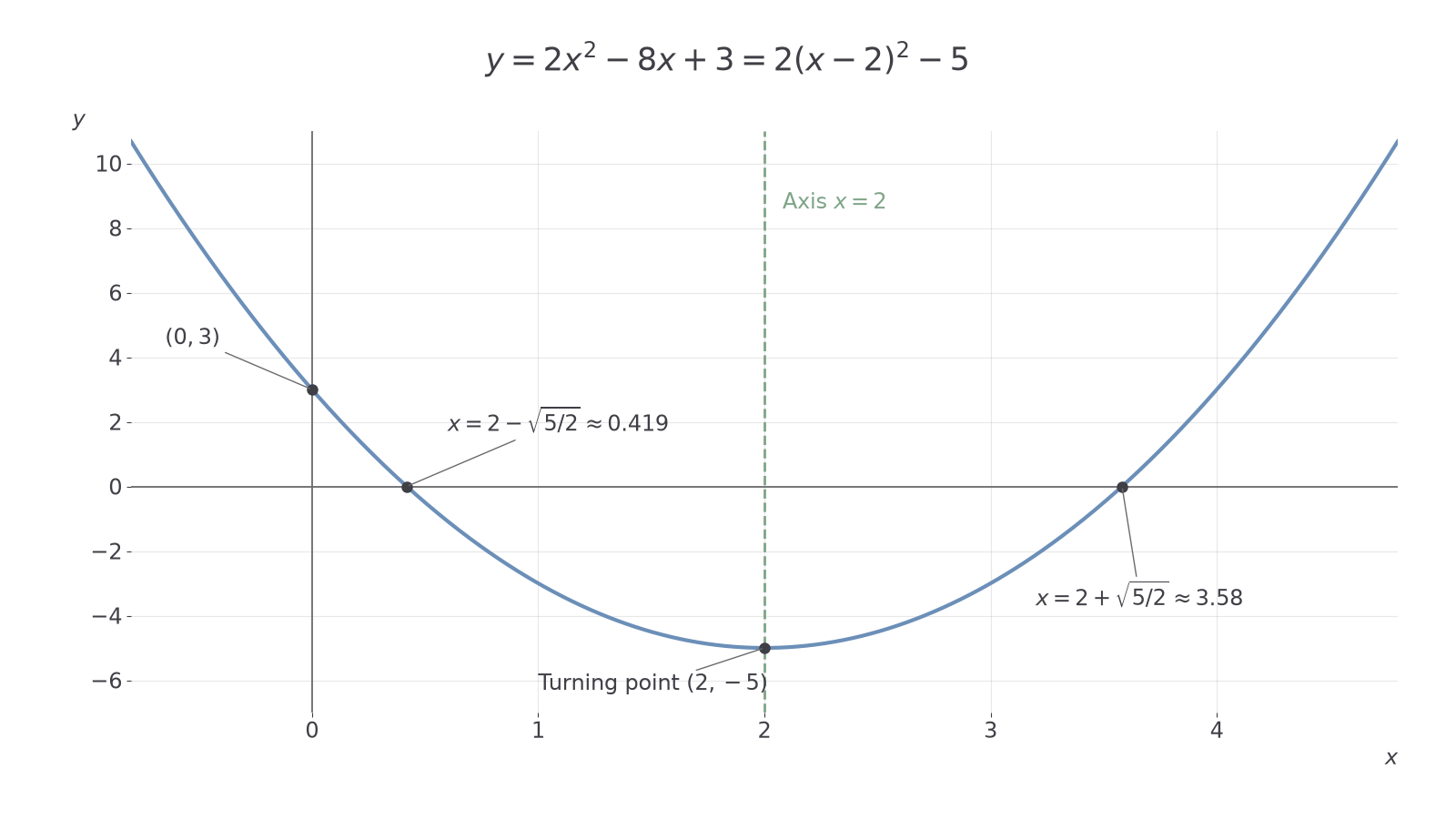
Change only the constant from to . The graph rises by , leaving the symmetry axis unchanged.
Worked example 2: a vertical shift
Question. Complete the square for , and find its minimum.
Plan. Reuse the same inner square and change the final constant.
Why this step? The bound is attained when , so it is the minimum, not merely a lower estimate.
Answer. Minimum , attained at .
Check. ; values at and are both .
The sign inside the square is easy to misread.
Watch out
Wrong: the turning point of is . The square is zero at , so the turning point is .
Apply the same square-and-correct method with a new linear coefficient.
The discriminant
The quadratic formula contains . A positive number under that root gives two real choices, zero makes them coincide, and a negative number gives no real value. This lets you count roots without solving for them.
Discriminant
For , , define
: two distinct real roots; : a repeated real root; : no real roots.
Not in the formula booklet: learn it.
These are also statements about the graph's intersections with the horizontal axis. A repeated root still solves the equation; it is not “no roots”.
[DIAGRAM: asset_slug: p1_2_3_work_with_quadratic_functions_and_their_graphs__diagram_01; asset_name: Three discriminant cases; caption: The discriminant counts real roots; description: Three upward parabolas show two crossings for D positive, one touching point for D zero and no crossing for D negative.]
Worked example 3: no real roots
Question. Determine the number of real roots of .
Plan. Calculate the discriminant and interpret its sign.
Why this step? Counting roots needs only the sign, not the formula's two values.
Answer. There are no real roots.
Check. , so it cannot equal zero.
Change only the constant from to . The graph now just reaches the axis.
Worked example 4: a repeated root
Question. Determine the number of distinct real roots of .
Plan. Recalculate the discriminant.
Why this step? The two signs in the quadratic formula give the same value when its square root is zero.
Answer. One distinct real root, repeated.
Check. , so the root is twice.
A negative discriminant by itself does not tell you whether the curve stays above or below the axis; the sign of supplies that information.
Watch out
Wrong: “, so there are two distinct roots.” Right: the roots coincide. Use for two distinct real roots.
A parameter question reverses the process: set the required discriminant condition first.
Solving quadratic equations
A factorisation such as gives two linear equations, because a zero product has at least one zero factor. If the brackets are not obvious, the quadratic formula works for every quadratic with real roots.
Quadratic formula
For , with and ,
Not in the formula booklet: learn it.
Put the equation equal to zero before reading , , . Factorisation is often shortest; completing the square is equally valid and reveals the turning point at the same time.
Worked example 5: factorisation
Question. Solve .
Plan. Factorise, then set each factor equal to zero.
Why this step? Dividing by one factor could discard the root that makes it zero.
Answer. or .
Check. Substitution gives and .
Change only the constant from to . The roots are now surds, so the formula is convenient.
Worked example 6: exact surd roots
Question. Solve exactly.
Plan. Substitute , , in the formula and simplify.
Why this step? Keeping the root exact avoids losing information through rounding.
Answer. or .
Check. Rearranging gives , satisfied by both answers.
For comparison, completing the square in gives , hence . A calculator's polynomial solver would return approximately and . Enter coefficients , , , retaining the negative signs; substitute outputs back to check. Calculator roots are acceptable when permitted, but do not replace required algebraic working or exact forms.
Exam tip
If the question excludes solutions relying entirely on calculator technology, display factorisation, square completion or formula substitution. A calculator is still useful for checking your algebra.
Use an efficient exact method for this new quadratic.
Quadratics in a function of the unknown
The expression contains the square of . Setting reveals an ordinary quadratic. Solve for , then solve for ; stopping at leaves the original question unanswered.
You already know
. A logarithm reverses a power: means . Since , it can never equal a negative number.
Substitution preserves the repeated expression. Check its range: if , then ; if , then . Neither statement is a formula supplied in the booklet.
Worked example 7: a quadratic in a square
Question. Solve .
Plan. Put , solve, then take both square roots of each positive value.
Why this step? Each positive value of gives both a positive and a negative .
Answer. , .
Check. The original gives when , and when .
Change only the constant to . One temporary root will now fail its range condition.
Worked example 8: rejecting an impossible square
Question. Solve over the reals.
Plan. Use , then reject negative values of .
Why this step? A real square cannot be , although solves the temporary quadratic.
Answer. .
Check. for either sign.
The same substitution idea works when the repeated expression is an exponential. Here is a second pair so you can see the different back-substitution step.
Worked example 9: an exponential quadratic
Question. Solve exactly.
Plan. Put , factorise, then reverse the exponential.
Why this step? The temporary roots are outputs of , not values of .
Answer. or .
Check. With outputs and , the original is respectively and .
Change only the constant to . Exponential outputs must still be positive.
Worked example 10: an impossible exponential output
Question. Solve .
Plan. Use and check the quadratic roots against that condition.
Why this step? No real power of a positive base is negative.
Answer. .
Check. .
The natural exponential works identically; its inverse is , so gives for .
Watch out
Wrong: “, so .” If , solve , giving . Always undo your substitution.
Try the same quadratic structure with base .
Quadratics in trigonometric and logarithmic functions
A quadratic can hide in or just as it hides in . The quadratic algebra does not change; the last step does. First make the small amount of function knowledge explicit.
You already know
In degrees, , , and . On one full turn, sine is positive in the first two quadrants and negative in the last two. For , means ; a logarithm's output may be negative.
For with , use the reference angle in degree mode and the quadrants to find every solution in the stated interval. For example, gives and . The inverse key alone does not list both. For logs, check the argument is positive, not the output. These inverse definitions and sine values are not supplied in the formula booklet.
Worked example 11: a quadratic in sine
Question. Solve for .
Plan. Put , solve the quadratic, then find every angle in the interval.
Why this step? A sine value normally corresponds to two angles on a full turn; the maximum value occurs once.
Answer. , , .
Check. Sine outputs and give and .
Change only the constant from to . One quadratic root is now outside sine's range.
Worked example 12: checking the sine range
Question. Solve for .
Plan. Use and reject .
Why this step? is an algebraic root but cannot be a real sine output.
Answer. , .
Check. Each gives sine , so the original is .
Now use . This time has no upper or lower bound, but must be positive. Logs reverse exponentials, so there is one positive input for each real output.
Worked example 13: a quadratic in a logarithm
Question. Solve .
Plan. State , put , then exponentiate each root.
Why this step? asks which input has logarithm ; it does not give .
Answer. and , both in the domain .
Check. Their logarithms are and , giving and .
Change only the logarithm's argument from to . The domain and final inverse step must change together.
Worked example 14: checking a shifted logarithm's domain
Question. Solve .
Plan. Require , then use .
Why this step? Exponentiating finds the whole argument , not .
Answer. , , both greater than .
Check. Subtracting gives positive arguments whose logs are and .
The same algebra can yield a negative logarithm, which is perfectly valid: gives .
Watch out
Reject , because the output is outside . Do not reject : only the log's argument must be positive.
This final check samples both back-substitution rules with new quadratic coefficients.
Choosing the method
Choose your representation to match your target. Factor form exposes roots, completed-square form exposes bounds, and the discriminant counts real roots. This is more reliable than trying the same tool on every question.
| Target | Useful first move |
|---|---|
| Roots | Factorise, use the formula, complete the square or use a permitted calculator solver |
| Turning point or bound | Complete the square |
| Number of real roots | Calculate the discriminant |
| Repeated expression | Substitute, solve, back-substitute and check conditions |
A surprising fact is that a positive value at every tested integer says little about all real inputs: is positive at every integer, yet at it is . Indeed, an integer satisfies or , so and . Between-integer behaviour needs an argument.
Worked example 15: proving positivity
Question. Show that for every real .
Plan. Complete the square and give a strict positive lower bound.
Why this step? The added , rather than the square alone, makes the result strictly positive.
Answer. The expression is positive for all real .
Check. Its smallest value is attained at and is , answering the opening question.
Change only the constant from to . The distinction between positive and non-negative now matters.
Worked example 16: a boundary case
Question. Determine whether is positive for every real .
Plan. Complete the square and inspect equality.
Why this step? A square can be zero, so non-negative does not imply strictly positive.
Answer. No: it is non-negative for every real input but equals zero at .
Check. .
A discriminant argument can also prove positivity when you include : an upward parabola with no real roots stays above the axis.
Exam tip
A “show that” proof needs a general reason and a conclusion. Testing several inputs cannot establish a claim for every real number.
Use the same completed-square reasoning to establish a new printed result.
Quick Recap
- has turning point ; inspect the sign of .
- distinguishes two real roots, a repeated root and no real roots.
- Choose a solving method to fit the required answer and show required algebra.
- A substituted quadratic is unfinished until you return to the original variable and check its domain, range and interval.
The opening expression can never be negative: .