Mechanics 6.1 - Fundamental and derived SI units
Units tell you whether a number describes a mass, a speed or a turning effect. You will build the SI units used in mechanics, convert compound units and use them to catch mistakes before trusting a calculation.
Base quantities
How can a speed of become without the car slowing down?
Imagine watching the same car with two speed displays. One counts kilometres covered per hour; the other counts metres covered per second. The motion is unchanged. The number changes because the measuring units change. We will explain the conversion once we have built the units.
You already know
, and . A negative power means a reciprocal: .
The SI system starts with base quantities and their units. Mechanics here uses three of them; this is not a claim that the whole SI system has only three base quantities.
Fundamental quantity
A fundamental, or base, quantity is used as a building block for other quantities. The three fundamental quantities needed here are length, time and mass, with SI units metre, second and kilogram respectively.
Keep the quantity, the unit's name and its symbol distinct. “Mass” is a quantity; “kilogram” is its unit; is the unit symbol.
| Quantity | SI unit | Symbol |
|---|---|---|
| length | metre | |
| time | second | |
| mass | kilogram |
Displacement is measured in metres too. The SI base unit of mass is the kilogram, despite the prefix in its name: , while . A gram and a kilometre are valid units, but they are not the base units used in our SI calculations.
[DIAGRAM: asset_slug: p3_6_1_understand_and_use_fundamental_and_derived_quantities_and_units_in_the_s_i_system__diagram_01; asset_name: Mechanics 6.1 - Fundamental and derived SI units - diagram 01; caption: Building velocity, acceleration, force and moment units from metres, seconds and kilograms; description: The three base units metre, second and kilogram sit above four derived-unit rows. Velocity uses length divided by time; acceleration divides velocity by time again; force multiplies mass by acceleration; moment multiplies force by perpendicular distance.]
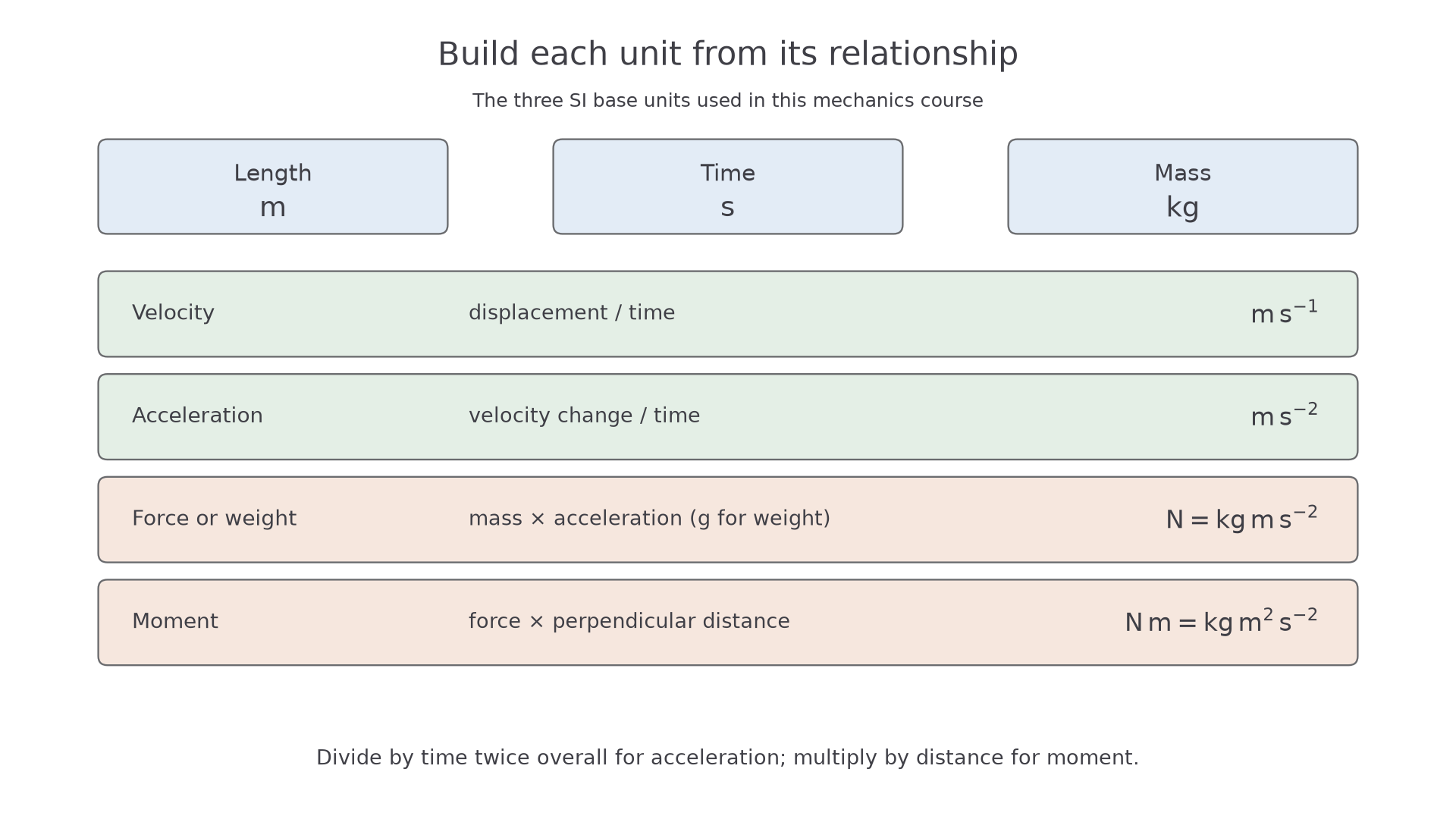
Read each row as a relationship between quantities. The unit then follows the same multiplication or division.
Key idea
A numerical value needs its quantity and its unit: describes a mass, while describes a force.
Start by identifying the base units accurately.
Rates and units
A rate tells you how much one quantity changes per unit of another. A model car travelling in at constant velocity covers each second. That explains both the division and the unit.
Derived quantity
A derived quantity is formed by combining other quantities. Its unit is built using the same relationship. Velocity is displacement per unit time; acceleration is change in velocity per unit time.
The word “per” puts time in the denominator. Acceleration divides by time twice overall, which explains its squared time unit.
Velocity and acceleration units
For motion in one fixed direction,
The average acceleration equals the acceleration throughout an interval when acceleration is constant. Elapsed time must be positive.
Not in the formula booklet: learn it.
You can calculate with the numbers and simplify the units alongside them.
Worked example 1: a rate of a rate
Question. A model car travels in the positive direction in at constant velocity. In a later interval, its velocity increases by in at constant acceleration. Find its initial velocity and its later acceleration.
Plan. Divide displacement by time, then divide velocity change by time.
Why divide by time again? Acceleration measures the rate at which velocity changes, rather than the rate at which position changes.
Answer. The velocity is ; the later acceleration is , both in the positive direction.
Check. and : multiplying each rate by its elapsed time recovers the stated change.
Change only the duration of the acceleration interval from to . The same velocity change now takes longer, so the acceleration should be smaller.
Worked example 2: the same change takes longer
Question. The car again travels in at constant positive velocity. Its velocity later increases by , now in at constant acceleration. Find the two rates.
Plan. Keep the displacement calculation and use the new time for the velocity change.
Why is the first answer unchanged? The later acceleration interval does not alter the displacement or time already supplied for the first interval.
Answer. The velocity is ; the later acceleration is .
Check. , and , as the longer time requires.
The unit records which change you divided by time.
Watch out
Writing an acceleration as gives it the unit of velocity. Dividing velocity change by seconds gives . State the unit carefully when the question asks for it.
Try the same pair of rate calculations with fresh data.
Force, weight and moment
A mass of has weight when . These numbers describe different quantities. Mass is a property of the body; weight is the gravitational force acting on it. Moving the same body to a place with a different gravitational acceleration changes its weight, not its mass.
Newton
The newton is the SI unit of force, with . A resultant force of one newton gives a mass of one kilogram an acceleration of one metre per second squared.
Newton's second law builds the force unit from mass and acceleration. Multiplying a force by a perpendicular distance builds the moment unit. Here we use these relationships to understand units; resolving forces and balancing moments come later.
Force, weight and moment units
For a constant mass, in a chosen direction,
Here is the resultant force in the chosen direction in the first line. and are the magnitudes of weight and gravitational acceleration. In the moment formula, is the force magnitude and is the perpendicular distance from the point to its line of action. Weight acts towards the attracting body.
The corresponding units are
Not in the formula booklet: learn it.
The distance in a moment calculation is perpendicular to the force's line of action. It is not automatically the length of a rod.
Worked example 3: a weight produces a moment
Question. A body has mass . Take . Find its weight and the magnitude of the moment of that weight about a point from its line of action.
Plan. Calculate the weight in newtons, then multiply by the perpendicular distance.
Why use , rather than , in the second line? A moment is force times distance, so the mass must first become a weight.
Answer. The weight is and its moment magnitude is .
Check. The moment has unit , and dividing by recovers the force magnitude .
Now halve only the perpendicular distance. The weight stays the same, but the turning effect should halve.
Worked example 4: change the distance, not the weight
Question. The same body has . Its weight's line of action is now from the point. Find the weight and moment magnitude.
Plan. Keep the weight calculation and replace the perpendicular distance.
Why does the weight stay fixed? Neither the mass nor the gravitational acceleration changed.
Answer. The weight is ; the moment magnitude is .
Check. , matching the halved distance.
For another numerical check, a body's weight is . At perpendicular distance , its moment is , giving to three significant figures. Keep the unrounded value until the final answer. Use unless told otherwise; give a numerical answer using this value to two or three significant figures.
Continue this lesson.
You’re previewing NovaLearn without an account. Create a free account to read the rest.
Create free account