Pure 4.6 - Sequences and series in modelling
Repeated changes become useful models when you define exactly what each term measures. You will choose arithmetic, geometric and relation-defined models, calculate individual quantities and meaningful totals, and interpret their limitations. Timing, units and the difference between a payment and a balance will matter as much as the algebra.
Choose the model from the wording
If a machine uses less chemical each day but needs an extra for cleaning, must its daily use eventually approach zero? Starting at , the next day uses . The added amount may change the long-term story.
You already know
Arithmetic sequences add a fixed amount. Geometric sequences multiply by a fixed ratio. A recurrence such as uses the preceding term and needs an initial value.
Before selecting a formula, define one term. If is the deposit in month , then is the total deposited. If is the account balance at the end of month , adding those balances usually counts the same money repeatedly.
Sequence model and series model
A model is a simplified mathematical description with stated assumptions. A sequence model lists repeated quantities; a series model adds those quantities when the total has a meaning. For example, adding daily water use gives total water used; adding snapshots of the same water tank's contents does not give total water used.
The change from one term to the next determines the structure. “More” alone is not enough: more and more describe different rules.
[DIAGRAM: asset_slug: p1_4_6_use_sequences_and_series_in_modelling__diagram_01; asset_name: Pure 4.6 - Sequences and series in modelling - diagram 01; recommended_method: drawn_math; description: Three panels compare exact arithmetic terms with equal additive changes, geometric terms with a fixed multiplicative ratio, and the recurrence update u_(n+1)=0.8u_n+10. Each panel defines the repeated quantity and distinguishes a term from a meaningful total.]
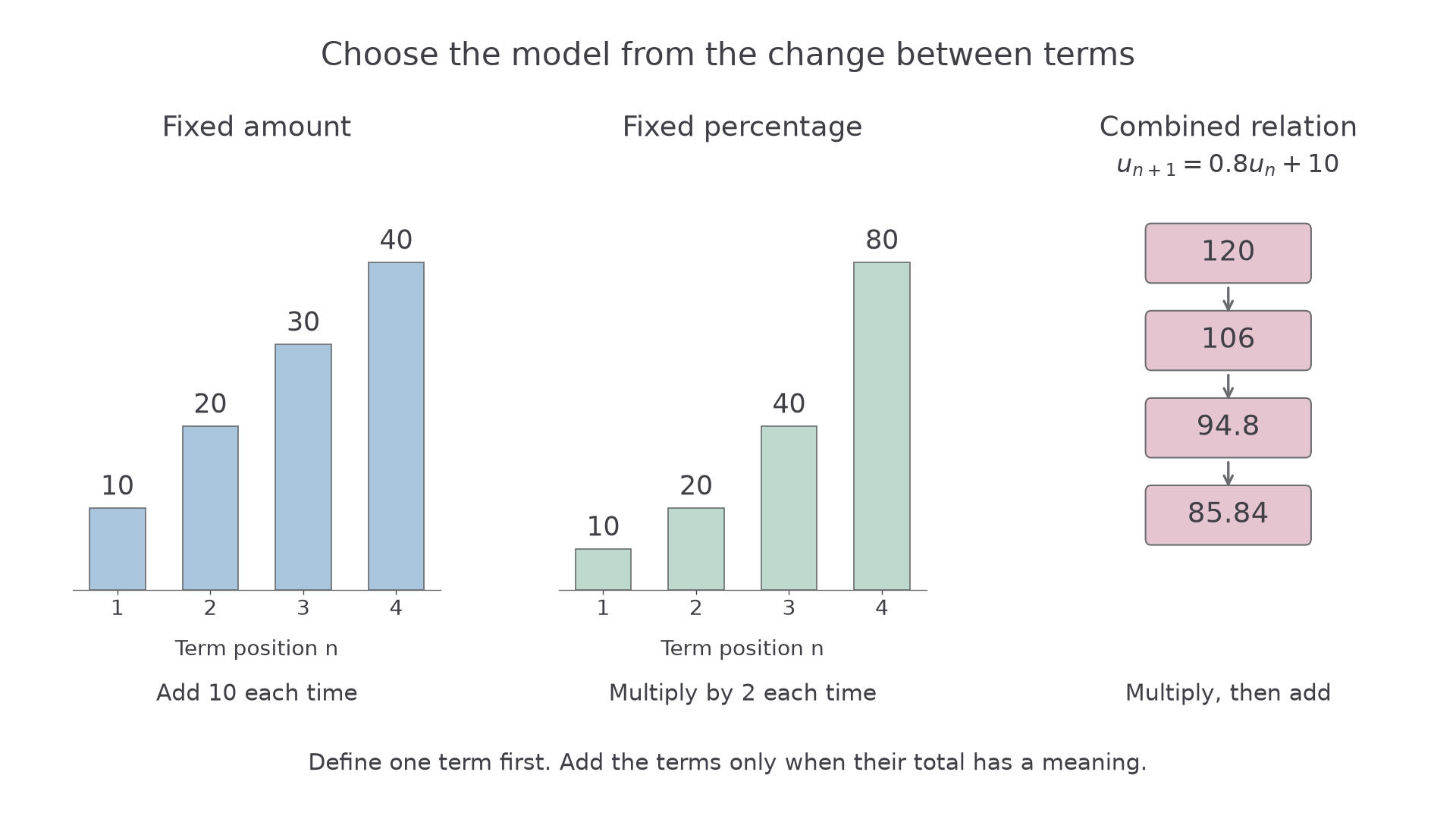
For a percentage , an increase uses and a decrease uses . These multipliers follow from the meaning of a percentage; they are not separately supplied in the formula booklet. The machine's rule combines multiplication and addition, so it is not generally a geometric sequence.
Key idea
Define the quantity and its timing first. Then translate fixed amounts into addition, fixed percentages into multiplication, and combined changes into the stated recurrence.
Decide which rule actually matches a percentage increase.
Arithmetic models for fixed changes
For deposits increasing by each month, the change is measured in pounds, not a percentage. An arithmetic model describes the deposits; it does not automatically include interest on the account balance.
The individual payment is , a recall formula that is not supplied in the booklet. The supplied result computes the total.
Arithmetic payment total
If the first payment is , the fixed change is , and there are payments,
Use the model only while the payment amounts fit the context. Here is the first payment and is the fixed change.
In the formula booklet.
The first payment is already made at position , so the payment in month has undergone eleven increases.
Worked example 1: a payment and an accumulated total
Question. Nadia deposits in month , then more each month. Ignoring interest, find the month deposit and the total deposited over months.
Plan. Define as the deposit in month ; use a term for one payment and a sum for the total.
Why this step? is only the final deposit; includes every deposit.
Answer. The final deposit is ; the total deposited is .
Check. The mean deposit is pounds, and .
Change only the fixed monthly increase, from to . The term count stays unchanged.
Worked example 2: a larger additive increase
Question. Nadia instead deposits first and more each month. Find the month deposit and the total for months, ignoring interest.
Plan. Use the same indexing with .
Why this step? Changing the increase affects each later payment, not just the final one.
Answer. in month , and in total.
Check. The extra deposits over the first plan are , totalling ; .
A negative can model decreasing deposits, but the model ends before deposits become negative unless withdrawals have explicitly been allowed.
Watch out
Using for the twelfth deposit counts twelve changes. There are only eleven changes after the first deposit.
Find both quantities for a fresh arithmetic plan.
Geometric models for fixed percentages
A percentage increase acts on the current payment, so the amount added changes. A increase on is , but the next increase is of , not another .
The individual payment is , which is not in the formula booklet. For a total, use the supplied finite sum.
Geometric payment total
For first payment , fixed ratio and ,
This is an equivalent form of the supplied geometric sum. Use if .
In the formula booklet.
A payment made in year experiences increases by year . An initial balance at time , however, experiences increases by time ; define timing before choosing the exponent.
Worked example 3: percentage growth in annual pledges
Question. A charity pledge is in year , increasing by each year. Find the year pledge and the total pledged over the first years, to the nearest pound.
Plan. Use , seven increases for the eighth pledge, and eight terms for the total.
Why this step? The term exponent is , while the sum formula uses ; they perform different jobs.
Answer. in year , and in total.
Check. Eight increasing pledges lie between and pounds; the total does too.
Change only the annual growth rate, to . Each exponent still counts the same number of increases.
Worked example 4: a lower percentage increase
Question. The first pledge is still , but it increases by annually. Find the year pledge and first-eight-year total, to the nearest pound.
Plan. Replace the multiplier by , retaining the term and sum structure.
Why this step? Halving the percentage does not halve the total: the original payment remains part of every term.
Answer. in year , and in total.
Check. Both outputs are smaller than in the plan, but exceed the constant-payment amounts and , respectively.
These models assume the percentage applies at each stated interval and that payments follow the rule before final rounding. If each actual payment is rounded to pennies, calculate according to that explicitly stated rule instead.
Watch out
A increase uses ; a decrease uses . The number is only the changed fraction, not the retained amount.
Find a total under a new fixed-percentage rule.
Infinite and limiting models
Repeated outputs that shrink by a fixed percentage may have a finite total even if the model has infinitely many stages. Distinguish the limit of each output, which may be zero, from the limit of the accumulated total.
A limiting geometric total
If successive outputs form a geometric sequence with first term and , then
For positive physical outputs, normally and . A negative ratio needs a context where signed quantities make sense.
In the formula booklet.
The formula describes the consequence of continuing the assumptions indefinitely. It does not establish that real equipment will follow the rule forever.
Worked example 5: a finite total from repeated shrinking outputs
Question. A tap releases in the first minute. Each following minute releases of the preceding minute's amount. Find the model's total release over all minutes.
Plan. Treat the minute-by-minute amounts as terms and sum the convergent geometric series.
Why this step? The term is the amount released during a minute, so adding terms gives total water released.
Answer. , according to the model.
Check. The first two minutes release ; the limiting total is larger, as it must be.
Change only the retained percentage, from to . Slower shrinkage produces a larger total.
Worked example 6: slower decay
Question. The first-minute release remains , but each later minute releases of the previous amount. Find the limiting total.
Plan. Use in the convergent sum.
Why this step? A smaller fractional loss leaves more water in every later term.
Answer. .
Check. Every term after the first is greater than in the model, so its total must exceed .
A realistic limitation is that individual drops have a non-zero size, so eventually a smoothly shrinking minute-by-minute rule becomes unsuitable. This is a specific physical reason, not just the vague claim that “models are inaccurate”.
Watch out
The limiting output and limiting total are different: in the first model, the minute's amount tends to , while the accumulated amount tends to .
Try another decaying-output model.
Models defined by a relation
A supplied formula can describe a model that is neither arithmetic nor geometric. For example, daily use grams gives for the first four days, totalling grams. The differences and ratios both change, so use the formula itself rather than forcing a standard series formula onto it.
For the opening machine, daily use follows . The reduction models the variable use, while is the additional daily cleaning requirement. The operations occur in that order.
Relation-defined model
A relation-defined model gives a rule linking successive quantities, together with an initial quantity and its timing. A combined rule such as is generally neither arithmetic nor geometric: it combines a fixed multiplier with a fixed addition.
Generate one term at a time. Only sum terms if each term describes a separate quantity to be accumulated.
Worked example 7: generating daily use and its total
Question. A machine uses grams of chemical on day , where and . Find total use over the first four days.
Plan. Generate three later daily amounts, then add all four daily uses.
Why this step? The additive means a geometric-sum formula cannot be applied directly to .
Answer. .
Check. Four decreasing daily uses between and grams give a total between and grams.
Change only the first day's use. The machine follows the same update rule.
Worked example 8: changing the initial quantity
Question. With the same recurrence but , find the total use over the first four days.
Plan. Restart the recurrence at the new initial value, then add the generated amounts.
Why this step? A recurrence retains the effect of its starting value through every later term.
Answer. .
Check. The difference between the two models' daily uses is , which totals .
Here is the surprise that answers our opening question. The daily use does not tend to zero. The unchanged value solves , giving . More than a guess, the exact relation
shows that deviations from form a geometric sequence. From the original start,
The daily use approaches . Consequently, the total use over indefinitely many days does not have a finite limit: the daily terms do not tend to zero.
Watch out
Adding after the reduction gives . Adding it before the reduction gives , a different model.
Generate a new combined recurrence carefully.
Interpret and check the model
A model's answer must describe the quantity asked for, over the correct interval and with sensible units. A larger final payment alone does not imply a larger total: payments total , while payments total , despite the smaller final payment.
For counts such as tickets sold, the model can produce non-integer intermediate expectations. Keep these unrounded until the requested final rounding, unless the model explicitly rounds each period. A limitation should connect a concrete assumption to the situation.
Worked example 9: a count model and its limitation
Question. A theatre models weekly season-ticket sales by in week , decreasing by each following week. Estimate total sales in eight weeks, to the nearest ticket, and state one limitation.
Plan. Sum eight terms with , then interpret the rounded output.
Why this step? Sales in week alone are not the total sold by the end of week .
Answer. About tickets. The assumed decrease may fail if a promotion changes demand.
Check. The total exceeds the first week's and is below the infinite model total .
Change only the weekly decrease, to . The period count and initial sales remain the same.
Worked example 10: interpreting a slower decrease
Question. The theatre instead models a weekly decrease from the same first-week sales. Estimate the eight-week total and state one limitation.
Plan. Use the revised multiplier and give a contextual conclusion.
Why this step? A smaller percentage decrease leaves more sales in every later week.
Answer. About tickets. A fixed percentage decline may be unsuitable when the remaining available tickets restrict sales.
Check. The total exceeds the -decrease prediction , as expected.
Our machine's limit has the same interpretive lesson: it is a daily use, not a finite lifetime total. The cleaning requirement keeps every day's use above that baseline in the original model.
Exam tip
State what the computed value measures. Give a specific limitation, such as changing demand, finite stock or indivisible drops, rather than merely saying that a model is unrealistic.
Translate, sum and interpret a new sales model.
Quick Recap
- Define one term and its timing before choosing a formula.
- Fixed additive changes give arithmetic models; fixed percentage changes give geometric models.
- Sum separate payments or outputs, rather than repeated snapshots of one balance.
- A combined recurrence generally needs direct iteration; check operation order and the starting value.
- Interpret units, valid term counts, rounding and the consequences of assumptions.
The opening machine does not approach zero daily use: its cleaning addition makes the daily amount approach .