Mechanics 7.3 - Constant acceleration formulae
Derive the constant-acceleration formulae from a velocity-time graph, then use them in straight-line and two-dimensional motion. You will choose equations, preserve vector components and distinguish displacement from position and speed.
Derive the straight-line formulae
How can a particle have the same displacement after and , yet travel further during the longer interval? Start with velocity and constant acceleration . A reversal will explain the puzzle.
You already know
A velocity-time gradient gives acceleration and signed area gives displacement. State a positive direction before assigning signs.
The five scalar quantities are displacement , initial velocity , final velocity , constant acceleration and elapsed time . They refer to the same interval. Constant acceleration means equal velocity changes in equal times, so the velocity-time graph is straight.
[DIAGRAM: asset_slug: p3_7_3_understand_and_use_formulae_for_constant_acceleration_including_2d__diagram_01; asset_name: Deriving constant-acceleration formulae; caption: Gradient gives velocity change and trapezium area gives displacement; description: A velocity-time line from u to v over time T has a rectangle uT and triangle one half times v minus u times T, with separately spaced derivation equations.]
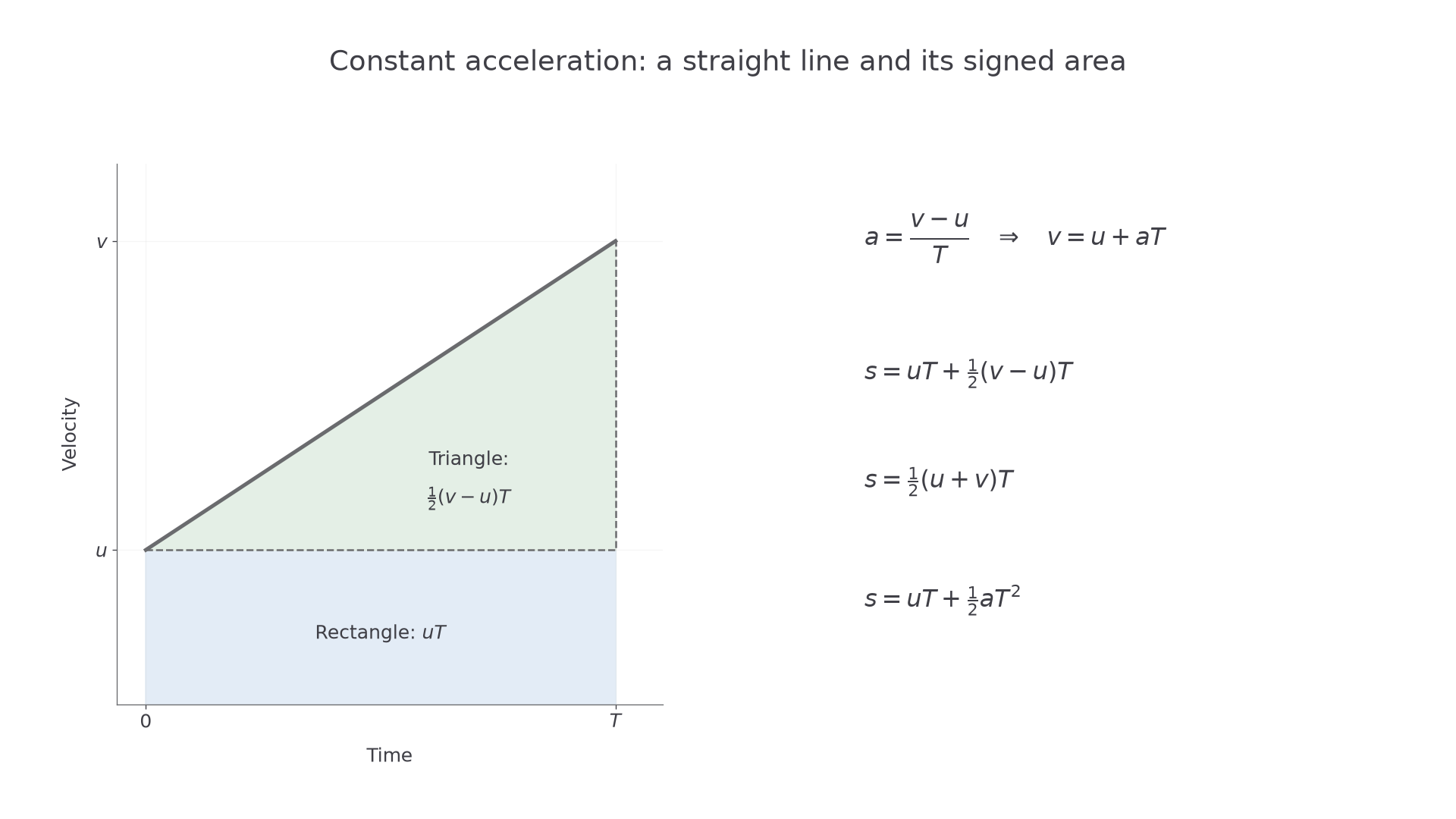
Its gradient and signed area give
Thus . Substitution into the area gives ; substituting instead gives . To eliminate time without dividing by , multiply the area equation by :
This also works when . Signed area keeps the derivation valid if the graph crosses the axis.
Straight-line constant acceleration
Acceleration must be constant on the interval; all signed quantities use one positive direction. In the formula booklet.
The equations are consequences of one graph. Practise choosing one that avoids an unneeded unknown.
Worked example 1: eliminate time
Question. A particle has , and displacement . Find its final speed.
Plan. Use the equation without time.
Answer.
Why take the positive square root? Speed is nonnegative. Here velocity is also positive because the acceleration increases an already positive velocity.
Check. gives .
Change only the displacement from to .
Worked example 2: the same equation, further travel
Question. With the same and , find final speed after displacement .
Plan. Use again.
Answer.
Why not find time first? It adds an unnecessary equation.
Check. , and .
Use the same choice with a new displacement.
Use SUVAT in one dimension
List the known quantities and the requested one before choosing a formula. Signs describe directions; a negative acceleration does not force a negative displacement.
Worked example 3: before reversal
Question. A particle has initial velocity and constant acceleration . Find velocity and displacement after .
Plan. Use the equations with known .
Answer.
Why retain the negative acceleration? It represents acceleration opposite to the chosen positive direction.
Check. Average velocity is ; multiplying by gives .
Change only the elapsed time to , allowing the model to continue through the reversal.
Worked example 4: beyond reversal
Question. For the same particle, find velocity, displacement and total distance after .
Plan. Find the turning time, then add the outward and return distances.
Answer.
Why does the longer interval give the same displacement? The particle passes on its way out and again on its way back.
Check. The signed trapezium area is , agreeing with displacement.
That is the opening puzzle resolved. In general, a constant nonzero acceleration does not stop acting just because velocity reaches zero; the particle then reverses if the model continues.
Watch out
Find any reversal before calling displacement a distance. Over an interval containing a reversal, add the magnitudes of the separate displacements.
Change only the elapsed time again.
Extend SUVAT to vectors
Two-dimensional motion uses the same scalar time in both perpendicular components. If and , then . The two entries can equally be written as a column vector.
[DIAGRAM: asset_slug: p3_7_3_understand_and_use_formulae_for_constant_acceleration_including_2d__diagram_02; asset_name: Vector displacement and its components; caption: One vector calculation is two component calculations at the same time; description: A starting point A and later position P define displacement s with horizontal and vertical component legs, alongside separated component equations for vector constant acceleration.]
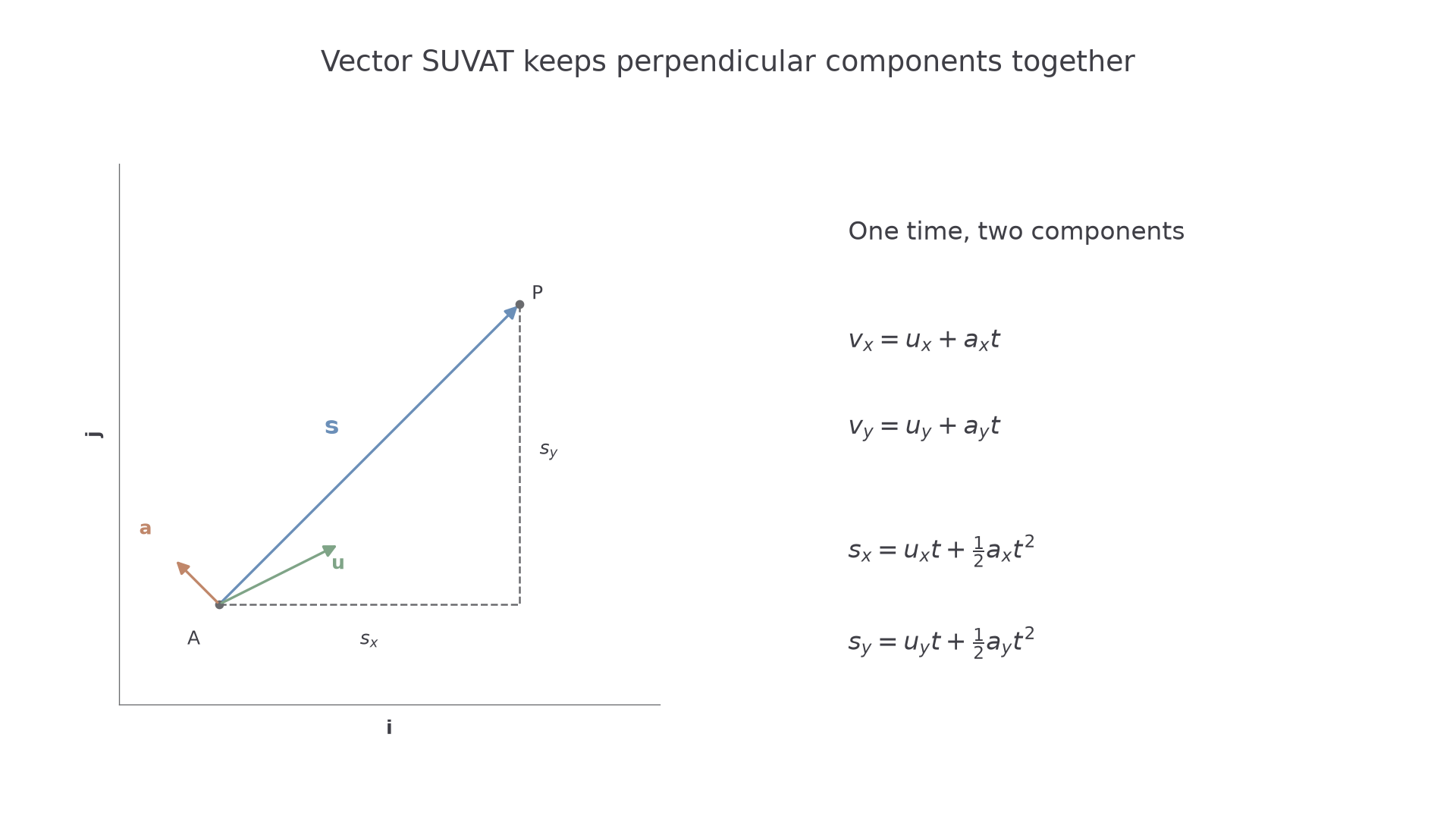
Apply the scalar equations separately to the components and recombine them.
Vector constant acceleration
The vector must be constant. These componentwise extensions and the position relation are not printed as vector formulae. Not in the formula booklet: learn it.
The scalar formula cannot be converted into a vector equation by making every symbol bold. Use components instead.
Worked example 5: vector velocity and displacement
Question. Given and , find velocity and displacement after .
Plan. Multiply each component by the same scalar time.
Answer.
Why keep the components separate? They can have different signs and different accelerations.
Check. .
Continue this lesson.
You’re previewing NovaLearn without an account. Create a free account to read the rest.
Create free account