Pure 5.6 - Compound and double angles, half-angles and R-form
Use and understand compound-angle formulae, derive double-angle and half-angle results, and combine sine and cosine into one shifted wave. You will use geometry to justify the formulae and solve equations on a stated interval.
Compound Angle Meaning
Can ever reach ? Each term has its own maximum, but they do not reach those maxima together. At , the sum is ; at , it is . We will find its actual maximum by turning the two terms into one wave.
First, we need to understand functions of a sum of angles. For example, , whereas . Sine does not distribute over addition.
You already know
, and . Also where .
The whole input to the function matters: is the sine of one angle.
Compound angle
A compound angle is a sum or difference of angles, such as or . In general, .
The correct expansion mixes the sine and cosine of both angles.
Compound-angle formulae
For all real angles and , measured in the same unit,
Also,
where , and exist, so the displayed denominator is non-zero.
In the formula booklet.
Use known exact angles to build a less familiar angle. The sine formula keeps the sign of the angle operation; the cosine formula reverses it.
Worked example 1: an exact sum
Question. Find the exact value of .
Plan. Split into , then use the sine addition formula.
Why this split? Both component angles have exact values you know.
Answer. .
Check. The value is about , between and , as expected.
Change only addition to subtraction in the input. The second term changes sign too.
Worked example 2: an exact difference
Question. Find the exact value of .
Plan. Write and keep the subtraction sign.
Why keep the formula visible? It prevents an accidental plus sign inherited from the previous example.
Answer. .
Check. This is about , positive and below .
The tangent formula works the same way: . Rationalising the denominator gives the exact result.
Watch out
Wrong: . The plus sign inside cosine produces a minus sign between the products. Right: .
Try another difference of known angles, this time using .
Deriving the compound-angle formulae
The six formulae come from one geometrical comparison: calculate the same chord in two ways. Take points and on a unit circle.
[DIAGRAM: asset_slug: p1_5_6_understand_and_use_double_angle_formulae__diagram_01; asset_name: One chord measured by an angle and by coordinates; caption: Two calculations of the same squared chord produce the cosine difference formula; description: Unit circle with non-special angles A and B, chord PQ, radii of length 1 and the angular difference marked. A separate coordinate panel labels P and Q and compares the cosine-rule and coordinate-distance expressions for PQ squared.]
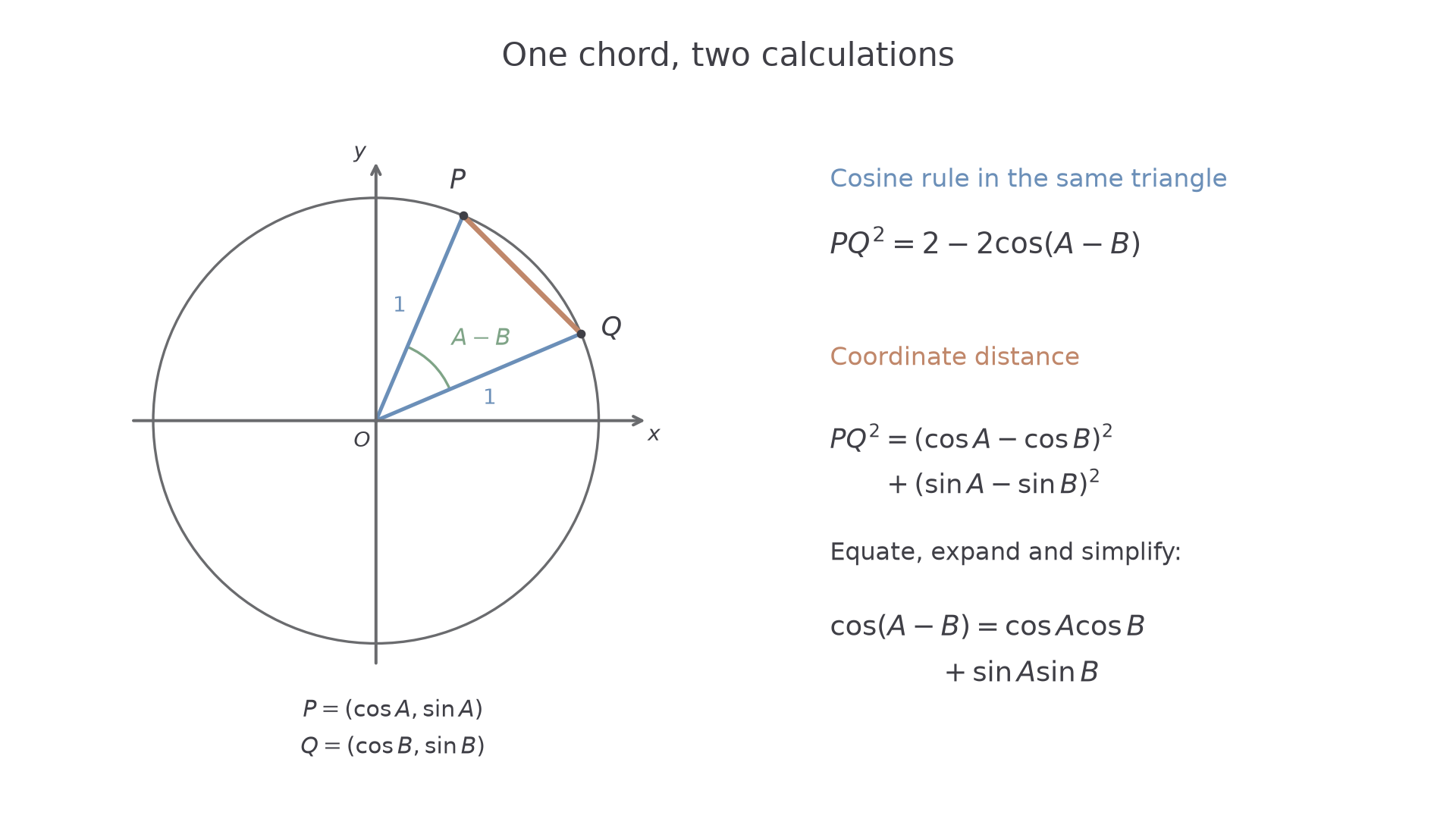
The cosine rule in triangle gives
For arbitrary directed angles, the smaller angle between the radii has the same cosine as : reflection changes the sign, and full turns change neither point. The coincident-point and diameter cases follow directly too.
Coordinate distance gives a second expression:
Equating these expressions and cancelling proves
From cosine difference to all six formulae
Cosine is even and sine is odd. Replace by :
For sine addition, use complementary angles; the following working uses radians:
Here and . Replacing by now gives . In degrees, replace by .
Finally, divide the sine formula by the cosine formula:
This last step requires , as well as a non-zero original denominator. Replacing by gives the tangent subtraction formula, since . Geometry has justified cosine difference; parity, complements and the quotient have justified every other case. The formulae are supplied, but understanding this derivation is still part of your work.
For example, expanding both terms proves the useful identity
The terms cancel; this is an identity for every real , not an equation selecting some angles.
Key idea
One chord proves cosine difference; parity gives cosine sum, complements give sine, and sine divided by cosine gives tangent with its additional restrictions.
Check the exact step that needs a restriction.
Double Angle Formulae
A double angle is the special compound angle . At , for instance, . Setting proves the general sine result.
Similarly, . Substituting , or the corresponding cosine expression, produces two more forms. These alternatives are useful choices, not extra facts from nowhere.
Double-angle formulae
For all real ,
Putting in tangent addition also gives
where exists and . These follow from supplied compound-angle formulae but are not separately printed.
Not in the formula booklet: learn it.
Look at the neighbouring terms before choosing a cosine form. A numerator points towards sine squared.
Worked example 3: choose a sine-square form
Question. Prove on the common domain.
Plan. Replace the numerator by and the denominator by .
Why this form? It immediately supplies a factor of the denominator. The original denominator requires .
Answer. The identity holds wherever both original expressions are defined.
Check. At , both sides equal . This checks the algebra, rather than replacing the proof.
Change only the numerator's minus sign to a plus. Now cosine squared is the useful form.
Worked example 4: choose a cosine-square form
Question. Prove on the common domain.
Plan. Use , then cancel factors.
Why change the form? Using here would hide the factor we need.
Answer. The identity is proved on the common domain.
Check. At , both sides equal .
At , exists but does not; the rational tangent formula cannot be used at that input.
Watch out
Wrong: . Right: . Doubling an angle changes the function's input, not just its output.
Now choose forms that expose a common factor rather than a fraction.
Solving With Double Angles
An equation with and becomes a quadratic in cosine. Use ; if the other term is sine, use instead.
You already know
Solve each factor of a quadratic separately. A value of is not yet an angle, and a value outside gives no real angle.
The first example retains a boundary solution, so the endpoint symbols matter.
Worked example 5: a quadratic in cosine
Question. Solve for , giving inexact angles to decimal place.
Plan. Replace , factorise in , then find every angle.
Why solve both branches? Cancelling would lose . For , cosine's two angles are and .
Answer. . The endpoint is excluded.
Check. At , the original left side is . At , it is .
Change only the sign of the single-angle term. The quadratic roots and their quadrants change.
Continue this lesson.
You’re previewing NovaLearn without an account. Create a free account to read the rest.
Create free account