Pure 10.2 - Magnitude, direction and component form
Components tell you how to move along the axes; magnitude and direction tell you the length and orientation of the same movement. You will convert between these descriptions, choose the correct quadrant for an angle, and use a unit vector to build a vector of a required length. The methods work in space as well as on a flat diagram.
Components Mean Movement
Does moving three units right and four units up put you seven units from where you started? The route along the axes has length seven, but the direct arrow is the hypotenuse of a right-angled triangle. Its length is five.
You already know
Pythagoras gives in a right-angled triangle. Vector components are signed changes along perpendicular coordinate axes.
The vector records both changes. Its magnitude records just the direct length.
[DIAGRAM: asset_slug: p1_10_2_calculate_magnitude_and_direction_and_convert_between_component_and_magnitude_direction_forms__diagram_01; asset_name: Components and the direct vector length; caption: The component route has length seven but the vector has magnitude five; description: A right-angled component triangle from the origin to (3, 4), with horizontal component 3i, vertical component 4j, diagonal magnitude 5 and an angle measured anticlockwise from the positive x-axis]
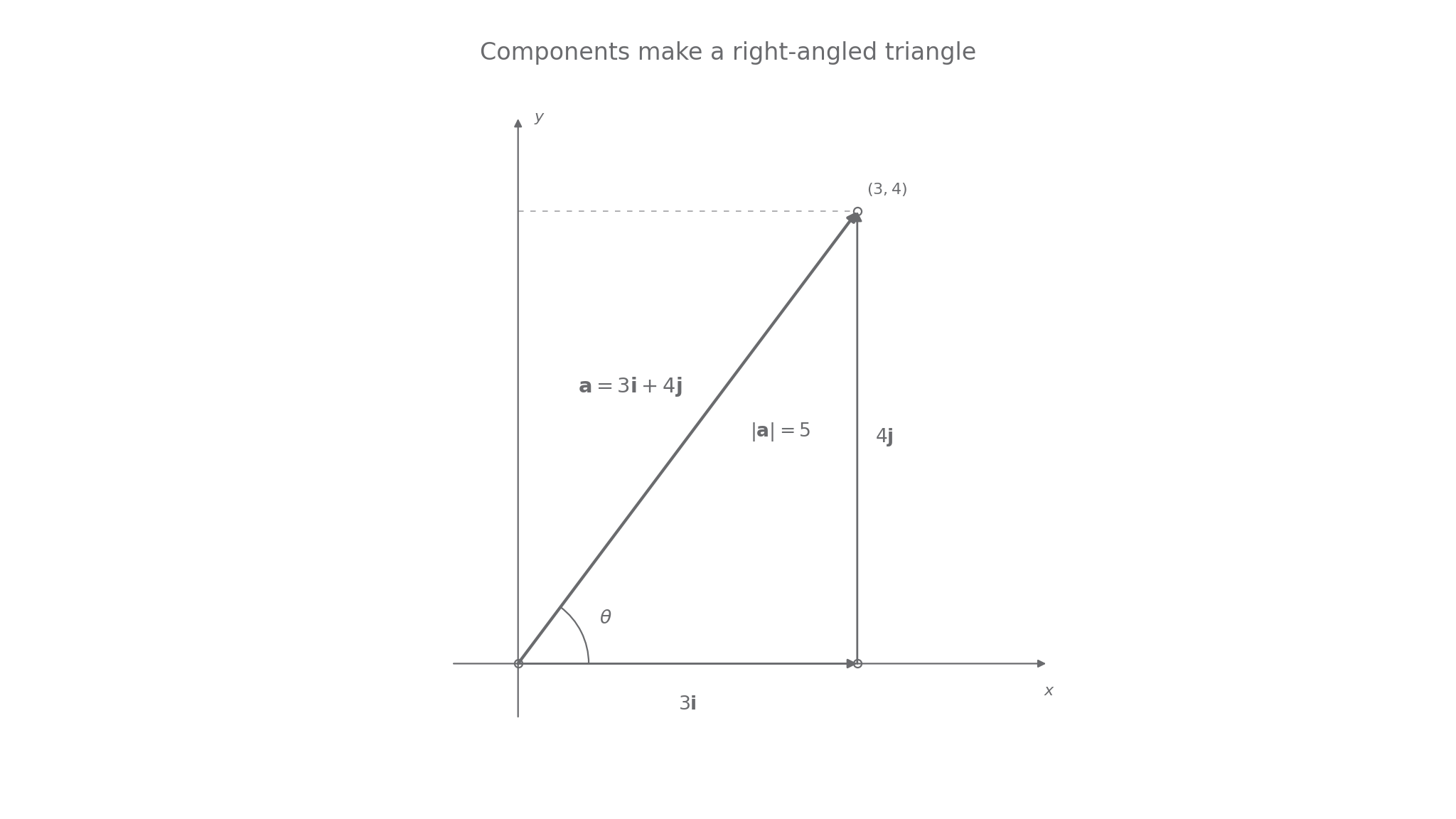
A magnitude is always non-negative, even when some components are negative.
Magnitude
The magnitude of a vector is its length. It is a scalar. Only the zero vector has magnitude zero; its direction is undefined.
Pythagoras gives the two-dimensional result. In three dimensions, first find the length of the projection in the -plane, then use Pythagoras again with the perpendicular -component. Thus the three squared components add.
Magnitude from components
For real components relative to perpendicular unit axes,
Not in the formula booklet: learn it.
There is a neat spatial version of the opening puzzle: three perpendicular one-unit steps have total route length three, but their resultant has magnitude . Even with every component positive, adding component lengths is not the magnitude rule.
Key idea
Square the signed components, add the squares, then take the non-negative square root.
Test that distinction on a new triangle.
From Components to Magnitude and Direction
To find a direction, decide which quadrant the signed components describe before using inverse trigonometry. Here we report anticlockwise directions in , unless a question specifies another convention. For instance, points left and up, so its anticlockwise direction from positive must lie between and .
Direction from components
For a nonzero planar vector , an angle from the positive -axis satisfies
Use the signs of both components to choose the quadrant. When , read the vertical direction directly.
Not in the formula booklet: learn it.
A reference angle from is acute. The required direction may not be acute.
Worked example 1: a quadrant-II direction
Question. Find the magnitude and direction of . Measure direction anticlockwise from positive , to one decimal place.
Plan. Use Pythagoras for length and subtract the acute reference angle from .
Why this step? A negative horizontal component and positive vertical component put the arrow in quadrant II, so itself cannot be the answer.
Answer. Magnitude , direction .
Check. and , using the unrounded angle.
Change only the vertical sign in the second example. The magnitude is unchanged, but the direction moves to quadrant III.
Worked example 2: a quadrant-III direction
Question. Find the magnitude and anticlockwise direction from positive of , to one decimal place.
Plan. Keep the same reference triangle and add its acute angle to .
Why this step? Both components are negative, so the arrow points left and down.
Answer. Magnitude , direction .
Check. Both the cosine and sine of are negative, giving the required component signs.
On an axis there is no acute reference triangle. A nonzero upward vector has direction , a downward one , a leftward one , and a rightward one . A quadrant-IV vector such as has direction , to one decimal place.
Watch out
Wrong: “, so points at .” That angle points right and down. Right: use the quadrant to obtain .
In this check both components are negative again, but the triangle changes.
From Magnitude and Direction to Components
Now start with the arrow's length and direction. A vector of length ten at has negative horizontal component and positive vertical component .
[DIAGRAM: asset_slug: p1_10_2_calculate_magnitude_and_direction_and_convert_between_component_and_magnitude_direction_forms__diagram_02; asset_name: Resolving a known magnitude and direction; caption: Cosine and sine supply the component sizes and their signs; description: A general vector with components R cos theta and R sin theta, alongside a quadrant-II vector of magnitude 10 at 120 degrees with components minus 5 and 5 root 3]
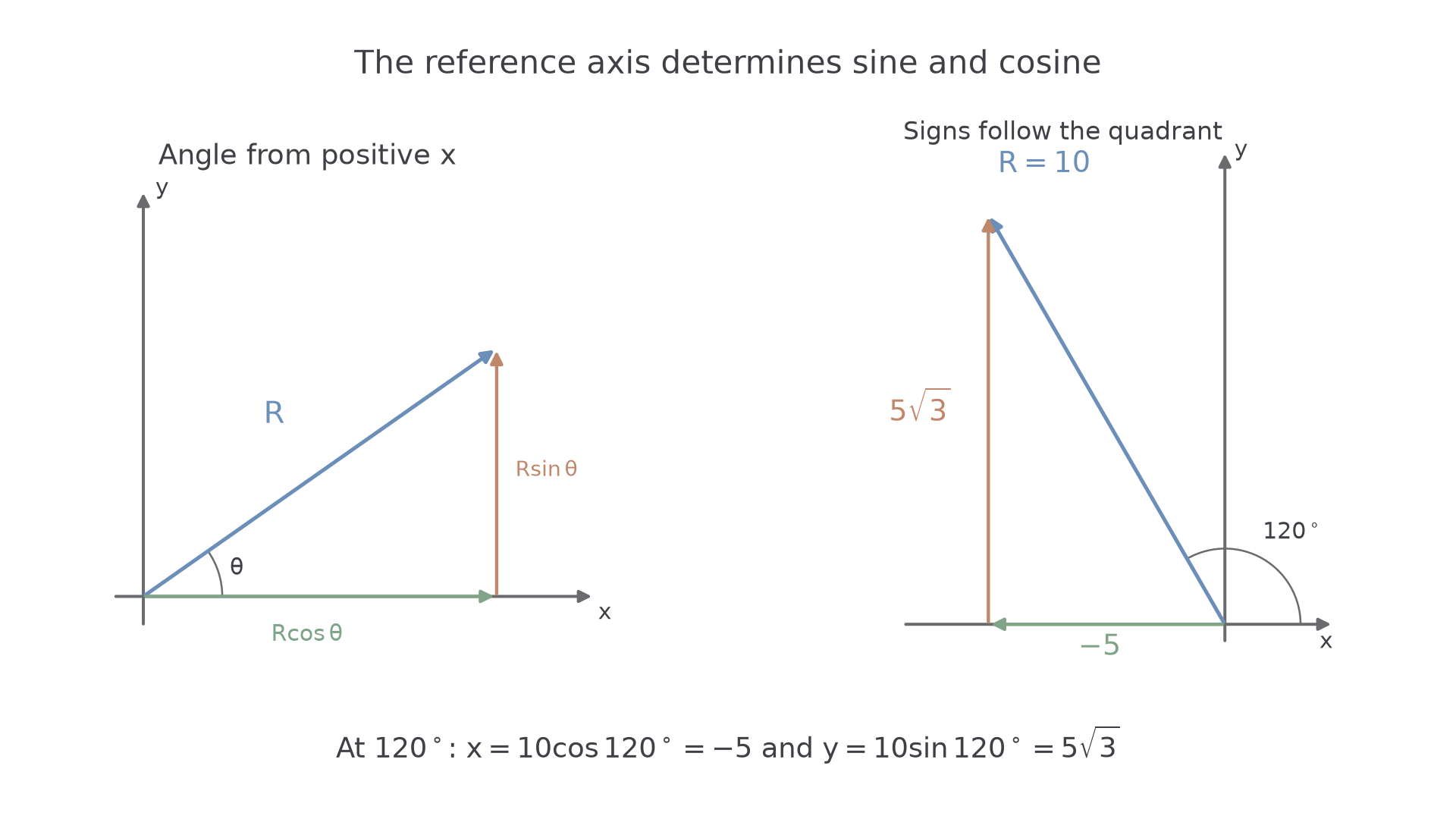
The choice of sine or cosine depends on the axis from which the angle is measured.
Components from a direction angle
If and is measured anticlockwise from positive ,
If instead an acute angle is measured east of north, the east component is and the north component is .
Not in the formula booklet: learn it.
Identify the reference axis before substituting. A bearing is measured clockwise from north, so east/north components of a bearing are also and , with their signs supplied by the angle.
Continue this lesson.
You’re previewing NovaLearn without an account. Create a free account to read the rest.
Create free account