Pure 5.3 - Sine, cosine and tangent functions
Build exact trigonometric values from two triangles, then use signs, symmetry and periodicity to reach any angle. Read the key features of the three graphs and see how a shift or a change of scale affects them.
Unit-circle meaning and exact values
Why does simply move sideways, while fits twice as many repeats into the same interval? We will read both graphs at the end. Begin with a smaller puzzle: why are and exactly equal?
You already know
The unit-circle point at angle is . Tangent is where . A half-turn is radians or .
Cut an equilateral triangle of side in half. Its right-triangle sides are , , , since the height is . A right-angled isosceles triangle with legs has hypotenuse . These two triangles generate all the special acute values below.
[DIAGRAM: asset_slug: p1_5_3_understand_and_use_the_sine_cosine_and_tangent_functions__diagram_01; asset_name: Exact-value triangles; caption: Two right triangles generate the special acute-angle values; description: A 30-60-90 triangle has sides 1, square root of 3 and 2. A 45-45-90 triangle has sides 1, 1 and square root of 2. Angles and sides are labelled separately.]
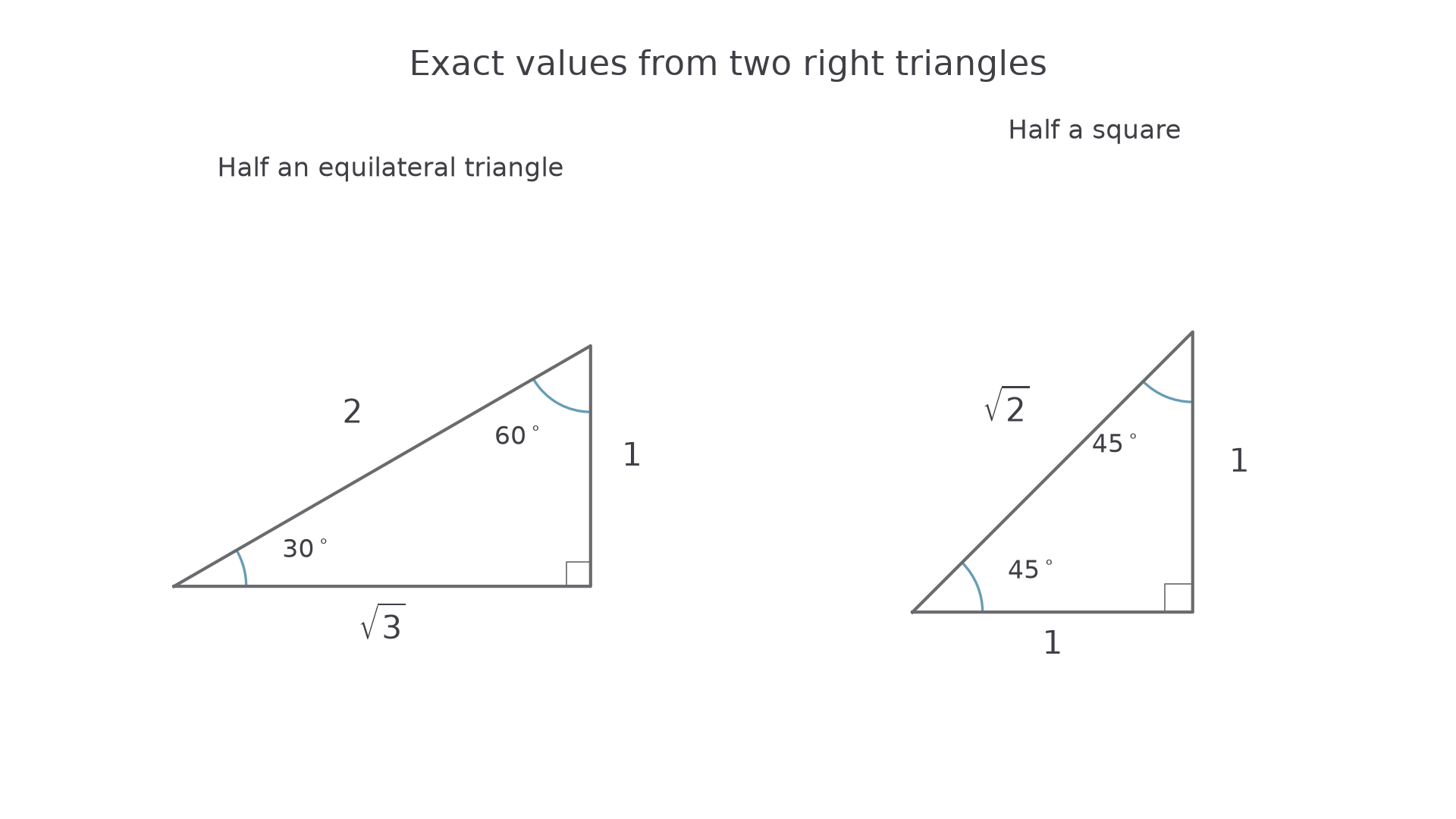
Exact trigonometric value
An exact value uses integers, fractions or surds without rounding. For example, is exact; is an approximation. Exact does not mean “a long calculator decimal”.
Use the triangle ratios for acute angles and the unit-circle coordinates for the endpoints. These values are not in the formula booklet: learn them.
| undefined |
Worked example 1: reading the special triangles
Question. Find , and exactly.
Plan. Use opposite over hypotenuse, adjacent over hypotenuse and opposite over adjacent.
Why this step? The two acute angles in a right triangle are complementary, so one angle's opposite side is the other's adjacent side.
Answer. , , , respectively.
Check. Both sine and cosine lie between and , and tangent is for equal legs.
Change only the acute angles to their complements. The opposite and adjacent roles swap.
Worked example 2: complementary acute angles
Question. Find , and exactly.
Plan. Read the same two triangles from the other acute angle.
Why this step? , while is its own complement.
Answer. , , , respectively.
Check. Dividing the sine by its cosine gives , the table's tangent.
Here is the surprising connection: swapping the two coordinates of a unit-circle point replaces by . That is why complementary sine and cosine values match; it is a reflection, rather than a numerical coincidence.
Watch out
Wrong: . Correct: it is undefined, since . A vertical asymptote is not a very large plotted value.
Use the same reference triangles with a different pair of acute angles.
Multiples and signs
At , the reference angle is , but the point lies in quadrant II. Sine stays positive and cosine becomes negative. A reference angle gives the magnitude; a quadrant gives the sign.
Reference angle
The reference angle is the acute angle between the terminal ray and the horizontal axis. For example, has reference angle ; has reference angle . Axis angles use their coordinates directly rather than an acute reference triangle.
In quadrant I all three functions are positive; in II only sine is positive; in III only tangent is positive; in IV only cosine is positive. These signs follow from horizontal and vertical coordinates, so you can reconstruct them if a mnemonic slips your mind.
Worked example 3: exact values outside quadrant I
Question. Find , and exactly.
Plan. Identify a reference angle and a sign for each value.
Why this step? Copying a first-quadrant value without its sign loses the actual coordinate or ratio.
Answer. , , , respectively.
Check. The first and third angles have negative vertical coordinates, agreeing with their sine or tangent signs.
Change only the quadrants while retaining the same reference angles in the same order.
Worked example 4: the same magnitudes with different signs
Question. Find , and exactly.
Plan. Reuse the special magnitudes and read the new quadrant signs.
Why this step? Tangent in quadrant III is positive because both sine and cosine are negative.
Answer. , , , respectively.
Check. .
A negative sign belongs to the value, not automatically to every angle greater than .
Watch out
Wrong: because the angle is “large”. Correct: quadrant IV has positive horizontal coordinate, so the cosine is .
Move the same reference angles to new quadrants once more.
Base graphs and symmetry
The cosine graph starts at , while sine starts at and rises. Tangent also passes through , but has breaks wherever its cosine denominator is zero. Those starting points help you distinguish the graphs immediately.
[DIAGRAM: asset_slug: p1_5_3_understand_and_use_the_sine_cosine_and_tangent_functions__diagram_02; asset_name: Base trigonometric graphs; caption: Sine and cosine repeat after a full turn; tangent after half a turn; description: Three aligned graphs show sine, cosine and tangent between minus 2 pi and 2 pi. The tangent graph has separate branches and dashed vertical asymptotes.]
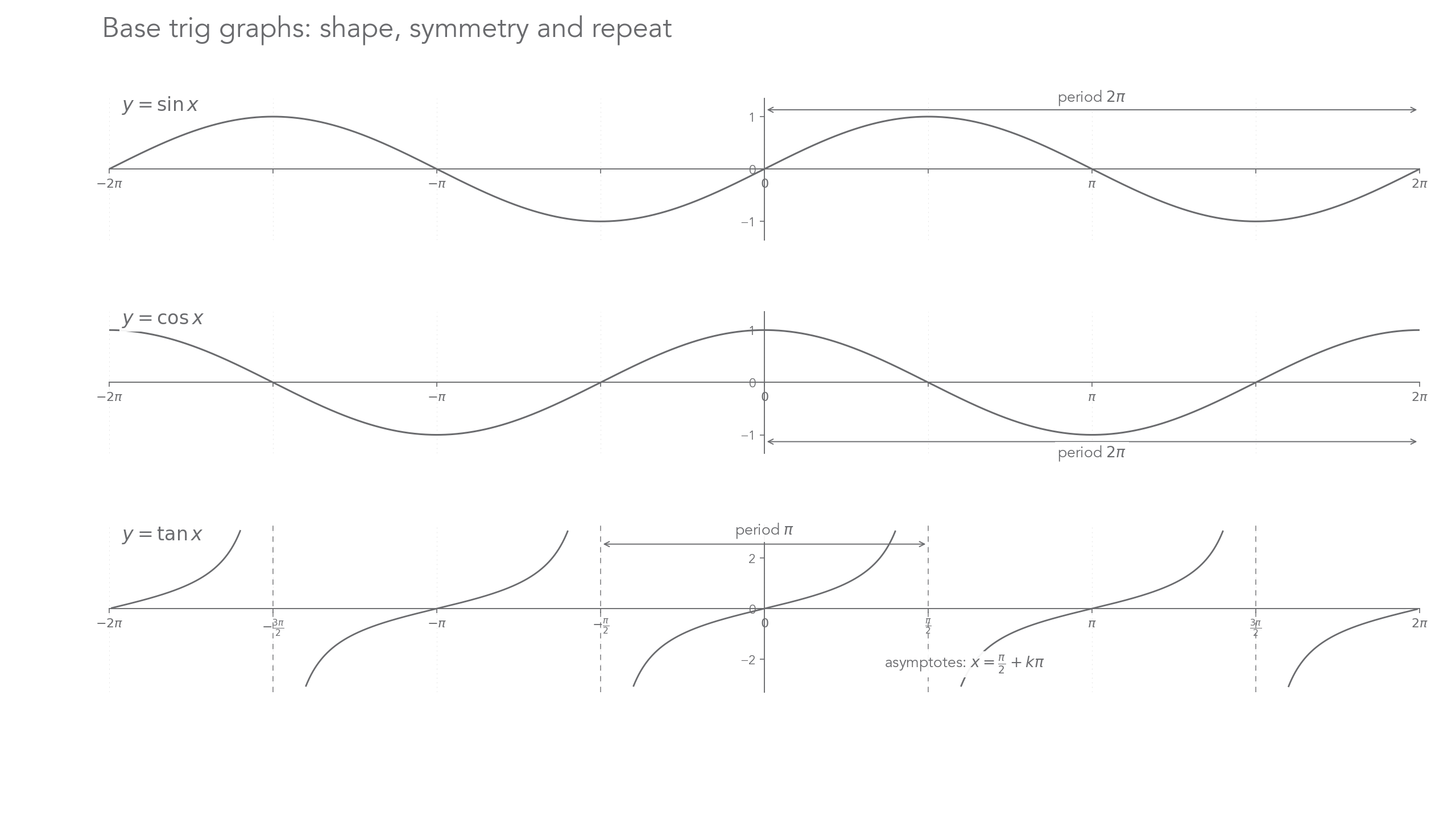
Period and symmetry
A period satisfies throughout the domain; the fundamental period is the smallest such positive repeat. An even function satisfies , giving reflection symmetry in the vertical axis. An odd function satisfies , giving half-turn symmetry about the origin.
Reflection in the horizontal axis changes the sine coordinate's sign but preserves cosine. Hence cosine is even, while sine and tangent are odd. Rotating a full turn restores both coordinates; a half-turn restores their ratio.
| Function | Domain | Range | Fundamental period | Zeros | Symmetry |
|---|---|---|---|---|---|
| or | odd | ||||
| or | even | ||||
| or | odd |
Here . Tangent's excluded inputs are vertical asymptotes. Sine and cosine attain maximum and minimum ; tangent has neither. These graph features and symmetry results are not separately supplied in the formula booklet: learn them.
Key idea
Use the graph's zeros, range, breaks and smallest repeat together; a single point does not identify a function.
Continue this lesson.
You’re previewing NovaLearn without an account. Create a free account to read the rest.
Create free account