Mechanics 8.2 - Newton's second law and resolving forces
Connect a force diagram to acceleration using Newton's second law. You will form signed equations along a straight line, work with perpendicular components and simple two-dimensional vectors, and choose useful axes for particles on smooth inclined planes.
Resultant force and acceleration
Can a particle moving right have an acceleration to the left? Start with a simpler force model: a particle has forces right and left. The resultant is right. Newton's second law tells us how that resultant changes the velocity; the particle's current motion does not decide the force direction.
You already know
Add forces as vectors. In one dimension, choose a positive direction and use signs. Zero resultant means constant velocity; a non-zero resultant changes velocity.
Mass measures how strongly the particle resists a given change in velocity. The same resultant produces half the acceleration when the mass is doubled.
Newton's second law
For a particle of constant mass ,
Use mass in , acceleration in and force in . Here we use constant forces and constant acceleration. Not in the formula booklet: learn it.
The left side is the resultant of all forces on the particle. The units agree because .
[DIAGRAM: asset_slug: p3_8_2_understand_and_use_newton_s_second_law_for_forces_in_straight_lines__diagram_01; asset_name: Mechanics 8.2 - Newton's second law and resolving forces - diagram 01; recommended_method: drawn_math; description: Draw a clean one-dimensional force diagram for a particle on a straight horizontal line. Show a positive direction arrow to the right, a rightward force of 18 N, a leftward force of 5 N, and rightward acceleration a. Include the equation 18 - 5 = 2a and the conclusion that the resultant force is 13 N to the right. Use spacious labels, real arrowheads, white background, and NovaLearn grey only.]
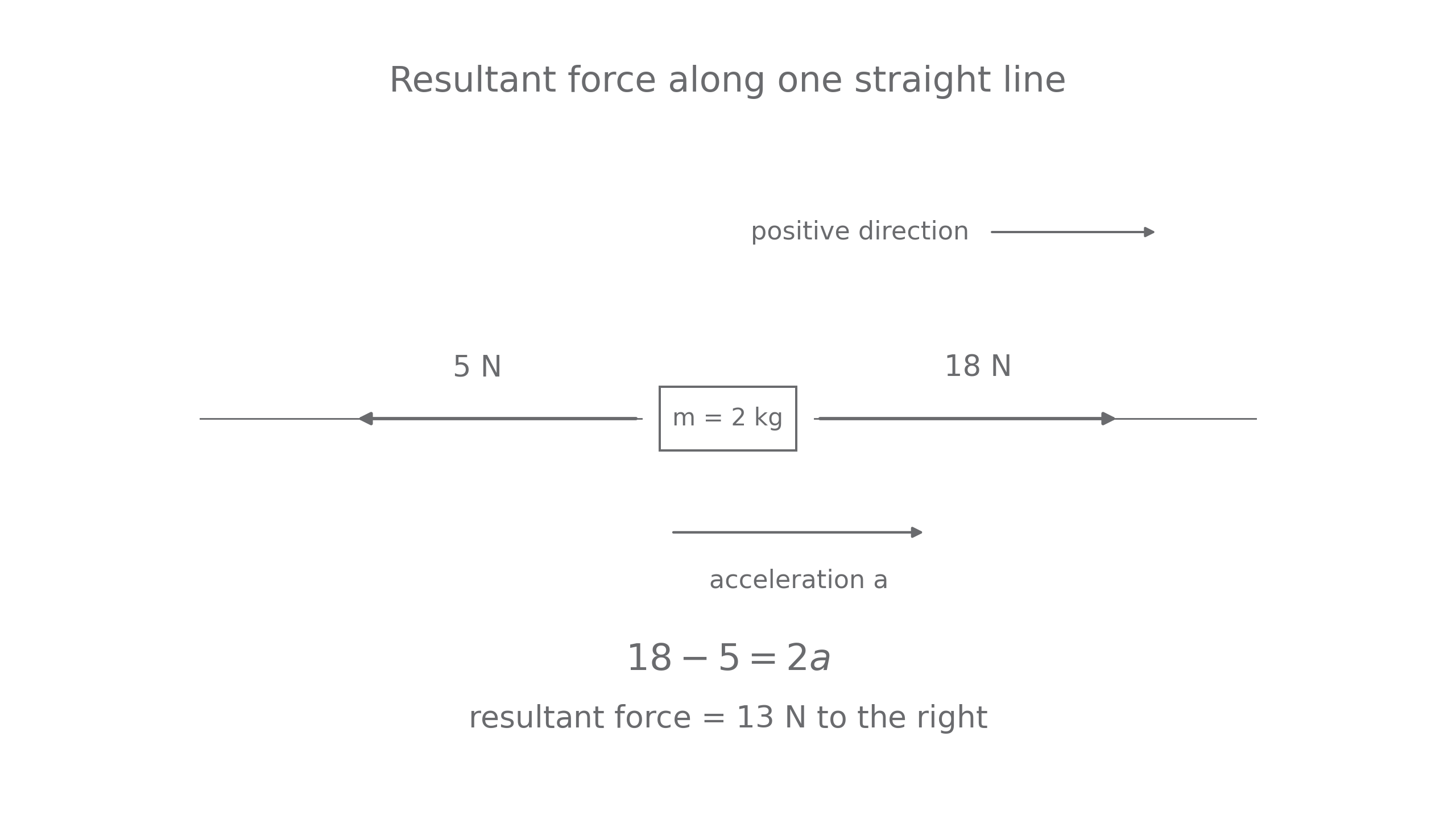
Translate the diagram into one complete equation before using the calculator.
Worked example 1: resultant then acceleration
Question. The only horizontal forces on a particle are right and left. Find its horizontal acceleration.
Plan. Take right as positive and divide the resultant by the mass.
Why use rather than ? The leftward force also acts on the particle.
Answer. to the right.
Check. , the signed resultant.
Change only the mass. This isolates why a force is not itself an acceleration.
Worked example 2: double the mass
Question. The same two forces act on a particle of mass . Find its horizontal acceleration.
Plan. Keep the resultant and change the mass in Newton's second law.
Why is the acceleration smaller? A larger mass needs a larger resultant for the same acceleration.
Answer. to the right.
Check. is half of , as the mass has doubled.
Keeping force and mass in their own units helps prevent an extra factor of gravity appearing.
Watch out
The equation is , not and not . Mass is ; multiplying it by would turn it into a weight.
Use a fresh force pair and mass.
Scalar equations in one direction
Signs describe the chosen axis, not whether the particle is speeding up. A negative acceleration is opposite to your positive direction. It slows a particle moving positively, but speeds a particle moving negatively.
Equation of motion
An equation of motion for a chosen particle and direction sets the signed resultant force in that direction equal to mass times the signed acceleration in that same direction.
Write the direction first, then include every force component along it.
Worked example 3: a positive acceleration
Question. A particle moves right along a horizontal line. A driving force of acts right and a resistance of acts left. Find its acceleration.
Plan. Take right as positive and subtract the resistance.
Why state the direction? The value means right only because right was chosen positive.
Answer. The particle accelerates right at .
Check. With left positive, gives , the same rightward acceleration.
Change only the resistance from to . The particle is still initially moving right.
Worked example 4: moving right, accelerating left
Question. A particle moves right. Its driving force is right and its resistance is left. Find its acceleration and describe its immediate motion.
Plan. Keep right positive, then interpret the acceleration relative to the velocity.
Why does it slow down? Its rightward velocity and leftward acceleration have opposite directions.
Answer. It accelerates left at , so it initially slows down.
Check. The resistance exceeds the drive by , consistent with a leftward resultant.
This answers our opening question: motion and acceleration can point in opposite directions. Keep the model only for the interval in which the force directions given still apply; resistance may reverse if motion reverses.
Exam tip
Show the full equation of motion. A negative acceleration needs a direction or a clear positive-axis statement; it is a physical conclusion, not an algebra error to remove.
Decide both the acceleration and its effect on the current motion.
Perpendicular component equations
An angled pull can affect two equations at once. A pull at above a horizontal plane has rightward component and upward component . Only the first belongs in the horizontal equation.
You already know
For a force of magnitude at angle above the horizontal, its components are horizontally and vertically. Weight is vertically downwards.
If a particle stays on a horizontal plane, its vertical acceleration is zero even while it accelerates horizontally.
Component equations
For perpendicular axes,
If the particle remains on a horizontal plane, ; a non-negative normal reaction must be consistent with contact. Not in the formula booklet: learn it.
Use in the following examples. A smooth surface supplies no friction.
Worked example 5: pulling above the horizontal
Question. A particle is pulled by at above a smooth horizontal plane. It remains on the plane. Find its horizontal acceleration and normal reaction.
Plan. Resolve horizontally for acceleration and vertically for reaction.
Why use two equations? The pull has two components, but horizontal acceleration does not create vertical acceleration.
Answer. , rightwards, and .
Check. The pull supports of the weight; , so contact is possible.
Now push at below the horizontal instead. The horizontal component is unchanged, while the vertical component reverses.
Worked example 6: pushing below the horizontal
Question. A particle is pushed by at below the horizontal, towards the right, on a smooth horizontal plane. Find its acceleration and normal reaction.
Plan. Reverse the sign of the vertical force component only.
Why is the reaction larger? The plane must support both the weight and the downward push.
Answer. , rightwards, and .
Check. The reaction increases by , twice the reversed vertical component.
That is a useful surprise: the same horizontal acceleration can accompany very different normal reactions. It follows exactly from the two independent component equations.
Watch out
Do not write for horizontal motion: those forces point in different directions. Resolve first and use one equation per direction.
Keep the downward component in the vertical equation here.
Vector form in i and j
Vector notation packages two component equations into one line. If the resultant is on a particle, then , so .
Continue this lesson.
You’re previewing NovaLearn without an account. Create a free account to read the rest.
Create free account