Pure 5.2 - Small angle approximations
Replace trigonometric expressions near zero by simple algebra, while keeping track of radians and the size of the whole angle. You will simplify quotients, estimate a small root and decide whether an approximation makes sense.
The local picture near zero
Could you estimate without pressing a trigonometric key? A tiny angle lets a quadratic do the job. First look at radians: its sine is , its tangent is , and its cosine is . Those values suggest two straight-line approximations and one quadratic.
You already know
Radian measure is arc length divided by radius. Convert degrees using ; radians. At zero, sine and tangent are , while cosine is .
On a unit circle, a small positive angle lies between its sine and tangent: for . The inner triangle, sector and outer tangent triangle give this comparison of areas. As the angle shrinks, all three squeeze together. Cosine is different: its graph is almost flat at height , so its first visible change is quadratic.
[DIAGRAM: asset_slug: p1_5_2_understand_and_use_the_standard_small_angle_approximations_of_sine_cosine_and_tangent__diagram_01; asset_name: Small-angle graphs; caption: Near zero, sine and tangent follow the line while cosine follows a shallow quadratic; description: Two panels compare sine and tangent with y equals x, and cosine with y equals 1 minus x squared over 2, on radian axes near zero.]
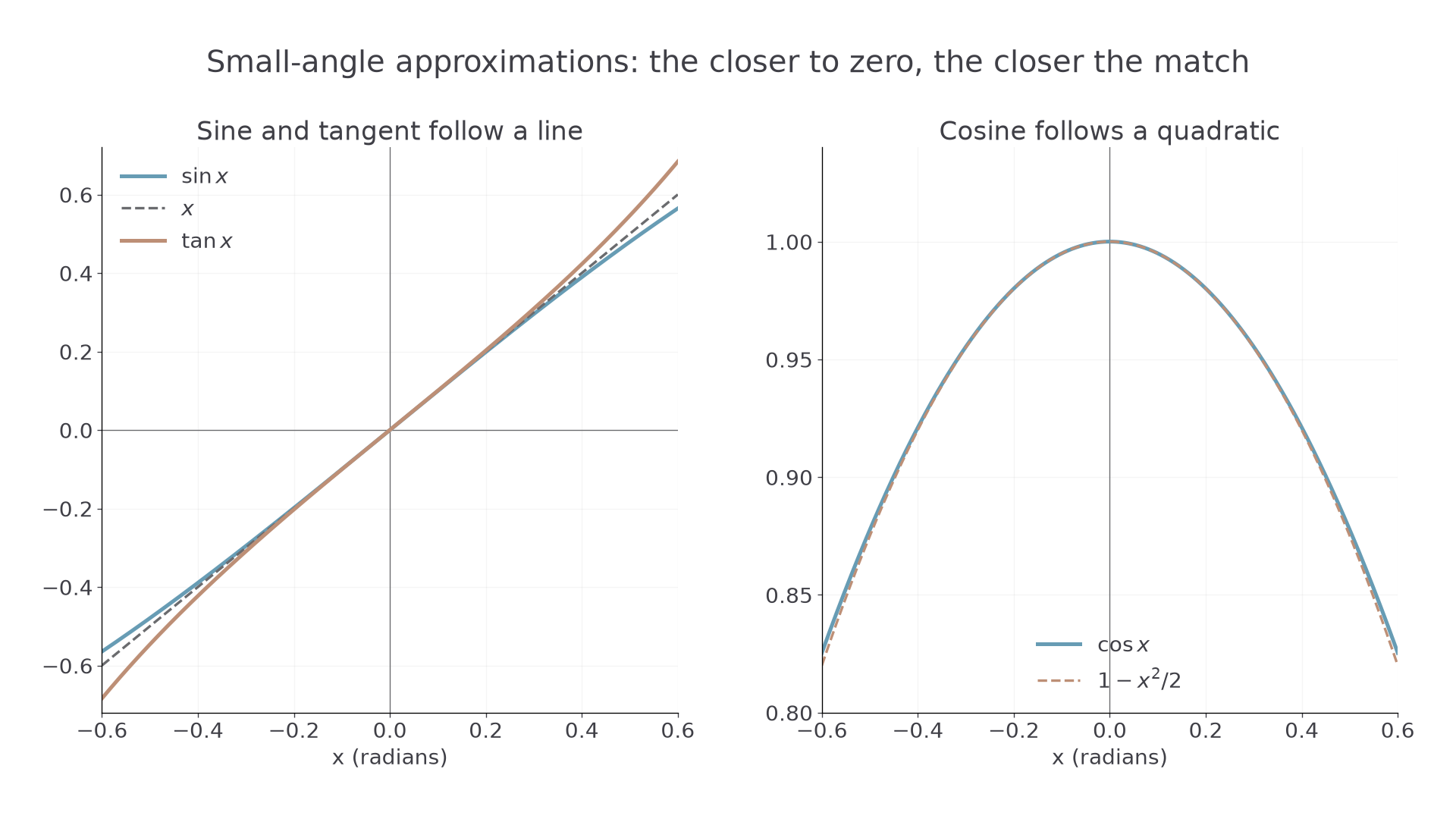
Small-angle approximations
For a small angle measured in radians,
They apply on either side of zero and become more accurate as decreases. In the formula booklet.
For , these give , and . A pleasing surprise is that the cosine estimate already agrees to decimal places. “Small” is about the required accuracy; there is no universal cut-off.
Approximation
An approximation replaces a value by a nearby, simpler value. The symbol signals that replacement. It is not an identity: for example, , even though they are close.
A calculator can measure the error, but it cannot rescue an approximation used with degrees as if they were radians.
Key idea
Approximate the whole radian angle, and keep the distinction between an approximate replacement and subsequent exact algebra.
Check which feature of cosine survives near zero.
Substitute the whole angle
In , the angle is , so the approximation contains , not . Think of the formula booklet's as an empty slot into which the whole angle goes. If the expression contains both and , both must be small.
Worked example 1: substituting a multiple angle
Question. For small non-zero in radians, approximate
Plan. Replace each trigonometric term using its whole angle, then simplify the quotient.
Why this step? Both top and bottom have leading terms in ; keeping the quadratic cosine term is essential.
Answer. The expression is approximately .
Check. At , direct evaluation gives about , close to .
Change only the multiple in the cosine angle, from to . Its coefficient is squared, so it has a larger effect than you might expect.
Worked example 2: the coefficient is squared
Question. For small non-zero in radians, approximate
Plan. Substitute the small-angle forms and cancel the common power.
Why this step? The becomes inside the quadratic; it is not a multiplier outside cosine.
Answer. Approximately .
Check. At , the original quotient is about , close to .
Write the square before simplifying the coefficient.
Watch out
Wrong: . Correct: . Also, small alone is insufficient if its multiplier is so large that the whole angle is not small.
Change the cosine multiple again, keeping the same structure.
Brackets and cancellation
In , the initial subtraction acts on the entire cosine approximation. You need . This is ordinary bracket algebra, but the two nearby ones make it an easy place to lose a sign.
You already know
, and only factors can cancel from a fraction. A factor can cancel only when ; cancelling does not define the original quotient at zero.
Pearson's 2024 small-angle question exposed exactly these slips: brackets, squaring the whole angle and losing the outer subtraction. Show the replacement line before tidying it.
Worked example 3: keeping the outer subtraction
Question. For small non-zero in radians, approximate
Plan. Approximate top and bottom separately, keeping the denominator's bracket.
Why this step? Replacing cosine by alone would erase the denominator's leading non-zero term.
Answer. Approximately .
Check. At , the original is about , close to .
Change only the denominator's angle from to . Its quadratic coefficient changes the final ratio.
Continue this lesson.
You’re previewing NovaLearn without an account. Create a free account to read the rest.
Create free account