Pure 5.5 - Trigonometric identities
Use the unit-circle identity and its reciprocal forms to rewrite expressions, prove identities and solve equations. You will keep track of domains and learn how to avoid losing a solution when a factor could be zero.
What a trigonometric identity means
A student solving , for , cancels a factor of and finds . Is that the complete answer? We will return to the missing possibility after learning why expressions can be rewritten without changing their value.
At , . The same sum is at every real angle: the unit-circle radius stays fixed as the point moves. In contrast, holds only at selected angles.
You already know
A point on the unit circle is , with squared distance . Reciprocals are undefined when their denominator is zero.
An identity makes a statement about a whole domain, rather than asking you to find a special input.
Trigonometric identity
A trigonometric identity is a relationship true for every angle for which both sides are defined. The symbol emphasises this. For example, on ; it makes no claim that tangent exists when cosine is zero.
For and , exclude cosine-zero inputs. For and , exclude sine-zero inputs. Cotangent's full definition is : at it is zero even though tangent is undefined.
Tangent ratio
For ,
Not in the formula booklet: learn it.
A proof must establish the relationship throughout the stated domain. Checking a few values is useful for spotting an error, but cannot prove a claim about every input.
Key idea
An identity changes the form of an expression; an equation selects the inputs at which two expressions are equal. Both require their original domain restrictions.
Use that distinction to judge a proposed identity.
Deriving the core identities
One fixed unit radius produces three useful identities. The surprise is that the secant and cosecant identities are simply the same circle equation divided by different squared coordinates. The division is legal only when that coordinate is non-zero.
[DIAGRAM: asset_slug: p1_5_5_understand_and_use_trigonometric_identities__diagram_01; asset_name: One circle gives three identities; caption: Divide the unit-circle identity by a non-zero squared coordinate; description: A unit-circle right triangle gives sine squared plus cosine squared equals 1. Two separate derivation panels show division by cosine squared or sine squared, with the corresponding domain restrictions.]
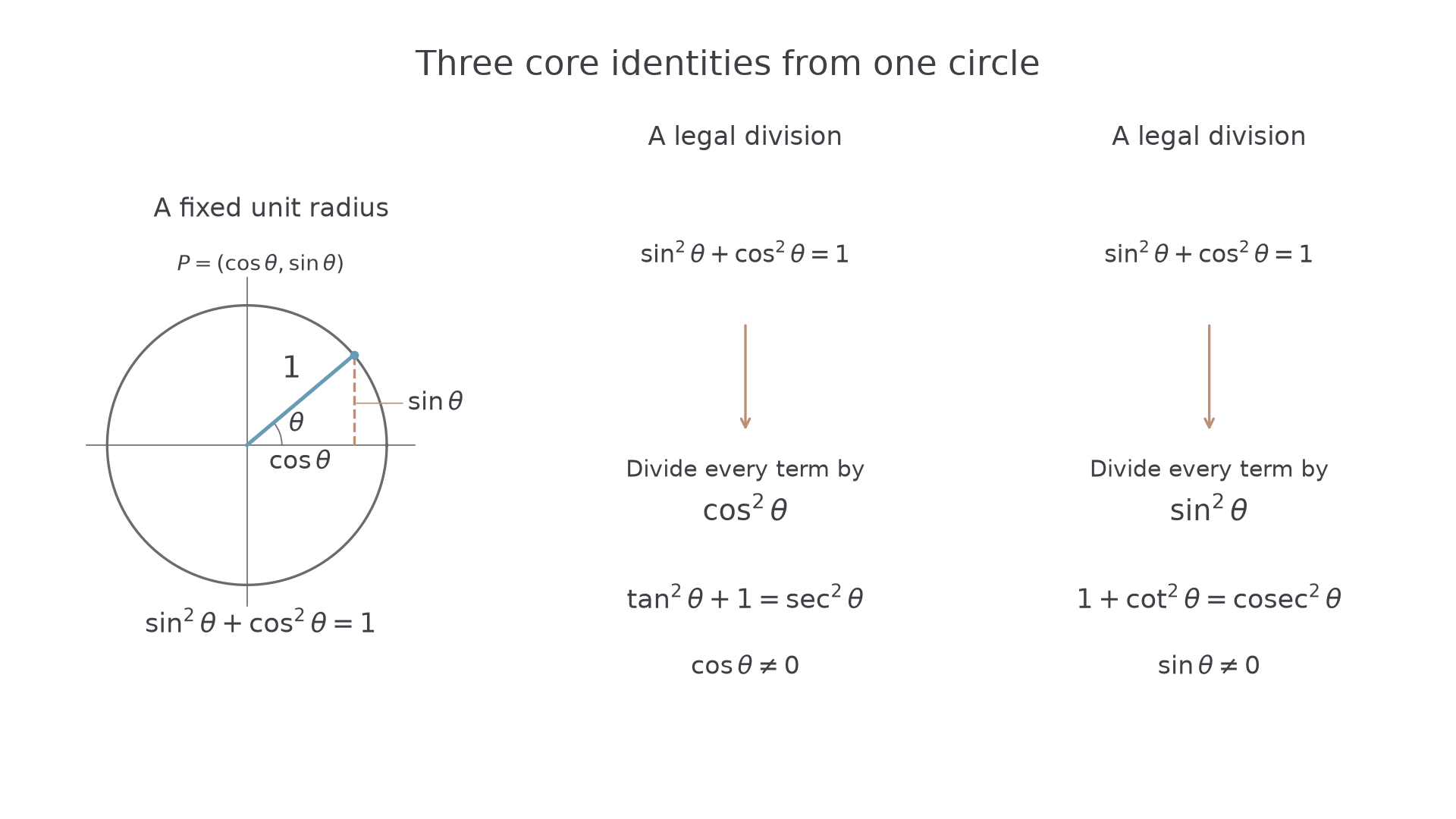
Pythagorean identity
For every real angle , in degrees or radians,
Not in the formula booklet: learn it.
Pythagoras proves this for the point because its distance from the origin is . Squared negative coordinates work just as well as positive ones. Dividing by a non-zero squared coordinate gives the two companion identities.
Secant and cosecant identities
Not in the formula booklet: learn it.
Here is the derivation, with every term divided by the same quantity.
Worked example 1: deriving the secant identity
Question. Starting from the unit-circle identity, prove , stating the restriction.
Plan. Divide every term by , then use the definitions.
Why this step? Dividing by cosine squared creates tangent squared and secant squared in the same line.
Answer. for .
Check. At , . This checks the result but does not replace the proof.
Change only the divisor from cosine squared to sine squared. The same reasoning now produces the other reciprocal identity.
Worked example 2: deriving the cosecant identity
Question. Starting from the unit-circle identity, prove , stating the restriction.
Plan. Divide each term by and recognise the resulting ratios.
Why this step? The chosen divisor determines which reciprocal appears; the starting unit-circle identity is unchanged.
Answer. for .
Check. At , , using and .
Both derivations divide an entire equation; dividing just one term would change it.
Watch out
Wrong: . The middle term must also be divided. Correct: .
Now derive a scaled form, rather than quoting the printed target.
Using identities to prove identities
In , replacing cosecant by creates a common denominator. The numerator then becomes , which the unit-circle identity can simplify. Work from one side of a proposed identity to the other, rather than assuming the target.
You already know
for . Also and , by rearranging the unit-circle identity.
Choosing the more complicated side often reveals the route. Rewrite reciprocal functions in sine and cosine when you cannot see a useful squared identity immediately.
Worked example 3: proving a cosecant identity
Question. Prove , for .
Plan. Rewrite the left side as one fraction, then use the unit-circle identity.
Why this step? A single denominator makes the squared identity visible in the numerator.
Answer. The left side equals the right side for every , proving the identity.
Check. At , the left side is ; the right side is .
Change only the sine/cosine pairing: use the analogous secant expression. The same fraction method works.
Continue this lesson.
You’re previewing NovaLearn without an account. Create a free account to read the rest.
Create free account