Pure 6.5 - Solving exponential equations
Find an unknown exponent using logarithms, and choose a common-base shortcut when one is available. You will solve equations with linear expressions in the exponent, keep exact answers exact and check that a real solution is possible.
What the equation means
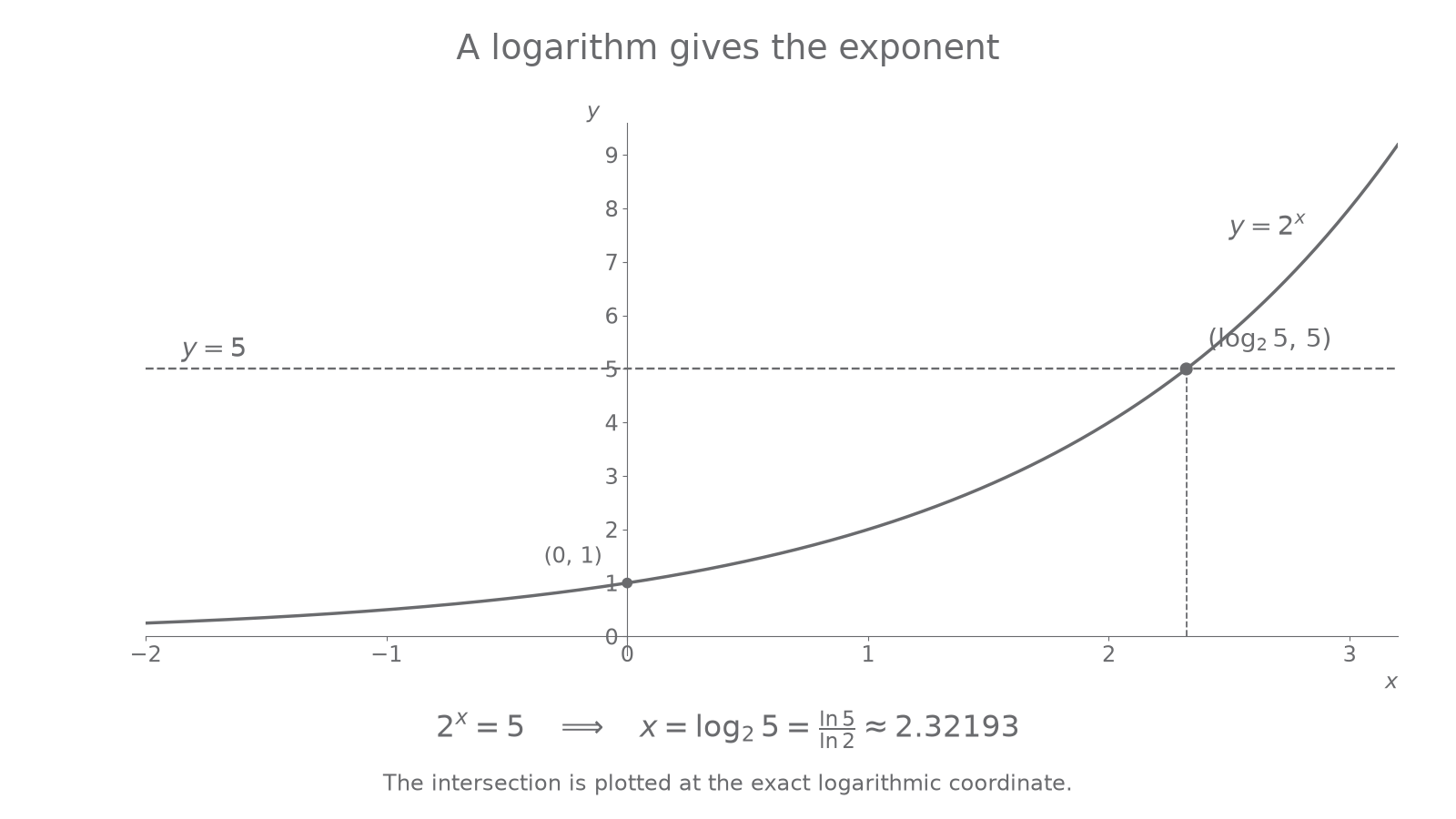
What power of gives ? Since and , the answer sits between and . A logarithm gives that awkward-looking exponent an exact name: .
You already know
Index laws give . Logarithms undo powers, and the power law gives for .
A horizontal line at height meets the increasing curve once. The intersection tells us both that the solution exists and that there is only one.
[DIAGRAM: asset_name: A logarithm locates an exponent; asset_slug: p1_6_5_solve_equations_of_the_form_a_x_b__diagram_01; caption: The intersection of the exponential curve and the horizontal line gives the required exponent; description: The graph of y=2^x meets y=5 at x=log base 2 of 5, between 2 and 3. A vertical guide links the intersection to its horizontal coordinate.]
Logarithm
For , and , the logarithm is the unique real exponent satisfying . For example, . There is no real , because is always positive.
The same uniqueness holds for : the curve decreases, but still reaches every positive output exactly once. The base is different: for every real , so has infinitely many solutions and has none. Negative bases are outside this real-exponential method because they do not define a real value for every real exponent.
Here is a small surprise: is not even a fraction. If it were for positive integers , then . The left side is even and the right side is odd, an impossibility. An exact logarithm is a complete answer, even when no fraction will do.
Key idea
A positive output gives exactly one real exponent when the positive base differs from . A zero or negative output gives no real solution.
Check the output before reaching for a calculator.
Using change of base
To calculate the exponent in , take the same logarithm of both sides. Natural logarithms are convenient, but base works too.
Change of base
For , , , and any logarithm base , ,
In particular, .
In the formula booklet.
You can see why the quotient appears: if , the power law gives . Since , , so division is legitimate.
Worked example 1: an exact exponent
Question. Solve , giving an exact answer and a value to significant figures.
Plan. Take natural logarithms, bring down the exponent and divide by the logarithm of the base.
Why this step? Taking a logarithm turns the unknown power into a multiplier, which ordinary algebra can isolate.
Answer. to significant figures; the logarithmic quotient is exact.
Check. The unrounded value is , between and , and .
Worked example 2 changes only the base, replacing by . The required exponent changes sign because a reciprocal base reverses growth.
Worked example 2: a base below one
Question. Solve , exactly and to significant figures.
Plan. Use the same logarithmic quotient and keep the negative denominator.
Why this step? , so a negative exponent is needed to make a base below produce an output above .
Answer. to significant figures.
Check. .
Keep the numerator and denominator in the same base. is not change of base. For another increasing-base equation, gives .
Watch out
Wrong: . Right: . The power becomes a multiplier, not a power of the logarithm.
The next equation keeps the reciprocal base from Worked example 2 and changes only the positive output.
Linear expressions in the exponent
In , the logarithm first reveals , rather than . Undo the exponential before solving that linear equation.
Continue this lesson.
You’re previewing NovaLearn without an account. Create a free account to read the rest.
Create free account