Mechanics 8.4 - Newton's third law and equilibrium
Learn to decide which body a force acts on, then build equilibrium or motion equations from its free-body diagram. You will connect Newton's third law to contact forces, lift reactions, ideal pulleys and particles on inclined planes. A careful choice of body does much of the work before the algebra begins.
Third-law pairs
If two boxes push equally hard on each other, how can either box accelerate? Imagine a hand pushing box , which pushes box to the right with . Box pushes to the left with , but these two forces belong to different boxes.
You already know
The resultant is the vector sum of the forces on one chosen body. Newton's second law is ; zero resultant means zero acceleration, which allows rest or constant velocity.
For the equation for , include the force on . For the equation for , include the hand's push and the force on . Naming both the agent and the receiving body prevents a surprisingly common mix-up.
Newton's third law
If body exerts a force on body , then exerts an equal-magnitude, opposite-direction force on , along the same line. These forces are the same type of interaction and act on different bodies.
A table's upward contact force on a book and the book's downward weight can balance, but they are not a third-law pair: both act on the book. The partner to the table's force is the book's force on the table. The partner to the Earth's gravitational force on the book is the book's gravitational force on the Earth.
[DIAGRAM: asset_slug: p3_8_4_understand_and_use_newton_s_third_law_and_equilibrium_of_forces__diagram_01; asset_name: Contact pair and equilibrium; description: Left, equal opposite contact forces act on separate bodies A and B. Right, balanced forces all act on one particle. Body labels are separated from force arrows.]
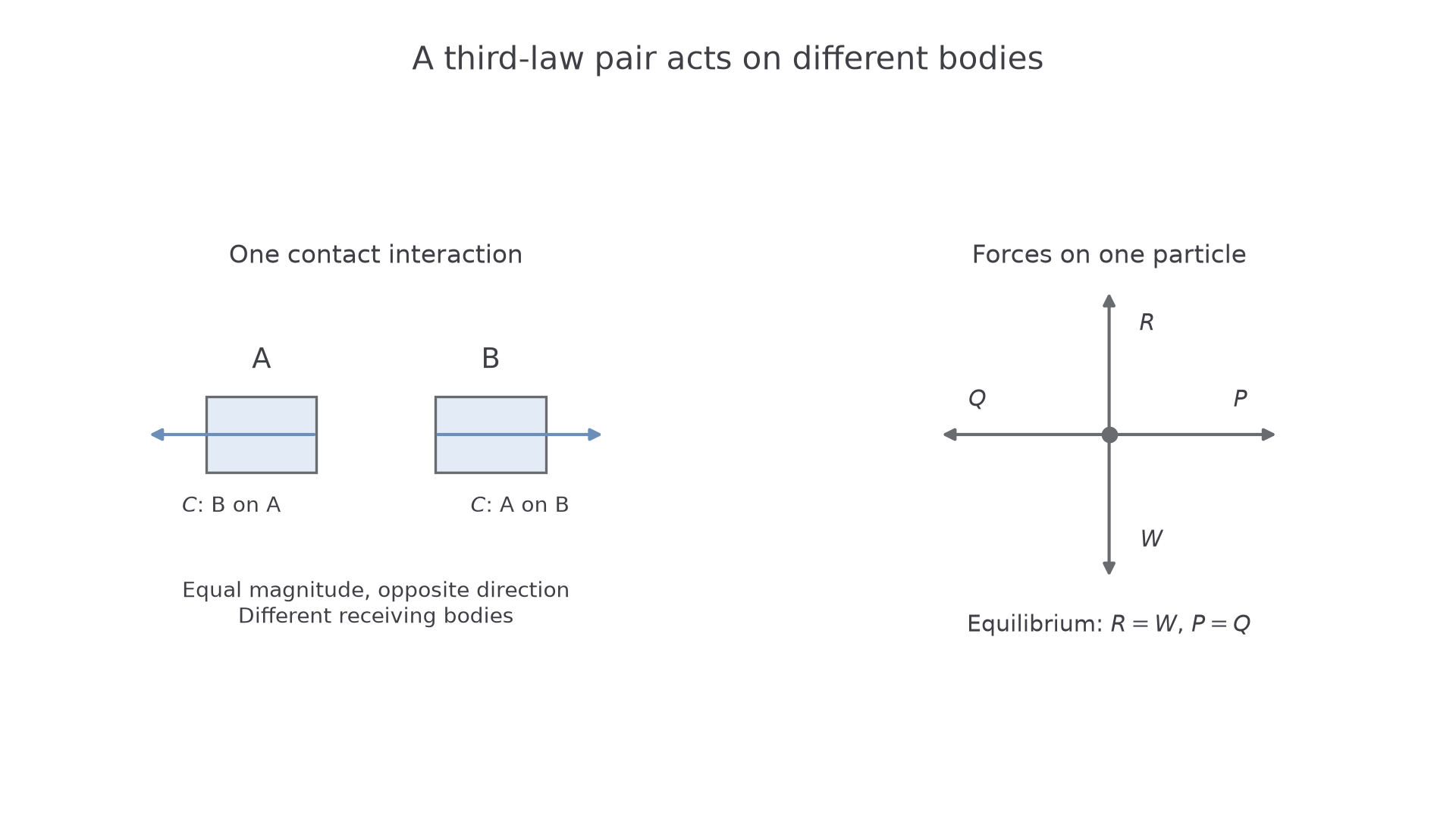
Here is a useful surprise to look for below: pushing a box towards a box can give a different contact force from pushing the heavier box towards the lighter one. A push of the same magnitude gives the same acceleration magnitude for the pair, yet the contact force changes. The separate body equations will explain why.
Key idea
Third-law pairs link two bodies; an equilibrium equation adds forces acting on one chosen body.
Use the receiving body to identify the pair in this familiar example.
Equilibrium equations
Three forces can balance even when no two are opposites. For instance, forces and together point left and up. The third force must point right and down by the same component amounts.
Equilibrium of a particle
A particle is in equilibrium when the resultant force on it is zero. Its acceleration is zero; it need not be stationary.
Choose two perpendicular directions, then balance each component. The vector and component statements express the same condition.
Particle equilibrium
For all forces acting on the chosen particle,
Not in the formula booklet: learn it.
Treating an unknown balancing force as the negative of the known sum keeps both signs under control.
Worked example 1: find a balancing force
Question. A particle is in equilibrium under , and . Find .
Plan. Add the known components, then negate their resultant.
Why negate the whole vector? Both perpendicular totals must vanish.
Answer. .
Check. The component totals are and .
Change just one feature: the second force now has a downward component. Keep its sign when adding.
Worked example 2: one component changes sign
Question. Replace the second force above by . Find the new balancing force.
Plan. Recalculate the known sum; equilibrium still requires its opposite.
Why is the vertical answer still downward? The known upward component exceeds the downward component .
Answer. .
Check. , while .
Equilibrium is a statement about acceleration, so a particle travelling steadily can obey these same equations.
Watch out
The line doubles the known resultant. Use .
Try the signed-component calculation with two new vectors.
Contact particles
Two boxes moving together have a common acceleration, but each has its own force equation. Choose the combined system to find acceleration efficiently; isolate a box to recover the contact force hidden inside that system.
Normal reaction
A smooth contact exerts a compressive force perpendicular to the contacting surface. Its magnitude cannot be negative: a surface can push, but it cannot pull a body towards itself.
For horizontal contact between boxes, call the magnitude . The two forces have opposite directions. They disappear when the equations for the combined system are added because they are internal forces.
Worked example 3: push one of two boxes
Question. Boxes and have masses and on a smooth horizontal floor. A horizontal force of pushes towards . Find their acceleration and contact force.
Plan. Use the total mass, then isolate , which is pushed only by the contact force horizontally.
Why isolate ? Its horizontal equation contains only the unknown contact force.
Answer. Both accelerate at in the push direction; .
Check. For , , so both body equations agree.
Change only which box receives a push of the same magnitude: push towards . The magnitude of the total external force stays the same, while the contact force changes.
Worked example 4: push the other box
Question. With the same masses and smooth floor, a force pushes towards . Find the acceleration and contact force.
Plan. Find the unchanged system acceleration, then isolate the unpushed box .
Why does change? It now accelerates the box rather than the box.
Answer. The acceleration magnitude is ; the contact force is .
Check. For , .
A lift floor is another contact. With upward positive, a person's equation is , where is signed. Upward velocity does not imply upward acceleration: an upward-moving lift slowing down has negative .
Worked example 5: a lift slows while rising
Question. A person of mass stands in a lift travelling upwards and slowing at . Find the floor's reaction. Use .
Plan. Isolate the person and take upward as positive, so .
Why is the reaction below the weight? The resultant must point downwards while the person slows.
Answer. The reaction is .
Check. , and , so contact is possible. A model requiring would instead predict loss of contact; the floor cannot pull downwards.
Only include forces on the chosen body. The person's force on the floor is the reaction's third-law partner, so it is absent from the person's diagram.
Exam tip
A combined-system equation finds acceleration, but cannot by itself find an internal contact force. Write a single-body equation as well.
Now vary the masses and push the larger box towards the smaller one.
Smooth pulleys
A hanging mass can pull a table particle horizontally even though their directions differ. A taut string links the distances travelled; the force equations still belong to separate particles.
Ideal string and pulley
A light string has negligible mass. A taut, inextensible string passing over a fixed pulley gives equal acceleration magnitudes for its two ends in this arrangement. With a smooth pulley and a light string, the tension has the same magnitude throughout the string.
The string pulls each particle along the string, away from that particle. A string cannot push. The two forces exerted by the string on the particles are not a third-law pair; each has its own partner acting back on the string.
[DIAGRAM: asset_slug: p3_8_4_understand_and_use_newton_s_third_law_and_equilibrium_of_forces__diagram_02; asset_name: Table particle and hanging particle; description: The ideal string connects A on a smooth table to hanging B. Separate free-body diagrams show reaction, weight and tension on A, and tension and weight on B.]
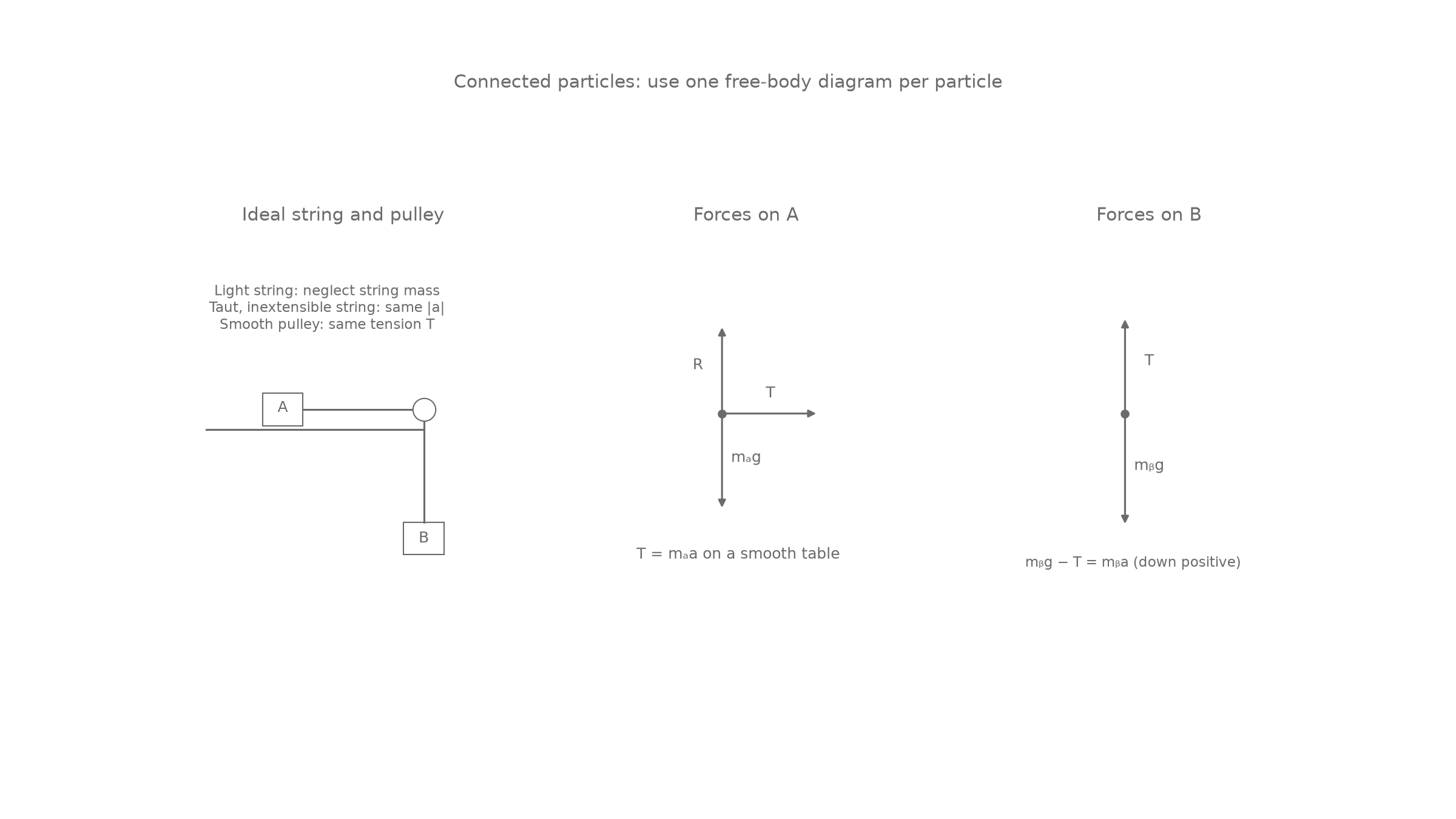
Choose positive directions consistent with the string: towards the pulley for the table particle, downwards for the hanging particle. The same then appears in both scalar equations.
Continue this lesson.
You’re previewing NovaLearn without an account. Create a free account to read the rest.
Create free account