Pure 9.4 - Numerical integration and the trapezium rule
Estimate an integral using straight-topped strips when a formula or a table supplies the function values. You will organise the calculation, use a sketch to judge the error, and turn suitable estimates into bounds for the true area.
Area from trapezia
Can joining five points by straight lines give an area you can trust? On from to , five points create four trapezia. Their total area is close to the curved area, and the curve's shape tells us which way the error goes.
You already know
A trapezium with parallel sides , , separated by distance , has area . A definite integral gives signed area; for a non-negative function it is the area under the graph. The single-trapezium area formula is not in the formula booklet.
Joining adjacent ordinates, meaning vertical heights, makes one trapezium per strip. The interior heights belong to two neighbouring strips; the end heights belong to one each.
[DIAGRAM: asset_slug: p1_9_4_understand_and_use_numerical_integration_of_functions_including_the_trapezium_rule__diagram_01; asset_name: Four trapezia below a square-root curve; caption: Five ordinates give four equal-width trapezia; description: The exact curve y=sqrt(2x+1) on 0 to 1 is compared with four shaded chord-topped trapezia at x=0,0.25,0.5,0.75,1. Heights y0 to y4 and h=0.25 are labelled.]
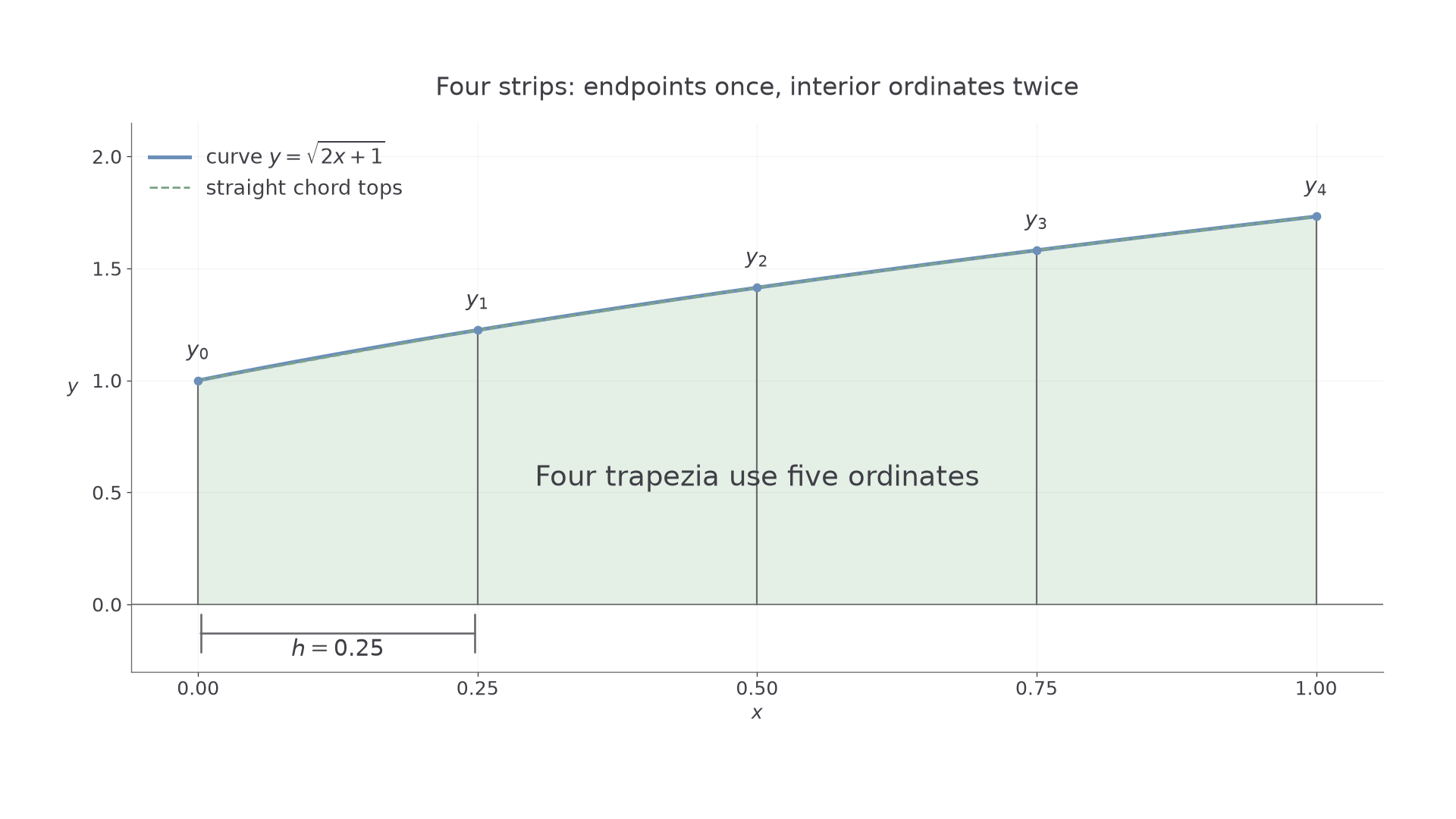
Adding , , and the remaining strip areas explains the weights in the composite rule.
Trapezium rule
For equal strips, , and :
The strips need ordinates.
In the formula booklet.
This compact formula assumes equal spacing. For unequal widths, add the individual trapezium areas using their own widths instead.
Worked example 1: counting strips correctly
Question. An interval from to uses three equal strips. Find and the required number of ordinates.
Plan. Divide the interval length by the number of strips, then include both endpoints.
Why this step? Three gaps have four boundary positions.
Answer. , with four ordinates.
Check. Three widths of cover the full length .
Change only the number of strips from three to six; the interval stays fixed.
Worked example 2: doubling the strips
Question. Divide the interval from to into six equal strips. Find and the number of ordinates.
Plan. Repeat the interval-length calculation with the new divisor.
Why this step? Halving the width doubles the number of strips, rather than the number of ordinates.
Answer. , with seven ordinates.
Check. The positions give exactly six gaps.
Count gaps before substituting into the rule.
Watch out
Wrong: six ordinates mean . Right: six ordinates give five strips, so . This changes the multiplier for the whole estimate.
Keep the interval and double the number of strips once more.
Using a table of values
Check equal spacing before using the composite rule. Then place the two end values outside the doubled interior sum. You are estimating an integral, not taking the mean of the readings.
Worked example 3: a supplied table
Question. Estimate using all these values.
Plan. Use and double only the three interior values.
Why this step? Every interior height is shared by two trapezia.
Answer. The integral is approximately , or an area of square units for a positive curve.
Check. The average height is estimated as , between the smallest and largest readings.
Keep the spacing and change only the middle reading from to . Its doubled weight makes the effect easy to predict.
Worked example 4: changing an interior reading
Question. Repeat the estimate with the same -values and readings , in that order.
Plan. Substitute the new interior value into the same weighted sum.
Why this step? Changing an interior ordinate by changes the estimate by .
Answer. The new estimate is .
Check. , agreeing with that predicted change.
There is a neat exactness hidden here: if the graph is a straight line, every chord is already part of the graph, so the trapezium rule is exact for any number of strips. For instance, the line on has area , whether you use one trapezium or a hundred.
Exam tip
Write a numerical value of in the substitution. A correct weight pattern with the wrong strip width changes every part of the answer.
Use the supplied rounded values as the data; do not replace them by a guessed underlying function.
From a function to an estimate
When a function replaces a supplied table, calculate the required heights first. Keep extra figures in memory; round the table for display rather than feeding those rounded numbers into later calculations.
Worked example 5: building the table
Question. Estimate using four equal strips.
Plan. Evaluate the function at , then apply the rule.
Using unrounded heights,
Why this step? The five function evaluations define four strips; the three middle heights are doubled.
Answer. The estimate is to three decimal places.
Check. Using the displayed four-decimal table gives , which rounds to the same answer.
Change only the constant inside the square root from to . The nodes and weights stay the same.
Continue this lesson.
You’re previewing NovaLearn without an account. Create a free account to read the rest.
Create free account