Pure 7.5 - Implicit and parametric differentiation
Find a curve's gradient even when its equation does not give directly in terms of . Differentiate implicit relations and parametric equations, then use the resulting first derivative to find tangents and normals, including horizontal and vertical cases.
Hidden Curves and First Derivatives
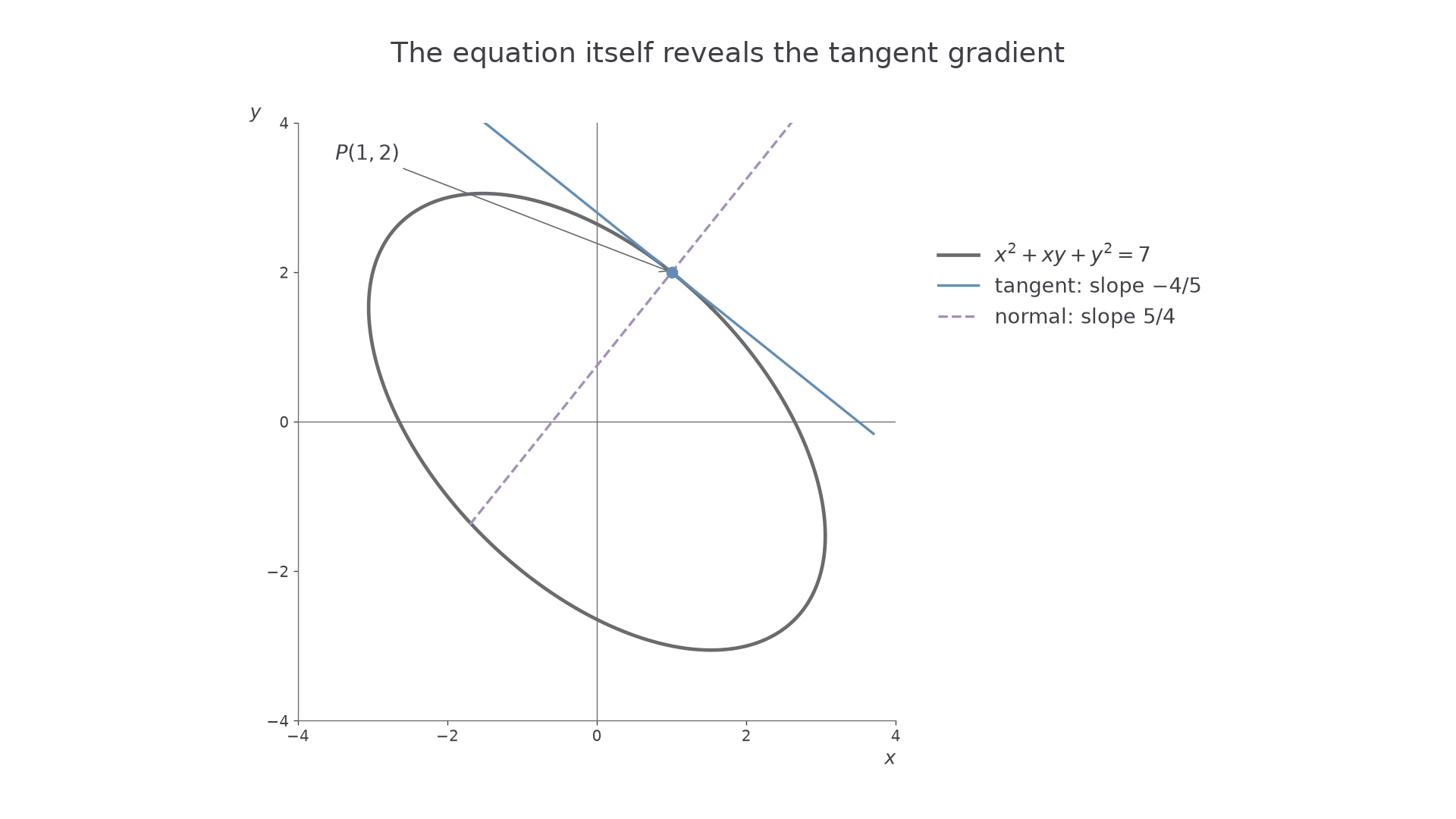
How can you find the tangent at on without first isolating ? Substituting the point gives , so it is on the curve. Rearranging the entire relation into explicit branches would be possible but awkward. We can differentiate the relation itself.
You already know
The chain rule differentiates a function of a changing input: . The product rule gives . A tangent uses the curve's derivative; a normal is perpendicular.
An implicit relation can describe more than one -value for a single -value. Near a suitable point, one branch still has a gradient.
[DIAGRAM: asset_slug: p1_7_5_differentiate_simple_functions_and_relations_defined_implicitly_or_parametrically__diagram_01; asset_name: A tangent to an implicit curve; caption: Differentiate the relation to find the local slope without isolating y; description: Equal-scale axes show x squared plus xy plus y squared equals 7, P(1,2), tangent slope minus four fifths and normal slope five quarters.]
Implicit Relation
An implicit relation links and in one equation, such as , rather than already giving . When finding , treat as a function of along the selected branch.
Consequently,
Both are applications of the recalled rules, which are not printed in the booklet. A bare would be the derivative with respect to , not with respect to . The same chain factor makes .
Key idea
Differentiate every term with respect to the same variable. Terms involving must include the way changes with .
The first derivative is our target here. Once it gives the tangent gradient, straight-line geometry supplies the tangent or normal.
Implicit Differentiation
Differentiate the whole relation, collect every term containing , then solve for it. Substitute a point afterwards: inserting numbers first destroys the changing quantities.
Worked example 1: the opening implicit tangent
Question. Find the tangent to at .
Plan. Use product rule for , chain rule for , then collect the derivative terms.
Why this step? The product changes through both factors, so its derivative has two terms.
Answer. Tangent , or .
Check. satisfies the curve and tangent, and the line's gradient is .
Change only the coefficient of from to . The constant is adjusted to keep the same point on the curve.
Worked example 2: a larger product coefficient
Question. Find the tangent to at .
Plan. Include the factor on both terms from differentiating .
Why this step? The constant on the right differentiates to zero, so the slope calculation depends on the changing terms on the left.
Answer. , or .
Check. The curve gives , and the tangent gives .
At on , the same derivative gives slope and tangent . The point must always be checked against the particular curve.
Watch out
Wrong: . The missing is the contribution from differentiating . Write .
Change the product coefficient again while keeping on the relation.
Parametric Differentiation
A parameter describes both coordinates: , . To find the slope in the - plane, divide the vertical rate by the horizontal rate.
Parametric First Derivative
For differentiable , , where ,
Not in the formula booklet: learn it.
This follows from the chain rule . It is a ratio of derivatives, not .
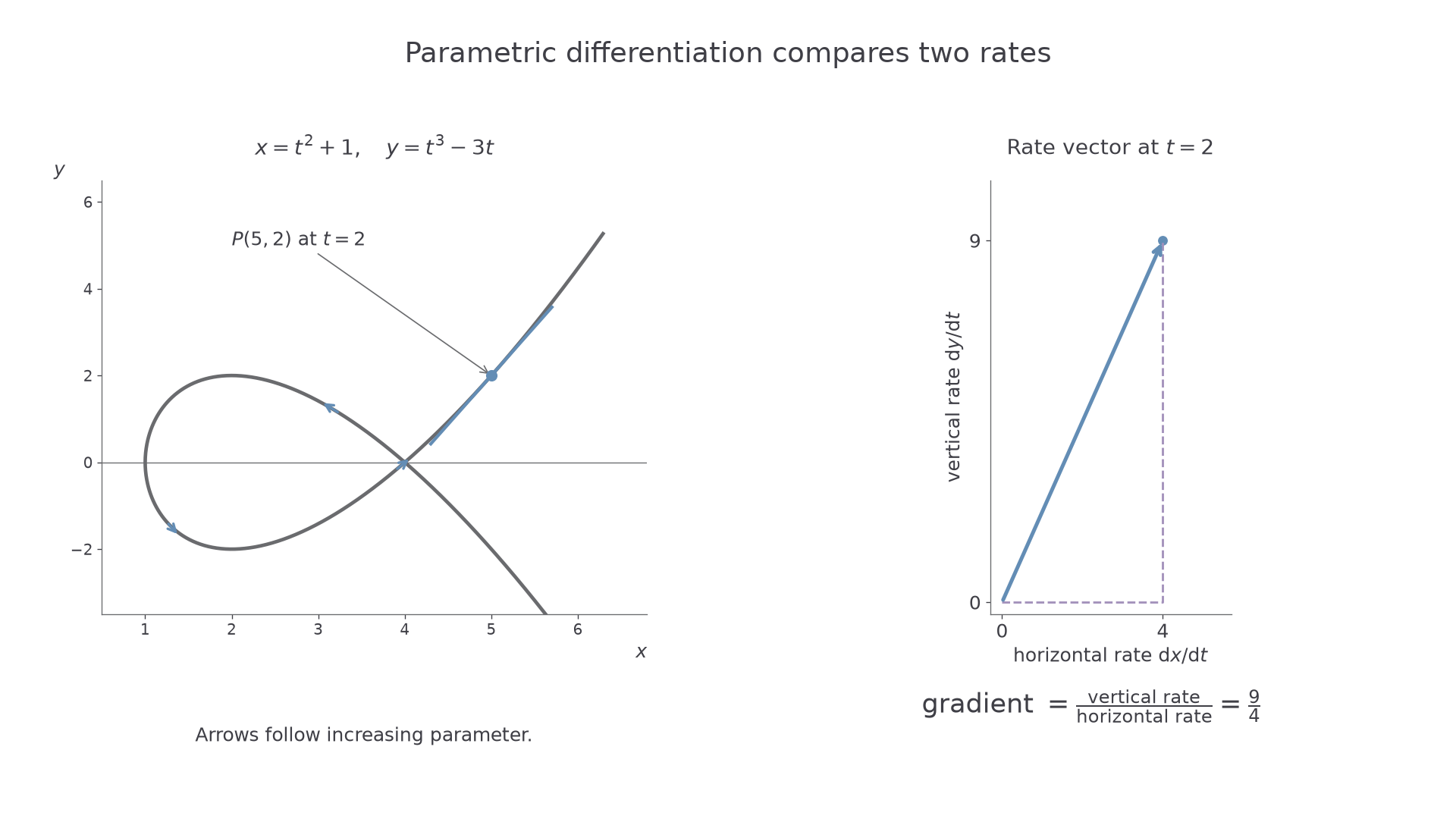
[DIAGRAM: asset_slug: p1_7_5_differentiate_simple_functions_and_relations_defined_implicitly_or_parametrically__diagram_02; asset_name: A parametric gradient; caption: At t=2, vertical rate 9 divided by horizontal rate 4 gives slope 9 over 4; description: The curve x=t squared plus 1, y=t cubed minus 3t has P(5,2) at t=2 with its tangent. A separate rate-vector panel shows horizontal component 4 and vertical component 9, explicitly labelled as rates.]
Worked example 3: a parametric tangent
Question. For , , find the tangent at .
Plan. Differentiate both coordinates, take the correct ratio, and find the curve point separately.
Why this step? Dividing vertical rate by horizontal rate gives rise per run.
Answer. .
Check. A small positive parameter change gives displacement approximately , with slope .
Change only the parameter value to . This produces a horizontal tangent.
Continue this lesson.
You’re previewing NovaLearn without an account. Create a free account to read the rest.
Create free account