Mechanics 7.4 - Calculus in kinematics
Use differentiation and integration to connect position, velocity and acceleration when acceleration may vary. You will apply initial conditions in one and two dimensions, calculate speed and direction at a specified time, and account for reversals when finding distance.
The calculus chain for motion
A particle is north-east of the origin: must it be travelling north-east? Consider . At , position has equal components, but its velocity does not. Calculus will reveal the difference.
You already know
Differentiate to find a rate of change; integrate to reverse differentiation. A vector has separate component functions, and speed is its velocity magnitude.
For straight-line motion, write for signed position relative to an origin. The same rules apply to displacement measured from the starting point.
The motion calculus chain
Indefinite integrals require constants determined by position or velocity conditions. Apply the same rules componentwise in a plane. Not in the formula booklet: learn it.
If position is in metres and time in seconds, each differentiation divides the unit by seconds. Each integration multiplies it by seconds.
[DIAGRAM: asset_slug: p3_7_4_use_calculus_in_kinematics_including_in_two_dimensions__diagram_01; asset_name: Calculus chain for motion; caption: Differentiate towards acceleration and integrate towards position; description: Position, velocity and acceleration boxes are linked by separate differentiation and integration arrows with clear labels and correct SI units.]
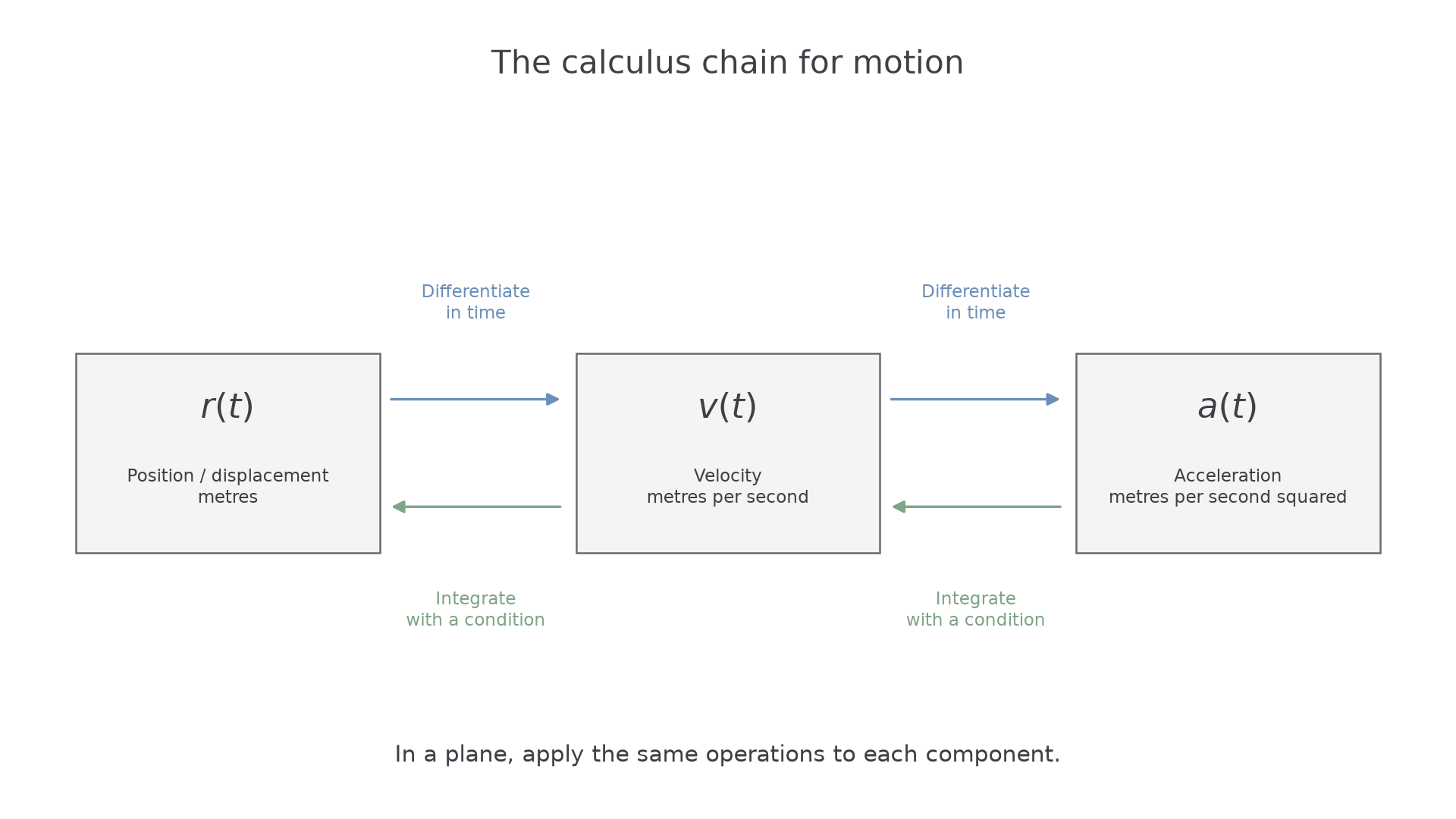
An indefinite integral describes a family of possible motions. “Initially at the origin” fixes position; “starts from rest” fixes velocity. Acceleration is variable, so substituting it into a constant-acceleration SUVAT equation would be invalid. Use the calculus rules from Pure Mathematics instead.
Key idea
Differentiate the given function before substituting a time; integrate first, then use the condition to fix the constant.
Choose the correct direction through the chain.
Differentiate position to find velocity and acceleration
Differentiate a position function once for velocity and twice for acceleration. Keep the function until you have taken the derivatives you need.
Worked example 1: instantaneous rest with acceleration
Question. A particle has metres, . Find velocity and acceleration at .
Plan. Differentiate twice, then evaluate both derivatives.
Answer.
Why can acceleration be nonzero at rest? Zero velocity is an instantaneous value; it need not be unchanging. This is a useful surprise: a particle can be at rest while its velocity is already changing.
Check. is negative just before and positive just after it, confirming a reversal there.
Change only the requested time to .
Worked example 2: after the reversal
Question. For the same position function, find velocity and acceleration at .
Plan. Use the derivative functions already obtained.
Answer.
Why is the particle speeding up at this instant? Its nonzero velocity and acceleration have the same sign.
Check. The factorised velocity gives .
The rules also handle trigonometric, exponential, logarithmic and rational functions. For example, gives and , using radians. A position , for , gives and .
Watch out
Substituting a time into position first gives one number. Differentiating that number loses the motion information and incorrectly gives zero.
Change only the evaluation time again.
Integrate and use initial conditions
Two integrations bring two constants. Keep them distinct because initial velocity and initial position supply different information.
Worked example 3: two integrations
Question. Acceleration is , with and . Find .
Plan. Integrate acceleration, use velocity, then integrate again and use position.
Answer.
Hence metres. Why use velocity first? Position cannot fix the constant in the velocity function.
Check. Differentiating twice returns ; at zero, position is and velocity is .
Change only the initial position to .
Worked example 4: change the starting point
Question. Keep and , but set . Find .
Plan. Reuse the velocity and change the position constant.
Answer.
So metres. Why does no derivative change? Adding a constant translates the position graph without changing its gradients.
Check. The two position functions differ by the fixed between starting points.
For a non-polynomial example, , and give and . Differentiate and check the conditions just as above.
Exam tip
Show the substitution of each condition into its own function. Include constants in the integration working rather than assuming the particle starts from rest or at the origin.
Vary only the starting position once more.
Differentiate vector motion component by component
For , the fixed unit vectors do not change. Differentiate their coefficient functions separately. Dot notation and means first and second time derivatives.
Vector time derivatives
The unit vectors are fixed and perpendicular. Not in the formula booklet: learn it.
The velocity arrow is tangent to the path, whereas position points from the origin.
[DIAGRAM: asset_slug: p3_7_4_use_calculus_in_kinematics_including_in_two_dimensions__diagram_02; asset_name: Position and tangent velocity; caption: Equal position components do not imply equal velocity components; description: The path r equals t squared plus 2t in the east component and 4t minus t squared in the north component. At t equals 1 the position is 3i plus 3j, tangent velocity is 4i plus 2j, and acceleration is 2i minus 2j.]
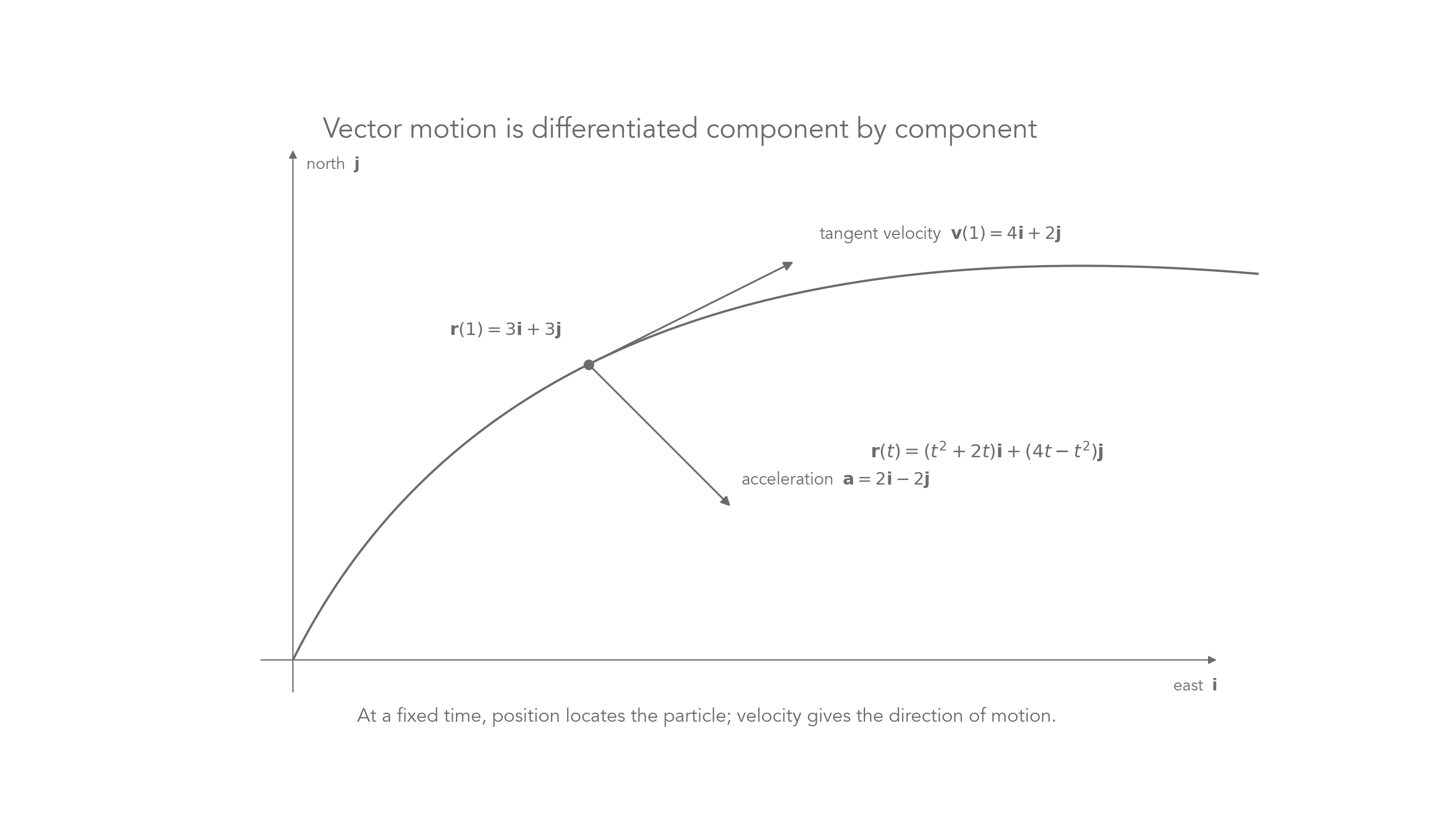
Now calculate the arrows shown.
Worked example 5: differentiate a vector path
Question. Given metres, find velocity, acceleration and speed at .
Plan. Differentiate both coefficients, then take the velocity magnitude.
Answer.
Why differentiate each component? Eastward and northward positions change independently with the same time.
Check. , but its component ratio differs from the velocity ratio .
Change only the evaluation time to .
Worked example 6: horizontal motion at the top of the path
Question. For the same path, find velocity, acceleration and speed at .
Plan. Evaluate the derivative vectors at the new time.
Answer.
Why has the particle not stopped? Only its northward velocity is zero; its eastward component remains positive.
Check. has its maximum at , consistent with the horizontal tangent.
Use one later time.
Continue this lesson.
You’re previewing NovaLearn without an account. Create a free account to read the rest.
Create free account