Pure 4.2 - Sequences
A sequence is an ordered list, but the rule behind the list tells you much more than its first few values. You will generate terms from position formulae and recurrence relations, establish increasing or decreasing behaviour, and identify the shortest repeating cycle. You will also see how changing a starting value can change the behaviour completely.
Sequence notation and nth-term formulae
Can the same rule produce an increasing sequence, a decreasing sequence and a constant sequence? The rule can do all three. Before investigating why, we need to distinguish a term's position from its value.
You already know
A function substitutes an input into a rule. For example, gives . A sequence formula uses whole-number positions as its inputs.
For , the first terms are . Here the subscript is a position; is the value at that position.
Sequence and term
A sequence is an ordered list of numbers. Its individual entries are terms. The notation denotes the term at position , usually . If indexing begins at , that must be stated. The list is a sequence; is its corresponding sum, or series.
An nth-term formula lets you jump straight to a distant position without generating earlier terms.
Worked example 1: substituting positions
Question. For , find .
Plan. Substitute each requested position for every occurrence of .
Why this step? asks for the fifth value, so the input is , regardless of the earlier values.
Answer. .
Check. Completing the square gives , which gives the same three values.
Change only the constant term in the formula. Every sequence value should increase by the same amount.
Worked example 2: changing a formula's constant
Question. For , find .
Plan. Substitute the same positions into the new formula.
Why this step? The added constant shifts values, not positions.
Answer. , respectively.
Check. Each result is greater than the matching value in Example 1.
Writing the substitution makes the role of the subscript visible.
Watch out
The line confuses a label with a value. Find by putting into the formula.
Keep the quadratic and linear terms fixed, and change the constant once more.
Recurrence relations
A recurrence feeds a term's value back into a rule. Starting with , the rule gives , then , then .
Recurrence relation
A recurrence relation expresses a term using earlier terms. Here the form is : the input is the previous term value. A starting term is needed to define a particular sequence. For a reciprocal rule, every denominator used must be non-zero.
The index says when to use the rule; it is not the rule's input. A calculator's previous-answer facility can help with numerical iteration, but a parameter question needs algebraic terms.
Worked example 3: using a later term to find a parameter
Question. Let and , where . Given , show that , and find .
Plan. Express the second and third terms in , then use the given third term.
Why this step? Forming requires feeding in the whole expression , not the position .
Answer. The required equation follows, and ; the other root is excluded.
Check. With , the terms begin .
Change only the supplied third term. The recurrence calculations remain the same until the final equation.
Worked example 4: a different terminal condition
Question. With , and , find if .
Plan. Equate the expression for to .
Why this step? The given value belongs to , after two applications of the rule.
Answer. .
Check. The sequence begins , as required.
In a “show that” task, include the substitution that produces the printed equation; copying it is not a proof.
Watch out
For , writing substitutes the position instead of . Use the previous term's value each time.
Change the third-term condition again, retaining the same rule.
Increasing and decreasing sequences
The sequence , defined by , rises at every step: . For an infinite sequence, the reason must cover every relevant position.
Increasing and decreasing
A sequence is increasing if for every relevant , and decreasing if for every relevant . These are strict inequalities here. A constant sequence is neither strictly increasing nor strictly decreasing.
The graph contains isolated points at integer positions; joining them would suggest inputs that the sequence does not have.
[DIAGRAM: asset_slug: p1_4_2_work_with_sequences__diagram_01; asset_name: Pure 4.2 - Sequences - diagram 01; recommended_method: drawn_math; description: Three discrete plots showing increasing u_n=2n, decreasing v_n=1/(3n+1), and reciprocal order-two sequence 3,1/3,3,1/3 at integer positions.]
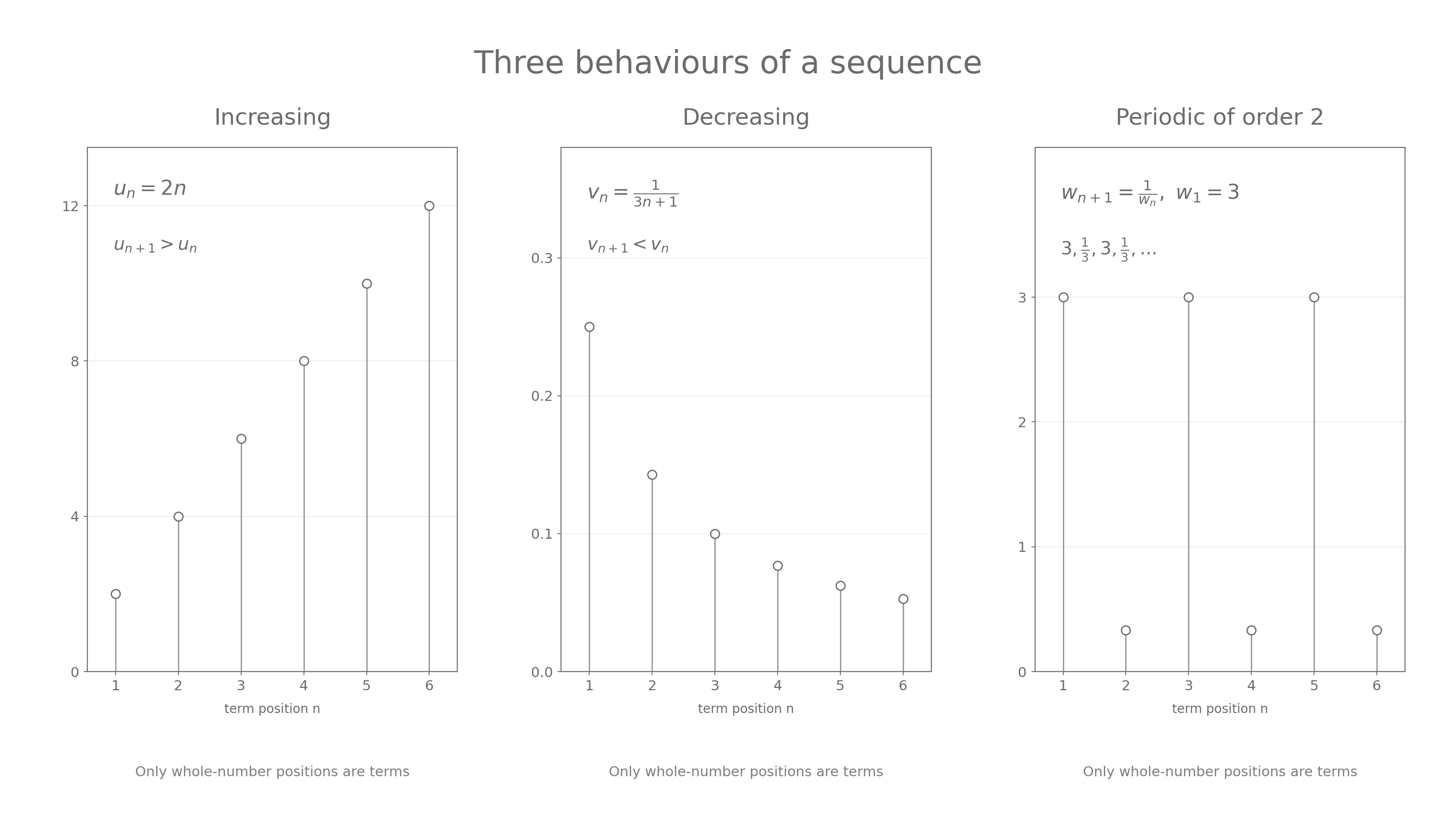
Comparing with zero works for positive and negative terms. Comparing a ratio with is safe only after checking the signs of the quantities involved.
Worked example 5: proving a reciprocal sequence decreases
Question. Show that decreases for .
Plan. Find the difference between consecutive terms and establish its sign.
Why this step? Both denominator factors are positive, so the numerator determines the sign.
Answer. for every , so the sequence is decreasing.
Check. Its first terms are , consistent with the proof.
Change only the sign of the formula. The terms remain negative, but their direction of movement reverses.
Worked example 6: negative terms can increase
Question. Determine whether increases or decreases for .
Plan. Use the difference, with the new minus sign.
Why this step? Increasing means becoming greater, even if all the terms are below zero.
Answer. The sequence is increasing for every positive integer position.
Check. .
A list of initial values checks arithmetic; the sign argument proves the claim for the whole sequence.
Watch out
“Negative terms mean decreasing” is false. For example, increases because each next term is greater.
Use the same sign test on a new reciprocal formula.
Periodic sequences
A recurrence can undo itself. For , applying the rule twice returns , provided the terms are non-zero. This gives a cycle without having to generate hundreds of terms.
Periodic sequence
A sequence is periodic with order if for every relevant , and is the smallest positive integer with this property. A constant sequence has order . A repeating block of four terms does not establish order if a shorter block also repeats.
For the reciprocal rule , with and , two updates always return to the same term. Its order is , unless the starting value is already unchanged by one update.
Worked example 7: proving an order-two cycle
Question. Let , . Find the first five terms and the order.
Plan. Generate terms and use the two-update identity to justify repetition.
Why this step? Returning to the same value under the same rule forces the subsequent cycle to repeat.
Answer. ; order , since adjacent terms differ.
Check. The non-zero terms make both reciprocal updates defined.
Change only the starting value, to one that the rule leaves unchanged. This reveals the shorter-cycle boundary case.
Worked example 8: a fixed starting value
Question. Let , . Find the first three terms and the order.
Plan. Test whether the first update changes the starting value.
Why this step? The order is the shortest cycle; a constant sequence repeats after one term.
Answer. ; order .
Check. The unchanged-value equation gives , which this positive start satisfies.
The specification's reciprocal example , similarly has order , alternating and .
Watch out
“Two updates return to the start, so the order must be ” misses constant sequences. Check whether one update already returns the same value.
Try the reciprocal rule with fresh numbers and check the shortest cycle.
Classifying sequences from their definitions
The opening recurrence has an unchanged value: . Compare every term with , rather than guessing from a few terms.
If , the first line keeps every term above , and the second line makes every step positive. The sequence increases. If , the sign stays negative, so the sequence decreases. If , every term is . One rule really does give all three behaviours.
The starting value matters just as much as the update rule. For instance, starts give , , and , respectively.
Key idea
For a recurrence, justify that the sign or cycle persists under the rule. For an nth-term formula, compare successive terms for the whole stated domain.
Some sequences belong to none of the three non-constant categories. For , the first terms are . It is neither strictly increasing nor decreasing. Its quadratic term makes it unbounded below, whereas a periodic sequence repeats a finite, bounded list, so it is not periodic either.
A few repeated values therefore do not prove a cycle. Equally, a sequence can increase towards a limit without ever becoming constant: is an example. Classification describes the whole rule on its domain.
| Given definition | Useful test |
|---|---|
| find and establish its sign | |
| generate carefully, then explain why the sign or cycle persists | |
| a repeated block | check the shortest period and justify repetition |
The distinction between finite evidence and a universal reason is the same one used in proof.
Quick Recap
- An nth-term formula uses a position; a recurrence uses the previous term value and needs a start.
- Prove increasing or decreasing behaviour for every relevant position.
- A periodic sequence has a shortest repeating cycle; a constant sequence has order .
- Initial terms suggest behaviour, while the rule establishes it.
The opening rule increases from starts above , decreases from starts below , and stays constant from .