Mechanics 8.1 - Force and Newton's first law
Learn to name the forces on one body, add them with their directions and use Newton's first law to decide whether its velocity changes. You will build force diagrams and use zero-resultant equations for objects at rest and objects already moving.
Forces as vectors
Can a trolley keep moving when the resultant force on it is zero? Imagine a trolley already travelling right at . A pull of acts right and a resistance of acts left. The two forces cancel. Does the trolley stop, or carry on? We will settle that question by distinguishing a force from its resultant.
You already know
A vector has magnitude and direction. Opposite directions have opposite signs on a chosen axis; for example, right and left represent different vectors.
Choose the body before drawing arrows. A force exerted on the trolley belongs in its diagram; a force the trolley exerts on the floor belongs in the floor's diagram.
Force and resultant force
A force is a push or pull on a body, measured in newtons, . It is a vector. The resultant force is the vector sum of all forces acting on the chosen body. For example, opposite forces have zero resultant; two forces in the same direction have resultant .
For forces along one line, signs do the vector work. Write which direction is positive before subtracting.
Worked example 1: opposing pulls
Question. The only horizontal forces on a trolley are right and left. Find the horizontal resultant.
Plan. Take right as positive and add the signed forces.
Why subtract? The forces act along the same line in opposite directions.
Answer. The resultant is to the right.
Check. The larger force points right, and .
Now reverse which pull is larger. That changes the sign of the answer, not the addition rule.
Worked example 2: a negative component
Question. The only horizontal forces on a trolley are right and left. Find the horizontal resultant.
Plan. Keep right positive so that the sign identifies the direction.
Why keep the minus sign? It tells us that the resultant points opposite to right.
Answer. The resultant is to the left.
Check. Taking left positive instead gives , the same physical result.
A resultant is a signed component or a vector; its magnitude is non-negative.
Watch out
The line ignores direction. For the opposing forces in example 2, the correct rightward component is .
Try another opposing pair, keeping the direction in your conclusion.
Common force names
The name of a force helps you draw its direction before you know its magnitude. Picture a particle pulled right along a rough horizontal table by a taut horizontal string: the string pulls right, the resistance acts left, the table pushes up and the weight acts down.
[DIAGRAM: asset_slug: p3_8_1_understand_the_concept_of_force_and_understand_and_use_newton_s_first_law__diagram_01; asset_name: Mechanics 8.1 - Force and Newton's first law - diagram 01; recommended_method: drawn_math; description: Draw a spacious four-panel force-type diagram in NovaLearn style. Panel 1 shows a block on a horizontal surface with normal reaction perpendicular to the surface and weight vertically down. Panel 2 shows a block attached to a taut string with tension pulling along the string. Panel 3 shows a compressed rod pushing a particle with thrust/compression along the rod. Panel 4 shows a block moving right with resistance acting left, opposite motion or tendency to move.]
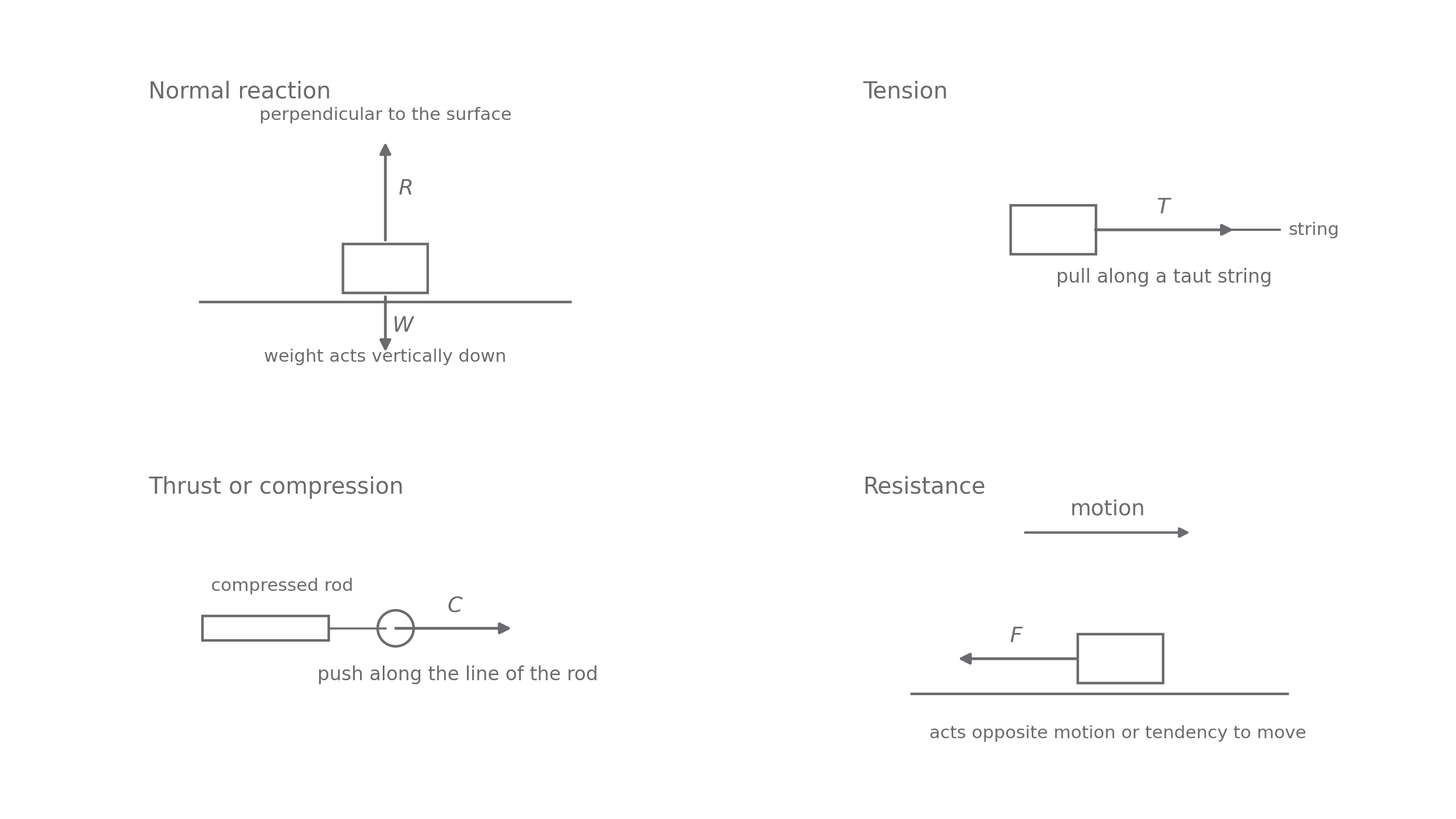
Each arrow describes an interaction with something outside the chosen body.
Common forces
A normal reaction is a contact force perpendicular to the surface. Tension is a pulling force along a taut string. Thrust or compression is a push along a rod or contact line. Resistance, such as drag or friction, opposes motion or the tendency for relative motion. Weight is the gravitational force, vertically downwards near Earth's surface.
For a block on a slope, the reaction is tilted because it is normal to the slope; the weight is still vertical. A slack string exerts no tension, and a string cannot push. Resistance is not automatically leftwards: reverse the motion and its direction reverses. If the weight is supplied in newtons, use that value directly; a mass in kilograms is a different quantity.
Key idea
Draw only forces acting on your chosen body, with directions determined by the interaction: normal means perpendicular, and tension means a pull along the string.
Use the physical description to distinguish a force direction from a motion direction.
Newton's first law
A trolley can have several forces acting on it while its velocity stays unchanged. What matters is their sum. In our opening case, , so there is no change to the trolley's rightward velocity.
[DIAGRAM: asset_slug: p3_8_1_understand_the_concept_of_force_and_understand_and_use_newton_s_first_law__diagram_02; asset_name: Mechanics 8.1 - Force and Newton's first law - diagram 02; recommended_method: drawn_math; description: Draw a two-panel NovaLearn style diagram. Left panel: a block at rest with equal forces to the left and right, labelled resultant force = and stays at rest. Right panel: a block already moving right at constant with equal forces to the left and right, labelled resultant force = and continues at the same velocity.]
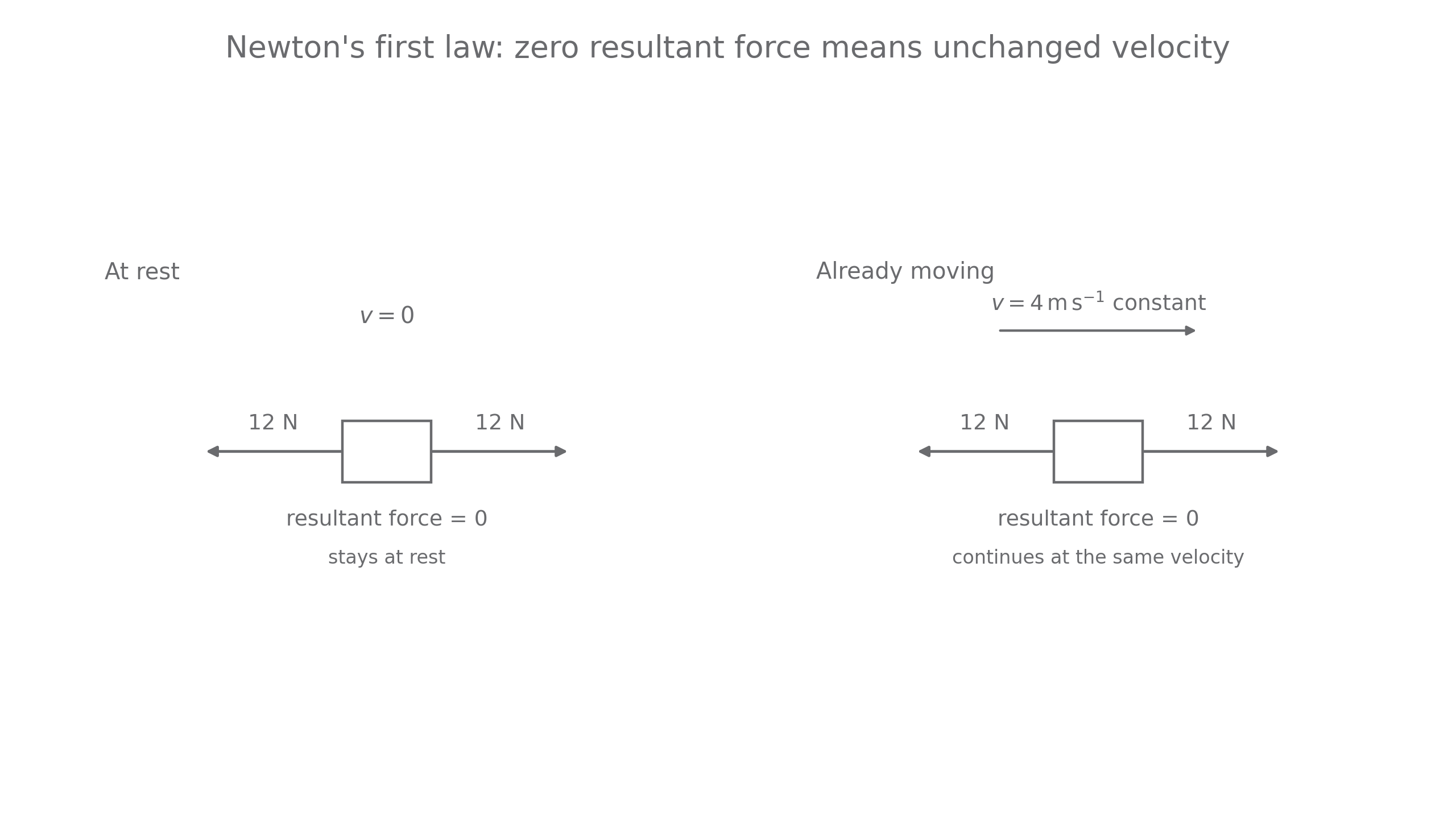
The two cases have the same force balance but different initial velocities.
Newton's first law
For a body in the usual fixed-frame mechanics model,
The body remains at rest or continues at constant speed in a straight line. Not in the formula booklet: learn it.
Constant velocity includes direction. Constant speed around a bend is not constant velocity. A particle in equilibrium has zero resultant force; it need not be stationary.
Continue this lesson.
You’re previewing NovaLearn without an account. Create a free account to read the rest.
Create free account