Pure 4.4 - Arithmetic sequences and series
Adding the same amount repeatedly creates an arithmetic sequence; adding its terms creates an arithmetic series. You will find terms and totals, prove the sum formula, and solve equations involving an unknown number of terms. Contexts with decreasing payments will show why a mathematically valid root can still be unsuitable.
Recognise an arithmetic sequence
Can you add without doing ninety-nine additions? The first and last terms make , and so do the second and second-last. We will turn that observation into a proof that works for any arithmetic series.
You already know
A sequence lists values, while a series adds them. Subtracting a term from the next gives its signed change: for , each difference is .
For this decreasing list, the first term is and the common difference is . The negative sign describes the direction of change; it is part of the data.
Arithmetic sequence
An arithmetic sequence has the same difference between every pair of consecutive terms. Starting at , it has terms
For example, is arithmetic with . The list is not arithmetic because its successive differences are .
The difference can be positive, negative or zero. A constant sequence is the boundary case . If only a few terms are displayed, equal differences identify the arithmetic pattern intended; proving an entire formula defines an arithmetic sequence requires showing that the difference is constant for all relevant positions.
For ,
This establishes the arithmetic structure for every , rather than just checking the first three terms.
Key idea
Arithmetic describes a fixed additive change, including a negative change. It does not mean “positive terms” or “increasing terms”.
Check the sign of a common difference before using any formula.
Find the nth term
To reach term from term , you make steps. That gap count explains the in the nth-term formula.
[DIAGRAM: asset_slug: p1_4_4_understand_and_work_with_arithmetic_sequences_and_series__diagram_01; asset_name: Pure 4.4 - Arithmetic sequences and series - diagram 01; recommended_method: drawn_math; description: Two clear panels show n-1 equal additions from the first term to term n and the pairing of a numerical arithmetic series with its reversed copy, giving equal column sums and the general equation 2S_n=n(a+l).]
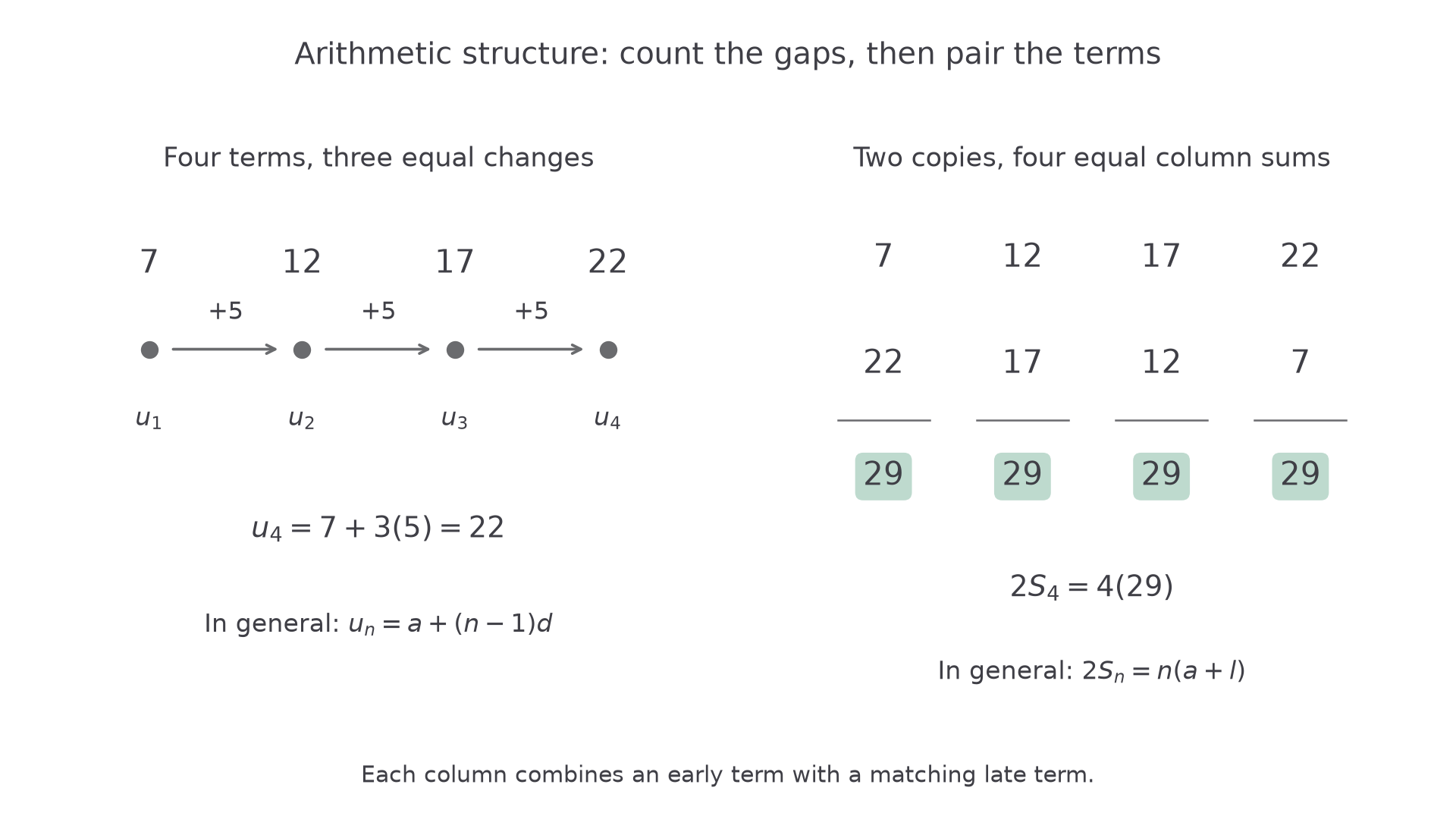
The left-hand picture tracks changes from the first term; it is not a count of how many terms are present.
Nth term of an arithmetic sequence
For , first term and common difference ,
Not in the formula booklet: learn it.
Use this same equation whether the unknown is a term, its position, the first term or the difference.
Worked example 1: counting the steps to a term
Question. An arithmetic sequence has and . Find .
Plan. Add copies of the common difference to the first term.
Why this step? The first term already supplies , so only increases are needed.
Answer. .
Check. The increase from to is .
Change only which quantity is unknown. The same term information now determines the common difference.
Worked example 2: reversing the nth-term calculation
Question. An arithmetic sequence has and . Find .
Plan. Substitute into the nth-term equation and solve for .
Why this step? The total change is spread across equal gaps, not .
Answer. .
Check. The reconstructed term is .
If two non-consecutive terms are given, subtract their equations. For example, and give , , hence , and . Subtraction counts the gaps between the two positions directly.
Watch out
starts one change too late: at it gives . Use , and check the first term.
Reverse the calculation with new term values.
Prove the sum formula
In , there are fifty pairs totalling . That gives quickly. To prove a formula for every term count, including odd counts, use a second reversed copy rather than trying to pair terms within one copy.
Let . Write the same sum forwards and backwards, then add corresponding terms:
Every column has the same total because the increase on one row is matched by the decrease on the other. Dividing by gives the required sum. The argument works for any sign of , and does not require to be even.
Arithmetic-series sum
For an arithmetic series with ,
Here is the first term, the last term and the common difference.
In the formula booklet.
The first natural numbers have , and . Substitution in the proved formula gives
This special-case formula is not separately printed in the 9MA0 booklet; derive it from the supplied arithmetic sum. It also explains a pleasing fact: the mean of the integers from to is , although none of them equals .
Worked example 3: summing a fixed number of terms
Question. Find the sum of the first terms of .
Plan. Use , and the sum formula containing .
Why this step? The last term is not supplied, so the form using avoids finding it separately.
Answer. .
Check. The final term is , giving average ; .
Change only the number of terms. The sequence's first term and common difference remain fixed.
Worked example 4: changing the term count
Question. Find the sum of the first terms of .
Plan. Use the same formula with .
Why this step? Increasing the term count also increases the last term; the old average cannot be reused.
Answer. .
Check. The last term is , and .
Knowing the formula is useful; explaining the equal pairs is what makes the proof convincing.
Watch out
The doubled sum has columns, not . Since , divide by once, after counting the columns.
Explain the general argument and its natural-number special case.
Choose the efficient formula
A series written up to a specified last term hides its term count. Find the count first; the final term is usually the best route to it.
| Known information | Efficient equation |
|---|---|
| first solve for |
Worked example 5: finding a hidden term count
Question. Find .
Plan. Find how many steps of lead from to , then sum.
Why this step? The equal gaps connect terms.
Answer. .
Check. The middle term is , matching the average .
Change only the last included term. This changes the term count as well as the average.
Worked example 6: extending an endpoint-defined sum
Question. Find .
Plan. Solve the endpoint equation before summing.
Why this step? The old count belongs to a different final term.
Answer. .
Check. The five added terms total , and .
An endpoint equation must give a positive integer count. For example, is not a term of the sequence beginning ; its gap count is not an integer.
Watch out
A fractional is not permission to round the term count. Check whether the proposed last value actually belongs to the sequence.
Use a new series with a visible endpoint.
Use arithmetic series in context
A known total often produces a quadratic in the number of payments. Define the individual payment first so that you sum the right quantities.
Worked example 7: finding the duration of a saving plan
Question. A student saves in week , then more each week. The total saved after weeks is . Find .
Plan. Set the arithmetic sum equal to the total, then keep a positive integer root.
Why this step? The total is a sum of payments; would describe one payment instead.
Answer. weeks; is unsuitable.
Check. Week is pounds, so .
Change only the target total. The saving rule stays fixed.
Worked example 8: the same plan with a new target
Question. Under the same saving rule, after how many weeks is the total ?
Plan. Form the new sum equation and solve it.
Why this step? A total condition need not be achievable at a whole number of weeks.
Answer. There is no exact whole-week solution: the positive root is , not an integer.
Check. , while ; the total lies strictly between them.
The single change to the total has exposed an important boundary: do not round a solution if the question asks for an exact total. If it asks when the total first exceeds , the answer instead is weeks.
Exam tip
Use the context to interpret roots. A duration needs a positive integer; “equals” and “first exceeds” require different conclusions when the root is fractional.
Try an exactly achievable total with new numbers.
Decreasing payments and valid term counts
For decreasing payments, even two positive integer roots may solve the sum equation. The payment amounts themselves decide whether a root fits the model.
Suppose each payment must be strictly positive. If and , require . This prevents the formula from extending into zero or negative “payments”.
Worked example 9: rejecting a positive but unrealistic root
Question. Payments are , and all payments must be positive. After payments the total is . Find .
Plan. Solve the sum equation, then check the last payment for each root.
Why this step? Both roots solve the algebra, but extends the model beyond positive payments.
Answer. payments.
Check. .
Change only the required total. There are again two integer roots, and the same positivity condition chooses between them.
Worked example 10: applying the term restriction
Question. Under the same positive-payment rule, the total is . Find the number of payments.
Plan. Solve the new sum equation and test each root's last term.
Why this step? A positive duration is necessary, but it does not guarantee positive payments.
Answer. payments.
Check. , and all preceding payments are larger than .
Our opening total is now explained by the general proof: . The same pairing idea handles increasing and decreasing sequences; the context supplies any extra restrictions.
Watch out
“Both roots are positive, so both are valid” is wrong for this model. Check , as well as .
Solve a new decreasing-payment case using both checks.
Quick Recap
- Arithmetic sequences have a constant signed difference, and .
- Reversing a second copy makes equal pairs, giving .
- The first natural numbers sum to .
- Find an unknown term count before summing an endpoint-defined series.
- Check roots against the required integer count and the meaning of every term.
The opening sum is , because the average term is and there are terms.