Pure 9.3 - Newton-Raphson and recurrence relations
Use recurrence relations to approach roots, and derive Newton-Raphson by following a tangent to the axis. You will calculate successive approximations, simplify a requested recurrence and recognise when a fast method becomes unreliable.
Use a recurrence to chase a fixed point
Can a straight line give a better root estimate than your current guess? Before using tangents, try a simpler repeated instruction: start at , then take . The outputs and head towards , a root of .
You already know
A fixed point satisfies . An iteration gives such a point if it converges and is continuous there. A valid fixed-point equation does not itself guarantee convergence.
An iterate is one member of this sequence of approximations. Follow the question's starting index carefully.
Worked example 1: a square-root recurrence
Question. Use , with , to find , and identify the possible positive limit.
Plan. Calculate with stored values, then solve the fixed-point equation.
Why this step? The square-root output is non-negative, so only the positive solution of the quadratic can be a limit.
Answer. , ; the possible limit is .
Check. Later values , move towards , and .
Change only the constant to . The same reasoning now identifies a different fixed point.
Worked example 2: preserving the branch condition
Question. Use , with , to find , and the possible positive limit.
Plan. Repeat the substitutions, then solve the resulting quadratic.
Why this step? Squaring creates the candidate , which cannot equal the non-negative square root.
Answer. , ; the possible limit is .
Check. , and both sides of the unsquared equation are positive.
Checking a limit against the unsquared recurrence prevents an algebraic extra solution slipping through.
Watch out
Wrong: every root of the squared equation is a possible limit. Right: enforce the original recurrence's domain and sign restrictions as well.
For comparison, from gives , , , alternating about its positive fixed point. Your turn changes only the coefficient of in the last worked recurrence from to .
Derive Newton-Raphson from a tangent
At a current estimate , replace the curve by its tangent at . The tangent's intercept with the -axis becomes . When the tangent follows the curve well, that intercept can be much closer to a root.
[DIAGRAM: asset_slug: p1_9_3_solve_equations_using_the_newton_raphson_method_and_other_recurrence_relations__diagram_01; asset_name: Tangents improve an estimate or cause a large jump; caption: Newton-Raphson follows a tangent to its axis intercept; a small gradient can send it far away; description: Left panel shows tangents to x squared minus 2 at 2 and 1.5 with successive axis intercepts. Right panel shows the nearly horizontal tangent to (x minus 1) squared minus 0.04 at x=1.03 meeting the axis near 1.68167, beyond the nearer root 1.2.]
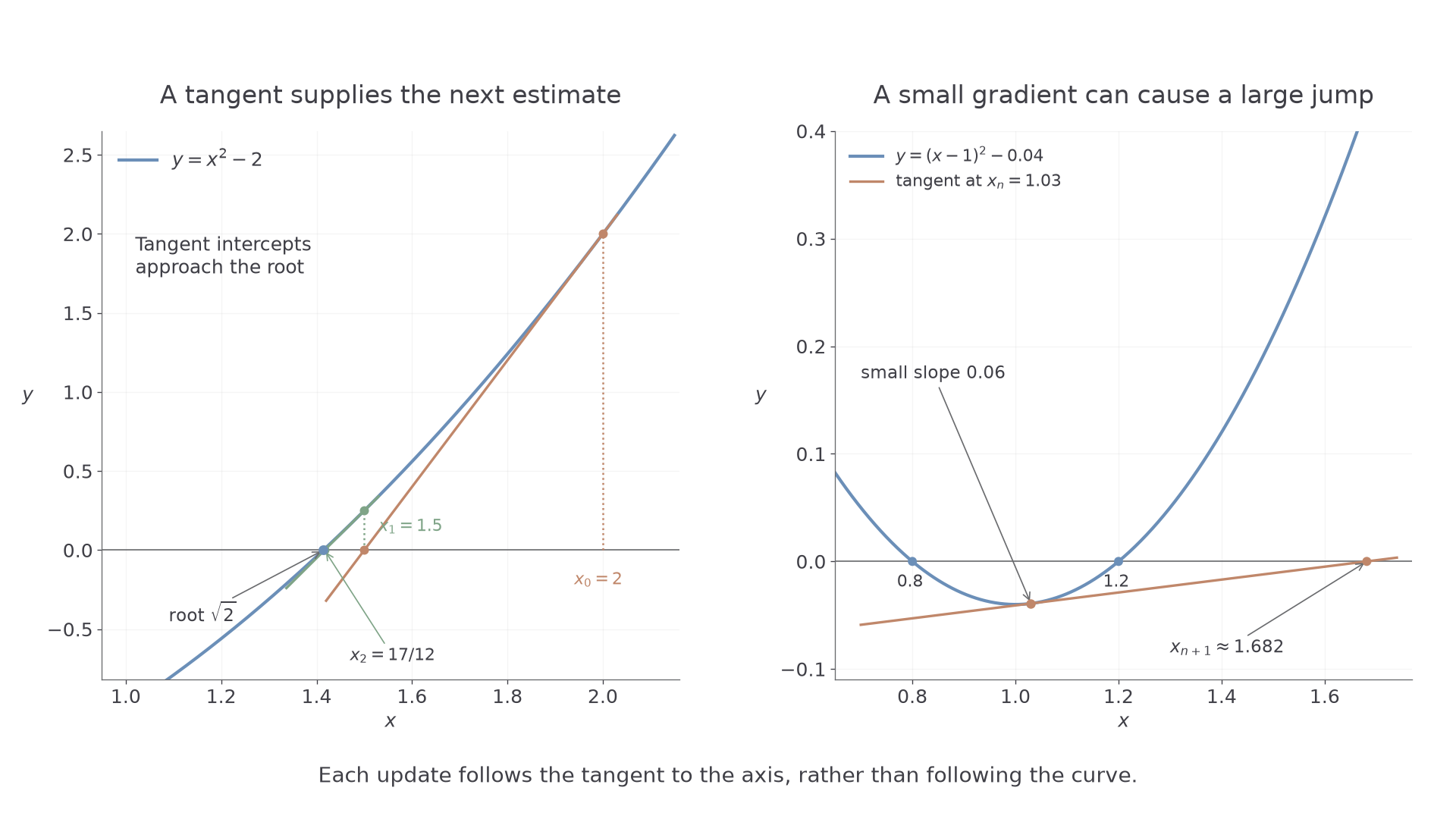
The tangent equation gives the formula rather than merely a picture to memorise:
Divide by the gradient, provided it is non-zero.
Newton-Raphson iteration
Use where is differentiable and . Convergence to the intended root is not guaranteed.
In the formula booklet.
A numerical tangent calculation makes the geometry concrete.
Worked example 3: deriving one step geometrically
Question. For , use the tangent at to find .
Plan. Find the point and gradient, then the tangent's intercept.
Why this step? The intercept is where the tangent predicts the curve reaches zero.
Answer. The next estimate is .
Check. ; is closer than the start .
Change only the constant in the curve to . The slope at remains , but the point's height changes.
Worked example 4: a changed tangent height
Question. For , use the tangent at to find .
Plan. Use the new function value with the same derivative.
Why this step? The correction is height divided by gradient, so changing the height changes the step.
Answer. .
Check. This is closer to than was.
The derivative is the slope at the current estimate, not at the root you are trying to find.
Key idea
The correction is the horizontal movement from the current point to the tangent's axis intercept.
Apply that geometry with new numbers.
Apply the Newton-Raphson formula
First write , differentiate, then insert the current estimate into both numerator and denominator. Keep the subtraction and brackets visible: a negative residual can make the estimate increase.
Worked example 5: two Newton-Raphson steps
Question. Use to find and for .
Plan. Differentiate the cubic and repeat the supplied formula using stored values.
Why this step? Reusing the unrounded preserves the accuracy of the second tangent calculation.
Answer. , .
Check. The residual at is about , far smaller in magnitude than .
Continue this lesson.
You’re previewing NovaLearn without an account. Create a free account to read the rest.
Create free account