Mechanics 8.5 - Addition and resultant forces in dynamics
Combine forces by adding their vectors, then use the resultant to find acceleration in a plane. You will turn magnitude-and-direction descriptions into components, recover directions without losing the quadrant, and use a given acceleration direction to determine unknown forces. The same two component equations connect force diagrams to motion.
Resultant force in a plane
Can a force and a force combine to make just ? Yes: let one point east and the other north. Their component triangle has hypotenuse , so adding their magnitudes would give the wrong physical effect.
You already know
Vectors add component by component. Newton's second law uses the resultant of all forces on the chosen particle: .
The useful surprise is broader: as the angle between those same two forces changes, their resultant magnitude can take any value from to . Opposite directions give ; the same direction gives . Direction is part of the data.
Resultant force
The resultant force is the vector sum of the forces acting on a particle. It is the single force with the same effect on the particle's acceleration as those forces acting together.
Use bold for the resultant here. It is a vector, unlike a normal reaction magnitude also sometimes denoted by .
Add force components
If , then
With constant positive mass , .
Not in the formula booklet: learn it.
The head-to-tail vector diagram and the component sum describe the same addition. Never place a third-law partner from another body's diagram in this sum.
[DIAGRAM: asset_slug: p3_8_5_understand_and_use_addition_of_forces_and_resultant_forces_in_dynamics__diagram_01; asset_name: Add force vectors; description: Perpendicular 3 N east and 4 N north forces on one particle, followed by a head-to-tail component triangle with 5 N resultant. Acceleration is parallel to the resultant for positive mass.]
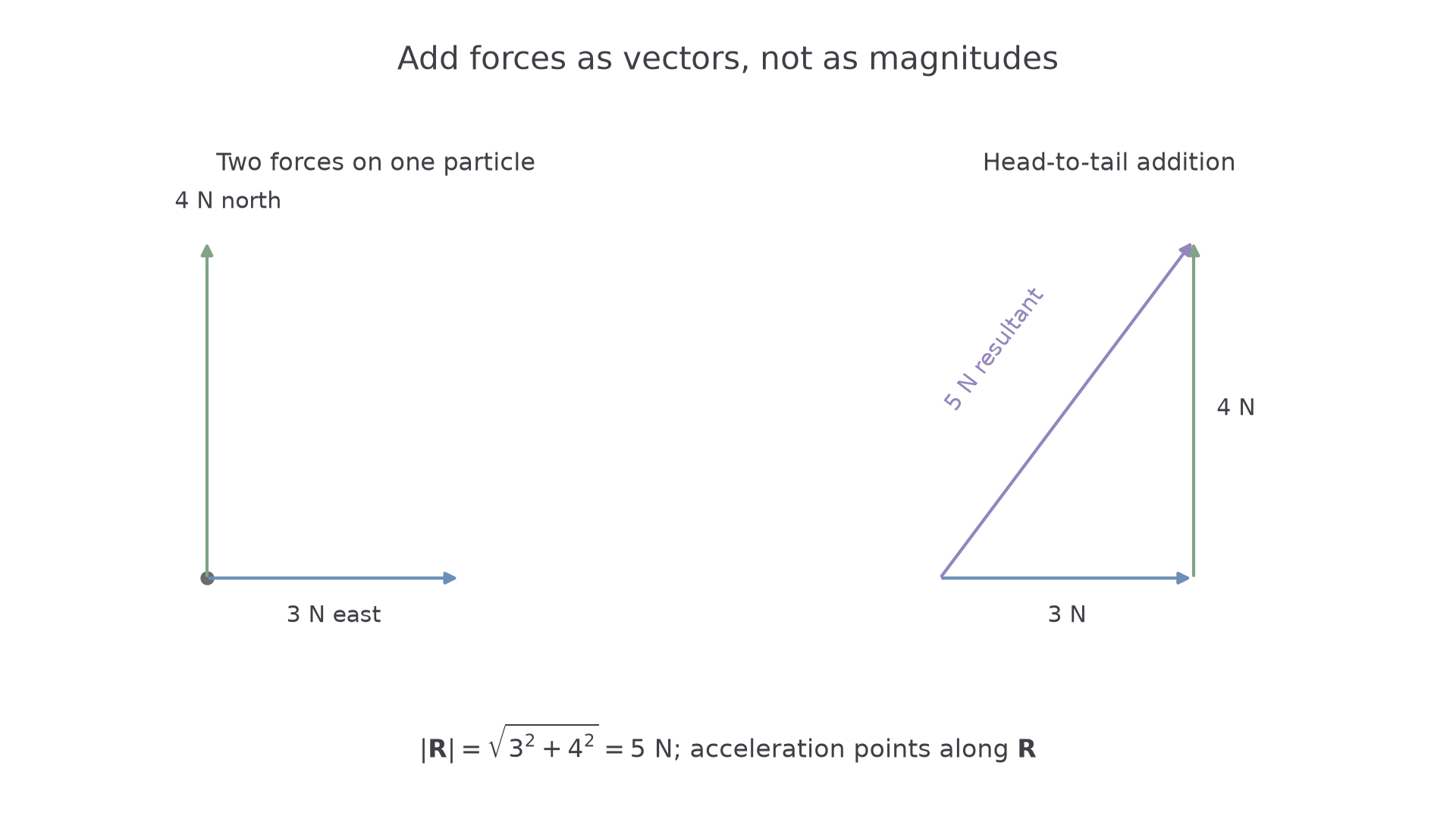
Add the signed components before dividing by the mass.
Worked example 1: three forces and a mass
Question. Forces , and act on a particle. Find resultant and acceleration.
Plan. Sum each component, then apply Newton's second law.
Why add first? Newton's second law concerns the combined effect, not any one force in isolation.
Answer. and .
Check. Multiplying each acceleration component by reproduces the resultant components.
Change just the direction of the third force by reversing it. Its magnitude stays unchanged, but both component signs reverse.
Worked example 2: reverse one force
Question. Keep the first two forces and mass above, but replace the third force by . Find resultant and acceleration.
Plan. Insert the reversed vector in the sum and divide by the same mass.
Why reverse both signs? Multiplying a vector by reverses its entire direction.
Answer. , .
Check. The resultant changed by , exactly twice the negative of the former third force.
The components may cancel even when none of the individual forces is zero.
Watch out
The line is valid only for forces in the same direction. Add the vectors before finding a magnitude.
Now combine three new component forces.
Magnitude and direction of the resultant
A component answer tells you how far a vector points along each axis. A magnitude-and-direction answer describes the same vector by its length and orientation. Sketch its quadrant before pressing the inverse tangent key.
Magnitude and direction from components
For ,
For non-zero components the acute reference angle satisfies ; choose the required direction from the component signs. A zero vector has no direction.
Not in the formula booklet: learn it.
If , the vector is vertical, so no division is needed. If , it is horizontal. When both are non-zero, your sketch tells you whether to add or subtract the acute angle from a straight or full turn.
Worked example 3: a first-quadrant resultant
Question. Find the magnitude of and its direction above the positive -direction, to decimal place.
Plan. Use Pythagoras, then inverse tangent within the known first quadrant.
Why is the acute calculator answer sufficient here? Both components are positive, so the direction lies between east and north.
Answer. Magnitude ; direction above the positive -axis.
Check. and , using unrounded .
Change only the horizontal sign. The magnitude and acute reference angle stay the same, but the quadrant changes.
Worked example 4: a leftward component
Question. Find the magnitude of and its direction anticlockwise from the positive -axis, to decimal place.
Plan. Find the acute reference angle, then locate it in quadrant II.
Why not report ? Its principal value is negative and points into the wrong quadrant.
Answer. Magnitude ; direction anticlockwise from the positive -axis.
Check. Cosine is negative and sine positive at this direction, matching the components.
An angle without a reference direction is ambiguous. Say where you start measuring and whether the turn is clockwise or anticlockwise.
Exam tip
For a requested direction, give the quadrant or bearing as well as a trigonometric calculation. A correct acute angle can still describe the wrong vector.
Use a different second-quadrant vector next.
Resolving forces given by magnitude and direction
A force at above the horizontal supplies upwards, with the remaining component to the right. Resolve each angled force before adding it to any other force.
Resolve a magnitude and direction
If a force of magnitude has direction measured anticlockwise from the positive -axis, then
If an acute angle is given from another reference line, identify adjacent and opposite components and assign their signs from the diagram.
Not in the formula booklet: learn it.
The component adjacent to the stated angle uses cosine. An angle from the vertical therefore puts cosine in the vertical component. Sine and cosine are not permanently attached to axis names.
[DIAGRAM: asset_slug: p3_8_5_understand_and_use_addition_of_forces_and_resultant_forces_in_dynamics__diagram_02; asset_name: Resolve then add; description: Left, a force at angle theta from the horizontal has horizontal component F cos theta and vertical component F sin theta. Right, a head-to-tail triangle shows the summed components and the resultant.]
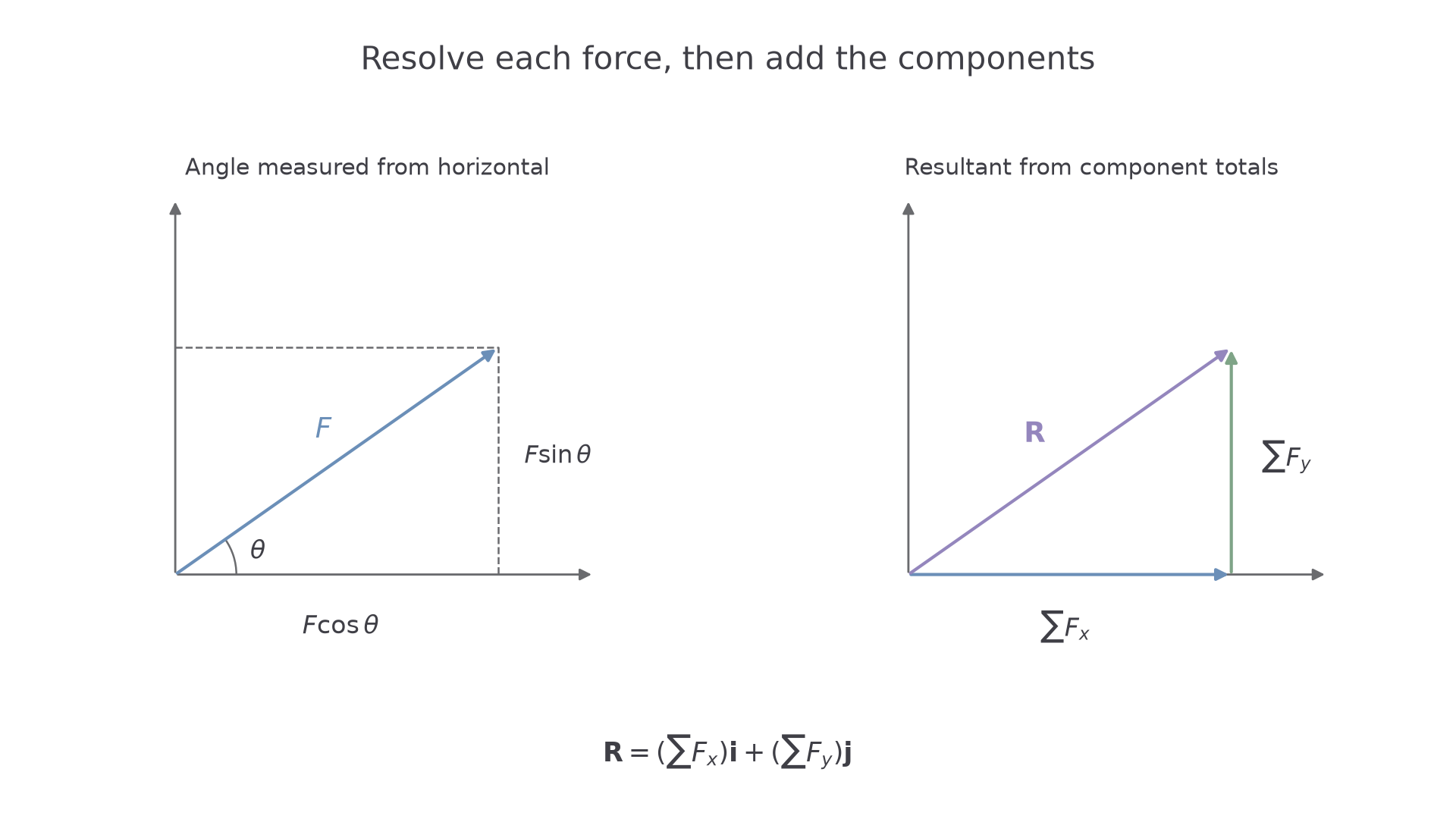
Keep exact trigonometric values when the angle permits them.
Worked example 5: resolve above the horizontal
Question. A force acts above the positive -direction. A second force is . Find the resultant exactly.
Plan. Resolve the first force, then add like components.
Why is the vertical component positive? The force points above the horizontal.
Answer. .
Check. The first force has squared magnitude .
Continue this lesson.
You’re previewing NovaLearn without an account. Create a free account to read the rest.
Create free account