Mechanics 8.6 - Friction, limiting friction and static friction
Decide how much friction a rough surface actually supplies, and when that amount reaches its limiting value. You will model rest and motion on horizontal and inclined surfaces, check what happens after stopping, and account for an angled force changing the normal reaction. The state of motion comes before the friction equation.
What the friction model measures
If a rough floor could supply of friction, why might it supply only ? Put an box on a horizontal floor with coefficient of friction , then push horizontally with . For the box to remain at rest, friction must balance that push, not exceed it.
You already know
Resolve perpendicular to a surface to find its normal reaction. Resolve parallel to it using for equilibrium or for motion, after choosing a positive direction.
Friction acts tangentially at the contact and opposes relative sliding, or the relative sliding that would occur without friction. A smooth surface supplies no friction. A rough stationary contact can supply zero friction when none is required.
Friction coefficient
The normal reaction magnitude is the perpendicular contact force. The friction magnitude acts along the surface. The dimensionless coefficient of friction gives the ratio of limiting friction to normal reaction in the model.
The ratio has no units because both numerator and denominator are forces. Static friction adjusts to the value needed for equilibrium, up to a maximum.
Static friction model
For a body in contact with a rough surface in equilibrium,
Here is the maximum available static friction, not automatically the actual value.
Not in the formula booklet: learn it.
If equilibrium requires a friction magnitude greater than , rest is impossible under the stated model. If the required magnitude is smaller, the actual value is smaller.
[DIAGRAM: asset_slug: p3_8_6_understand_and_use_the_f_r_model_for_friction_limiting_and_static_friction__diagram_01; asset_name: Actual and limiting friction; description: Three horizontal-contact diagrams show no horizontal push with zero friction, a smaller push balanced by static friction below mu R, and limiting equilibrium where the push and friction both equal mu R.]
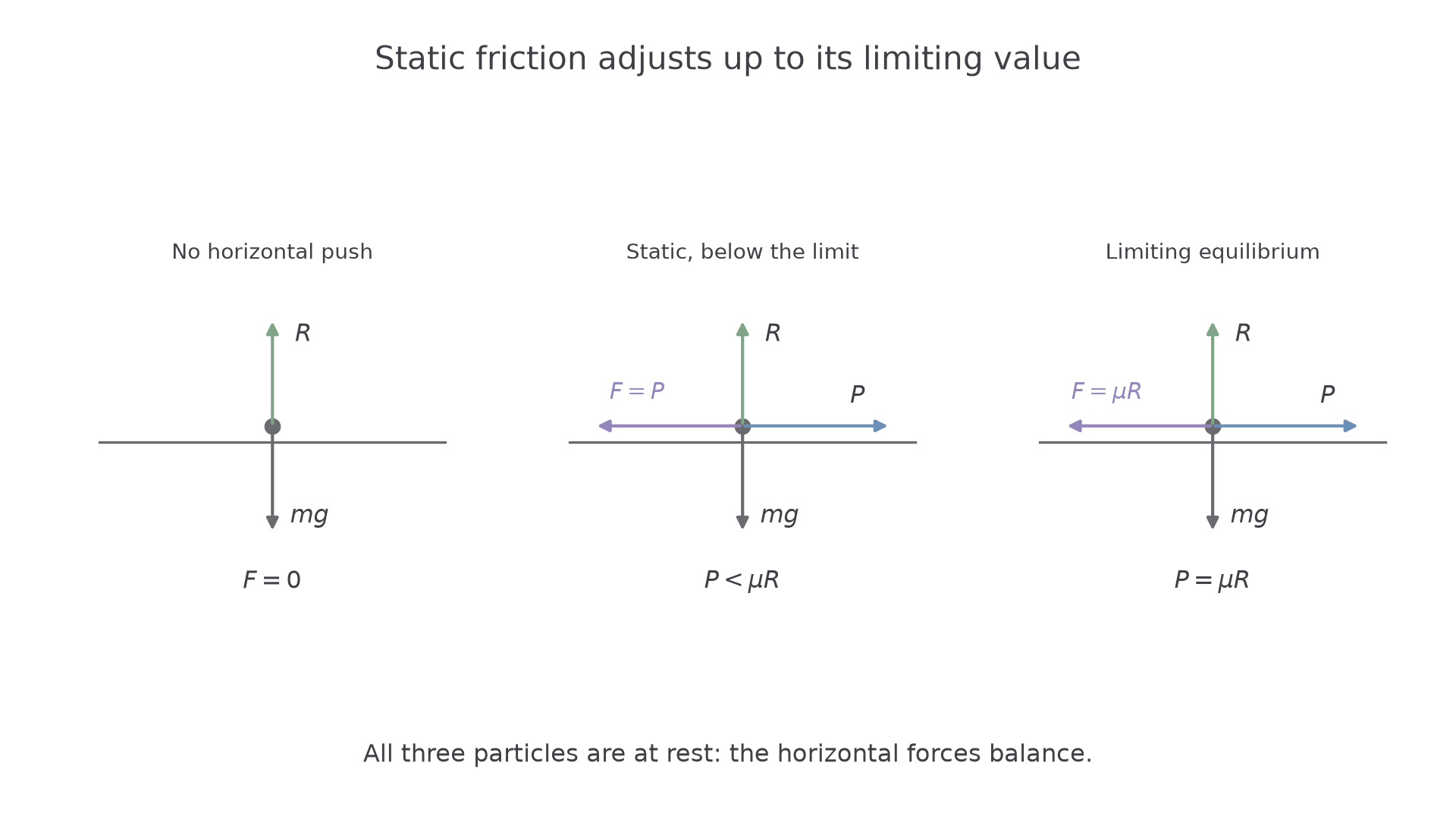
Compute the maximum and actual values separately.
Worked example 1: available friction and required friction
Question. An box rests on a rough horizontal floor, with . A horizontal push is applied and the box remains at rest. Find maximum and actual friction. Use .
Plan. Find vertically, calculate the maximum, then balance the horizontal push.
Why not use ? That would produce a non-zero horizontal resultant even though the box is stated to remain at rest.
Answer. Maximum friction is to significant figures; actual friction is , opposite the push.
Check. , so the required friction is available.
Change only the applied push to . The limiting value stays unchanged, but the actual friction responds.
Worked example 2: static friction adjusts
Question. With the same box and floor, a horizontal push is applied to the stationary box. Determine whether it can remain at rest and state its friction if it does.
Plan. Compare the friction needed for rest with the unchanged limiting value.
Why does the coefficient stay the same? It characterises this contact model, rather than the current force supplied by the floor.
Answer. It can remain at rest, with friction opposite the push.
Check. The horizontal resultant is , and the friction remains below the model's maximum.
A negative result from a signed friction component means the actual direction is opposite to the one chosen. Its magnitude is non-negative.
Watch out
The line for every stationary box replaces an adjustable force by its maximum. Use equilibrium to find actual friction first.
Keep the same limiting value but change the push again.
When to use equality
At the largest push that can be balanced, static friction reaches its maximum. The box can still be at rest: “limiting equilibrium” describes the boundary of possible rest, not an existing non-zero acceleration.
Limiting equilibrium
A body is in limiting equilibrium when it is in equilibrium and the frictional force has its maximum magnitude. It is on the point of slipping in the specified impending direction.
The specification also uses the equality for sliding motion in its friction model. This is an assumed law for the contact, rather than a claim that every real surface behaves identically at every speed.
Limiting or sliding friction
At limiting equilibrium, or while sliding under the stated friction model,
Friction opposes impending relative motion at the limit, and actual relative motion while sliding.
Not in the formula booklet: learn it.
The correct equation depends on the state, even if the surface and coefficient have not changed.
| State | Friction statement |
|---|---|
| Smooth contact | |
| Static contact, not necessarily limiting | Find required , then check |
| On the point of slipping | , with zero acceleration |
| Sliding in the specified model | , then use Newton's second law |
Use the boundary value to find a greatest allowable push.
Worked example 3: greatest horizontal force for rest
Question. A box rests on a horizontal rough floor with . Find the greatest horizontal force under which it can remain at rest. Use .
Plan. At the greatest force, horizontal equilibrium requires limiting friction.
Why use equality here? The word “greatest” selects the endpoint of the allowable inequality.
Answer. .
Check. Any can be balanced by . A greater push cannot.
Change only the coefficient to . The weight and reaction stay fixed, so the maximum scales with .
Worked example 4: a rougher contact
Question. For the same box and horizontal force, let . Find the greatest force consistent with rest.
Plan. Use the same normal reaction with the new limiting coefficient.
Why is unchanged? A purely horizontal push has no vertical component.
Answer. The greatest force is to significant figures.
Check. , as proportionality predicts.
The equality is an extra condition supplied by the limiting or sliding state. Simply seeing the word “rough” does not supply it.
Watch out
“Equilibrium” gives ; it does not alone give . “Limiting equilibrium” gives both statements.
Explain the distinction in your own words using the force conditions rather than a particular set of numbers.
Friction on an inclined plane
A slope gives weight a component along the surface. A particle about to slide down therefore needs uphill friction, whereas a particle already sliding uphill experiences downhill friction. Draw the state before choosing the arrow.
Rough incline with weight only
For a plane at angle to the horizontal, with no other force having a perpendicular component and with contact maintained,
Here is the weight component down the plane. Friction has maximum .
Not in the formula booklet: learn it.
The reaction is smaller than the whole weight because the plane is tilted. Resolve the actual force diagram if any additional angled force is present.
[DIAGRAM: asset_slug: p3_8_6_understand_and_use_the_f_r_model_for_friction_limiting_and_static_friction__diagram_02; asset_name: Friction directions on a slope; description: A particle about to slip down has uphill friction. A particle moving uphill has downhill friction. Both diagrams show vertical weight and a normal reaction perpendicular to the plane.]
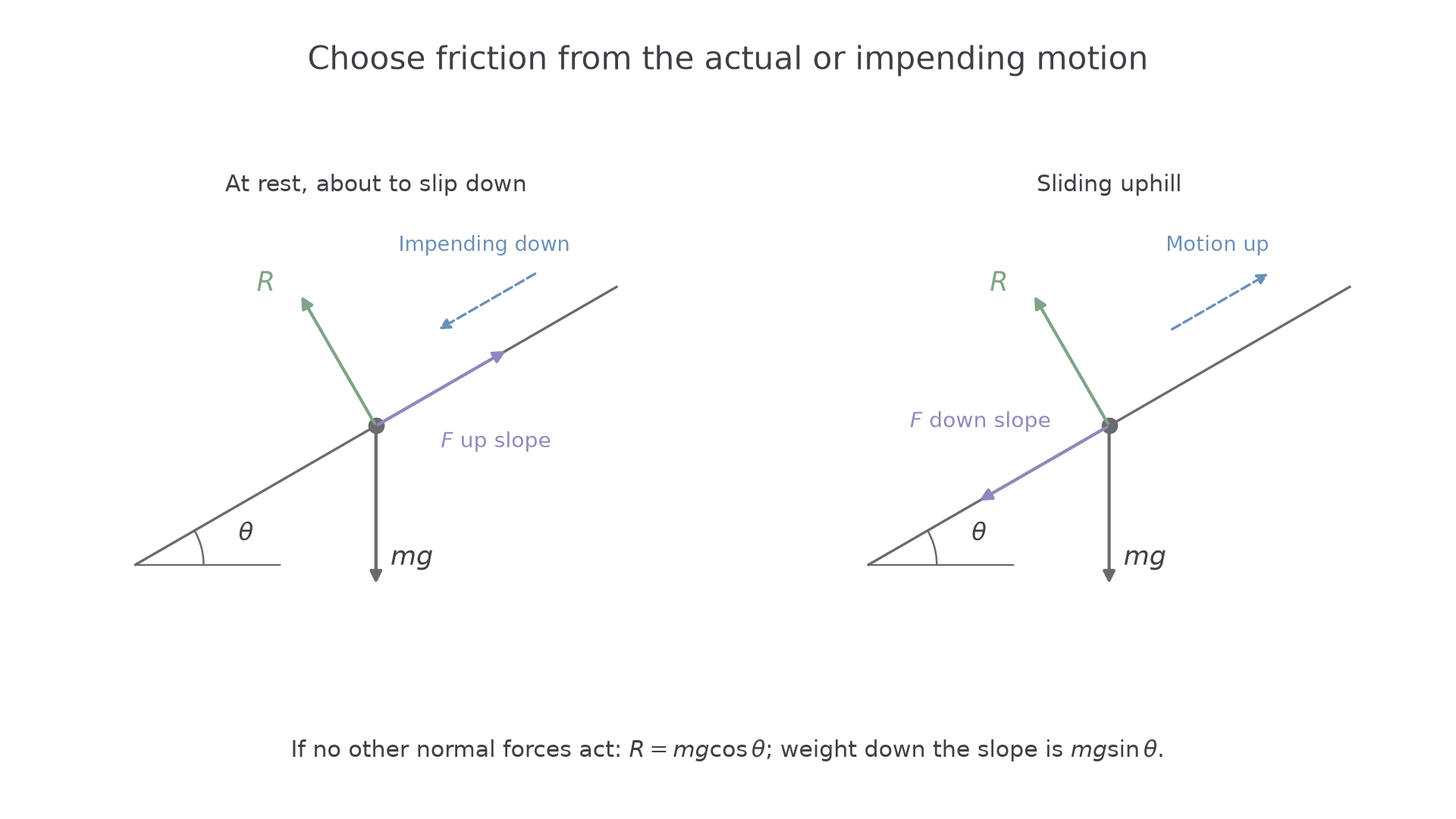
At the down-slipping boundary, both the weight component and the limiting friction scale with mass.
Worked example 5: coefficient at the slipping boundary
Question. A particle on a rough slope is on the point of sliding down. Given , , find .
Plan. Resolve in equilibrium, then equate the required friction to its limiting value.
Why can the mass cancel? Doubling the mass doubles both the downslope demand and the available maximum friction.
Answer. .
Check. In general at this boundary ; here .
Change only the slope angle, now with and . A steeper slope needs a greater coefficient at the boundary.
Worked example 6: a steeper limiting slope
Question. A particle is on the point of sliding down a slope where , . Find the coefficient of friction.
Plan. Balance along the slope and use the same limiting condition.
Why is friction uphill? Without it, gravity would start relative motion down the plane.
Answer. .
Check. , consistent with the steeper slope.
This gives a useful surprise: in this model, with weight as the only force apart from contact, the limiting angle is independent of mass. A larger mass increases the demand and capacity by the same factor. It does not mean mass is irrelevant when an extra fixed force is added.
Watch out
The statement “friction acts up the slope” is incomplete. It acts uphill for impending downward slip, but downhill for uphill sliding or impending upward slip.
Use the general boundary relation at a new angle.
Moving on a rough surface
During sliding, set friction opposite the velocity along the surface, then use . Acceleration may oppose the velocity, so its sign cannot choose the friction direction for you.
Sliding on an unforced incline
With no forces apart from weight and rough contact, take uphill as positive. For uphill sliding,
For downhill sliding, taking downhill as positive instead,
These equations apply only during the stated direction of sliding, while contact is maintained.
Not in the formula booklet: learn it.
Continue this lesson.
You’re previewing NovaLearn without an account. Create a free account to read the rest.
Create free account