Pure 4.5 - Geometric sequences and series
Repeated multiplication creates geometric sequences and their sums. You will find unknown terms and ratios, prove the finite sum formula, decide when a sum to infinity exists, and work backwards from sums. Logarithms will then let you find how many terms are needed to pass a target.
Fixed ratio structure
Can infinitely many positive numbers add to just ? The partial sums suggest they can. We will explain that limit and decide when the same idea fails.
You already know
A sequence lists terms; a series adds them. Index laws give when . A negative number raised to an odd power is negative; an even power is positive.
For , every new term is twice the previous one. The differences change, but the multiplicative rule stays fixed.
Geometric sequence
A geometric sequence has a fixed multiplier , its common ratio: . With non-zero consecutive terms, . For example, has . The list is not geometric, since its ratios differ.
Starting at , the terms are . There are multiplications from the first term to the nth.
Nth term of a geometric sequence
For first term , common ratio and ,
If , define the first term as and all subsequent terms as , avoiding any need to evaluate .
Not in the formula booklet: learn it.
Two known terms can reveal the ratio: divide their equations to eliminate , provided the denominator term is non-zero.
Worked example 1: finding a ratio from separated terms
Question. A geometric sequence has and . Find and .
Plan. Divide the term equations to find , then substitute back.
Why this step? Dividing removes the same first-term factor and leaves the three-step multiplier.
Answer. .
Check. and .
Change only the sign of the sixth term. The three-step multiplier, and therefore the ratio, becomes negative.
Worked example 2: allowing a negative ratio
Question. A geometric sequence has and . Find and .
Plan. Divide as before, retaining the sign of the quotient.
Why this step? An odd power determines the sign; replacing by would lose essential information.
Answer. .
Check. The terms begin .
If the gap between known positions is even, both signs of a real ratio may survive. For example, gives or , unless other information decides the sign.
Watch out
A geometric sequence need not increase, stay positive or converge. A negative ratio alternates signs; its magnitude controls whether term sizes grow or shrink.
Use a negative three-step multiplier with new values.
Finite geometric sums
The sum becomes especially simple if you double it and subtract the original sum. Most terms cancel. The same shift proves the general formula.
For terms,
Dividing by is legitimate only if . This proof is required knowledge even though the resulting formula is supplied.
Finite geometric sum
For and ,
If , every term equals and . The second fraction is an equivalent rearrangement of the printed first fraction.
In the formula booklet.
The formula applies to growing and alternating series as well as shrinking ones. Convergence is irrelevant for a finite number of terms.
Worked example 3: a growing finite series
Question. Find the sum of the first terms of .
Plan. Use , with the equivalent form.
Why this step? The form keeps numerator and denominator positive here; it is algebraically the same formula.
Answer. .
Check. .
Change only the sign of the ratio. The odd number of terms now matters when evaluating .
Worked example 4: a finite alternating series
Question. Find the sum of the first terms with and .
Plan. Substitute the whole negative ratio into .
Why this step? is negative, so subtracting it adds .
Answer. .
Check. .
The same proof works for , giving the lone non-zero first term. It does not work by division when , since the cancellation equation then reads .
Watch out
Using in the sum formula confuses the last term with the shifted term that remains after subtraction. The finite sum uses .
Try a new finite alternating sum.
Sum to infinity
For , successive partial sums are . They keep growing, yet the amount still missing from keeps halving.
[DIAGRAM: asset_slug: p1_4_5_understand_and_work_with_geometric_sequences_and_series__diagram_01; asset_name: Pure 4.5 - Geometric sequences and series - diagram 01; recommended_method: drawn_math; description: Two discrete partial-sum plots compare ratios one-half and negative one-half. The first approaches two from below; the second alternates around two-thirds. Every plotted point is at an integer term count and the limit is shown by a labelled dashed horizontal line.]
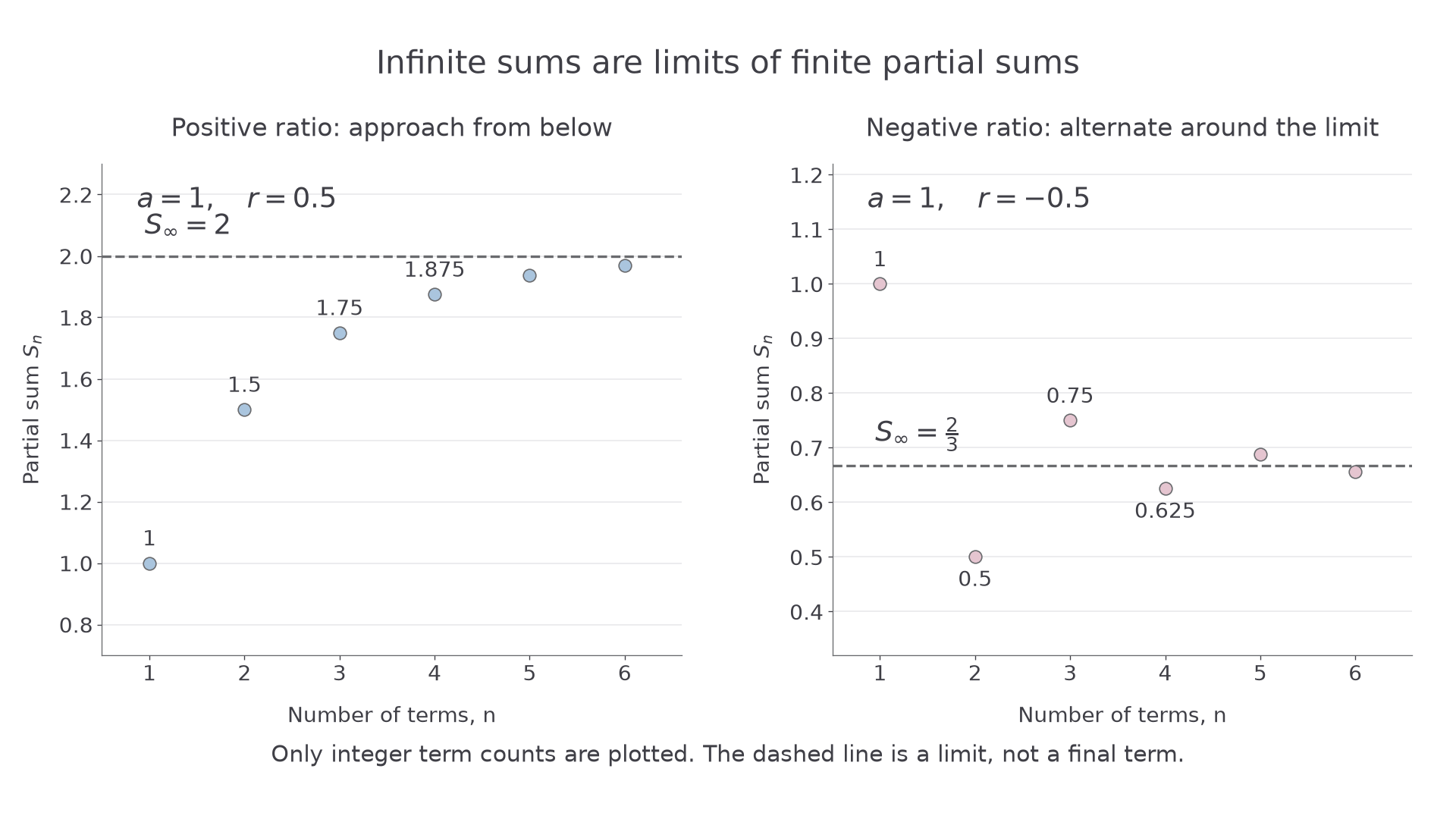
A sum to infinity is the limit of the partial sums, not the value reached after a final term. If , then , so the finite sum formula tends to a fixed value.
Sum to infinity
For a convergent geometric series,
For , the condition is necessary: otherwise the terms do not tend to zero. The all-zero series is a degenerate exception with sum .
In the formula booklet.
Shrinking term sizes are enough here because the series is geometric. They are not enough for an arbitrary series; do not extend this condition beyond the result just proved.
Worked example 5: convergence with a negative ratio
Question. Find the sum to infinity of .
Plan. Find the signed ratio, check its magnitude, then use the infinite sum.
Why this step? A negative ratio does not prevent convergence when its magnitude is below .
Answer. .
Check. The first two partial sums are and , on opposite sides of .
Change only the sign of the ratio. Now every term is positive, so the partial sums approach the limit from below.
Worked example 6: convergence with a positive ratio
Question. Find the sum to infinity of .
Plan. Use and check the same magnitude condition.
Why this step? Changing the sign changes the denominator from to .
Answer. .
Check. The first three terms total , and the remaining positive terms contribute .
If , then but . Terms grow in magnitude, so no finite sum to infinity exists for a non-zero first term. At , partial sums alternate without approaching one value; at , they grow linearly if .
Watch out
Checking only is insufficient. The condition is , equivalently .
Decide which of these new series may use the infinite-sum formula.
Working backwards from sums
A relationship between a finite and infinite sum can determine the ratio without knowing the first term. The key is to retain the common factors until you can cancel them legally.
For a non-zero convergent geometric series,
This follows by dividing the supplied formulas; it is a derived relationship, not a separately printed formula. If an even power of is known, both real signs may be possible.
Worked example 7: an even power leaves two ratios
Question. A convergent geometric series has non-zero first term. Given , show that .
Plan. Substitute both sum formulas, cancel the non-zero common factor, and solve for .
Why this step? Convergence gives , and the non-zero first term makes the cancelled factor non-zero.
Answer. or ; both satisfy .
Check. Either sign gives , as required.
Change only the multiplier linking the two sums. Keep the fourth partial sum, so the sign ambiguity survives.
Worked example 8: a different sum ratio
Question. A convergent geometric series has non-zero first term and . Find all possible .
Plan. Express the relation as an equation in .
Why this step? An even power cannot distinguish a ratio from its negative.
Answer. or .
Check. Both have magnitude below , and .
If instead a relation determines , only is real. Once a ratio is known, an actual sum such as determines . If a series starts at the second term, its first term is , not .
Exam tip
In a “show that” question, display the substitution and cancellation leading to the printed ratio. State why a cancelled factor is non-zero when that matters.
Use a new multiplier with the same fourth partial sum.
Using logs for n
If appears as an exponent, logarithms bring it down. For sums, first isolate ; taking logs of a whole difference such as does not separate its terms.
You already know
For , . Logarithms need positive arguments. Dividing an inequality by a negative number reverses its direction; when .
For positive-term geometric series with , partial sums increase towards . A target equal to or greater than that limit cannot be exceeded. For negative ratios, parity and alternating partial sums need separate attention; never take a real logarithm of a negative base.
Worked example 9: the least term count above a target
Question. A geometric series has , . Find the least for which .
Plan. Rearrange the sum inequality to a power inequality, use logs, then check neighbouring integers.
Why this step? Dividing by reverses the inequality.
Answer. The least integer is .
Check. , while .
Change only the target, keeping the sequence fixed. A target closer to the limit needs more terms.
Worked example 10: moving closer to the limit
Question. With , , find the least for which .
Plan. Isolate the remaining fraction of the limiting sum and use logs.
Why this step? The difference , rather than itself, is the geometric power.
Answer. .
Check. , and .
For an equation such as , isolate and solve , with . Check that the result is an allowed integer if an exact term count is required.
The opening puzzle is settled by the same limit: . No finite partial sum equals ; the remaining distance tends to zero.
Watch out
The least integer above is , not the nearest integer . Verify the two neighbouring sums, particularly for a strict inequality.
Apply the method to a new ratio and first term.
Quick Recap
- Geometric sequences multiply by a fixed signed ratio: .
- Subtracting a shifted copy proves for ; use if .
- A non-zero geometric series has a finite sum to infinity exactly when .
- Relationships between sums can determine ; even powers may leave two signs.
- Isolate before using logs, and check the integer threshold.
Infinitely many positive terms can have total : approaches that value because the missing fraction keeps halving.