Mechanics 7.1 - The language of kinematics
Describe a journey precisely by separating position, displacement, distance, velocity, speed and acceleration. You will calculate average rates and use signs to explain motion, ready for the graphs, formulae and calculus that follow.
Position and motion
Can you complete a journey with zero average velocity despite covering plenty of ground? Imagine cycling east, turning round and arriving back where you started. The answer depends on what “average” measures.
First we need a reference point. Choose an origin and take right as positive. Position places a particle left of ; it does not tell you which way the particle is moving. In a particle model, one point represents the object and its size and shape are ignored.
You already know
A signed coordinate gives a location relative to an origin. A scalar has magnitude only; a vector also has direction.
Changing the origin changes the position coordinates, but it does not change the physical journey.
Position
Position is location relative to a chosen origin. In straight-line motion a signed coordinate specifies which side of the origin a particle occupies. For example, with east positive, means west of .
A particle can be west of the origin and travelling east towards it. Position and direction of travel answer different questions.
Key idea
The sign of position locates the particle; you need velocity to know its direction of motion.
Keep that distinction when interpreting a negative coordinate.
Distance and displacement
Walking from to , then back to , covers more ground than the change between the endpoints. Keep a running total for the route and a separate comparison of start and finish.
Displacement
Displacement is change in position: final position minus initial position. In a straight line it is signed; it can be positive, negative or zero.
The path between those endpoints matters when the question asks for distance.
Distance travelled
Distance travelled is the total length of the path followed. It is nonnegative, with zero possible if no path has been covered.
The diagram compares an outward-and-return route with its single endpoint-to-endpoint displacement.
[DIAGRAM: asset_slug: p3_7_1_understand_and_use_the_language_of_kinematics_position_displacement_distance_velocity_speed_and_acceleration__diagram_01; asset_name: Distance and displacement on an outward-and-return route; caption: The route has length 8 metres and displacement +2 metres; description: A route from 0 to 5 metres and back to 2 metres has distance 8 metres and displacement +2 metres. A separate panel distinguishes signed velocity and acceleration from nonnegative speed.]
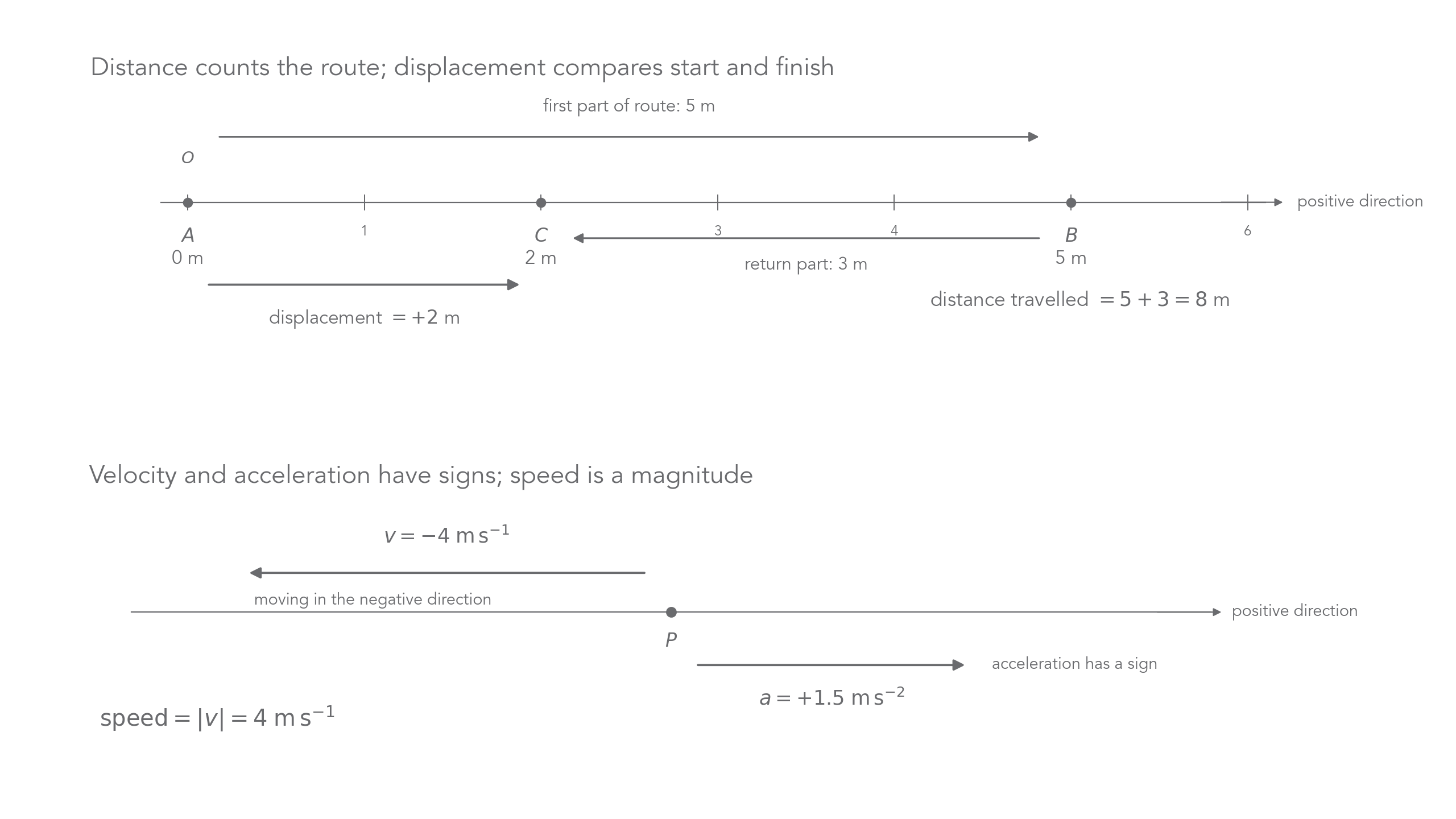
Use absolute differences for the path lengths.
Worked example 1: count the route
Question. A particle moves from to , then back to , with positions in metres. Find distance and displacement.
Plan. Add the two path lengths, then compare final and initial positions.
Answer.
Why use magnitudes for ? Each length contributes positively even when travel is to the left.
Check. : the route is at least as long as the direct separation.
Change only the final position to the starting position. The route remains nonzero.
Worked example 2: return to the start
Question. The same particle goes from to , then back to . Find distance and displacement.
Plan. Keep both path lengths; subtract the endpoint coordinates for displacement.
Answer.
Why is displacement zero? It records the net change, not how busy the particle has been.
Check. The return path retraces the outward , so the total is twice that length.
A negative displacement can also accompany a positive distance.
Watch out
Writing distance as final position minus initial position loses any backtracking. Add path lengths for distance; subtract endpoint positions for displacement.
Try another return journey with a different outward endpoint.
Velocity and speed
A speedometer measures how fast you move, without saying where you are going. Velocity includes that direction: means speed in the negative direction.
Velocity and speed
Velocity is the rate of change of displacement. Speed is the rate at which distance is travelled, equal to the magnitude of instantaneous velocity. In straight-line motion, speed is , including zero at rest.
For a whole journey, use the total elapsed time, including any stationary intervals.
Average rates
The time interval must be positive. Not in the formula booklet: learn it.
Here is the opening puzzle with actual numbers. It is a surprising but exact fact: a complete return journey has zero average velocity however large its distance.
Worked example 3: a complete return
Question. A cyclist travels east in , then west in . Find both average rates, taking east as positive.
Plan. Divide the whole distance and the net displacement by the same total time.
Answer.
Why use the same denominator? Both rates describe the same complete journey.
Check. The speed lies between the outward speed and return speed , in .
Continue this lesson.
You’re previewing NovaLearn without an account. Create a free account to read the rest.
Create free account