Pure 2.8 - Composite and inverse functions
Functions describe processes with one output for each allowed input. Learn to combine those processes, undo them and use their domains and graphs to decide which answers make sense. Keeping track of the direction of each mapping is the central skill.
Functions as mappings
A machine squares a number and adds one. If its display reads , can you recover the input? Both and produce , so the display alone cannot tell you. We will find the condition that makes reversal possible.
You already know
Substitution evaluates a rule: if , then . Solving gives two real values, and .
A function must say which inputs are allowed. For , , every real input is allowed and the outputs are all at least .
Function, domain and range
A function assigns each input in its domain exactly one output. Its range is the set of outputs actually produced. A one-one function never gives the same output from two different inputs; a many-one function does.
For example, on is one-one; on is many-one. A rule assigning both and to the single input is not a function.
The notation gives the rule as a mapping; gives the same rule in function notation. Its range can be written or . Square brackets include an endpoint; the round bracket at infinity never includes infinity as a number.
[DIAGRAM: asset_name: One-one and many-one mappings; asset_slug: p1_2_8_understand_and_use_composite_functions_inverse_functions_and_their_graphs__diagram_01; caption: Each input has exactly one output in both mappings; description: A one-one mapping sends 1, 2, 3 to 4, 5, 6 respectively. A many-one mapping sends -2 and 2 to 4 and 3 to 9.]
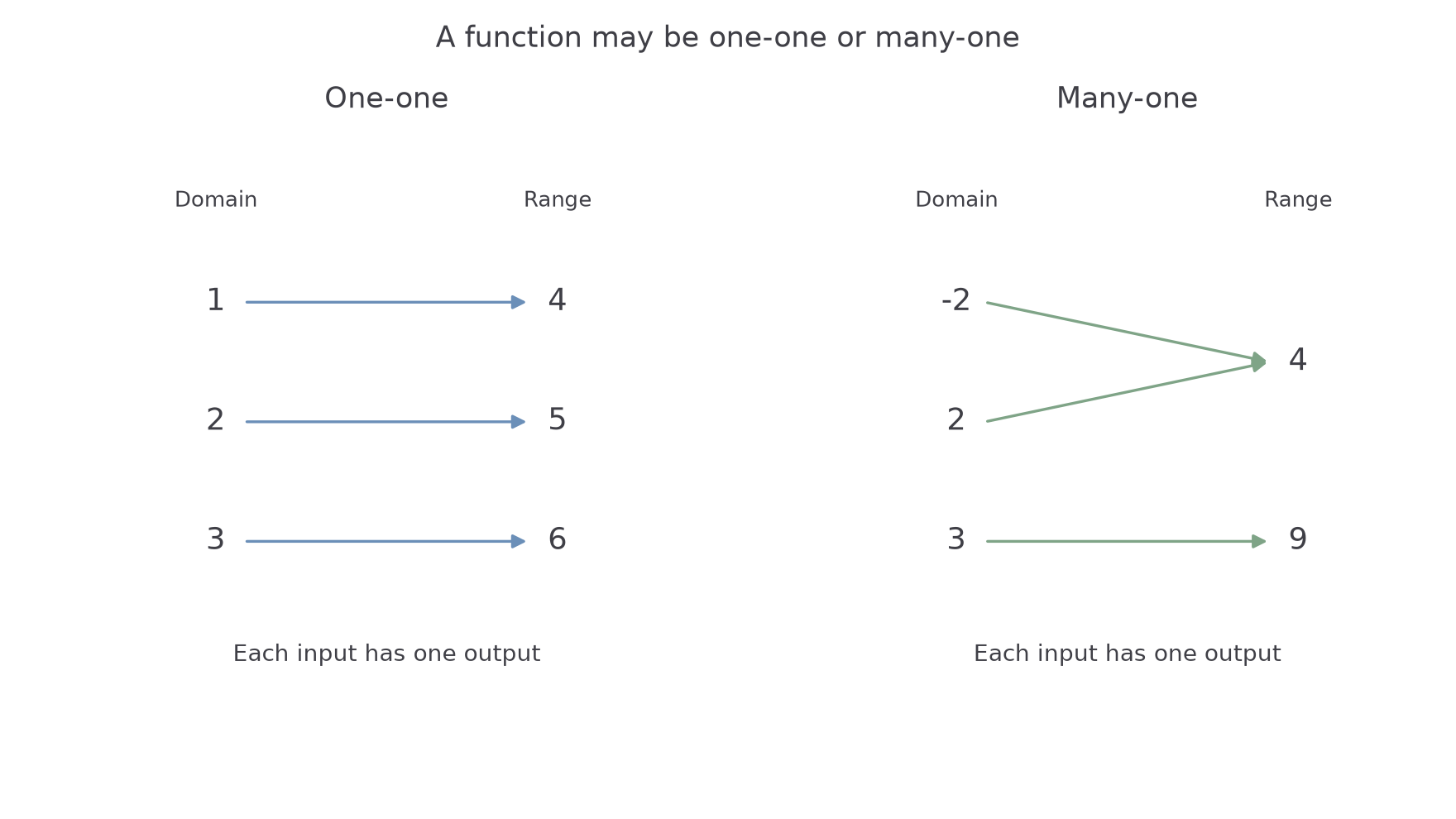
There is a neat surprise: restricting to makes it one-one without changing its range at all. Every output at least still occurs, but its duplicate negative input has disappeared. Restricting to works too, and gives a different inverse later.
Key idea
Many-one is allowed for a function; it is the obstacle to reversing that function uniquely.
Use the domain as well as the formula in this check.
Composite functions
A composite connects the output of one function to the input of another. With and , input goes through to , then through to .
Composite function
means do first, then . The input must belong to the domain of , and must belong to the domain of .
The nearest function to the input acts first. Composition generally changes when its order changes.
[DIAGRAM: asset_name: Function composition pipeline; asset_slug: p1_2_8_understand_and_use_composite_functions_inverse_functions_and_their_graphs__diagram_02; caption: The inner function acts first; description: Input x enters g, output g(x) enters f, and the final output is f(g(x)) or fg(x). The intermediate output must be in the domain of f.]
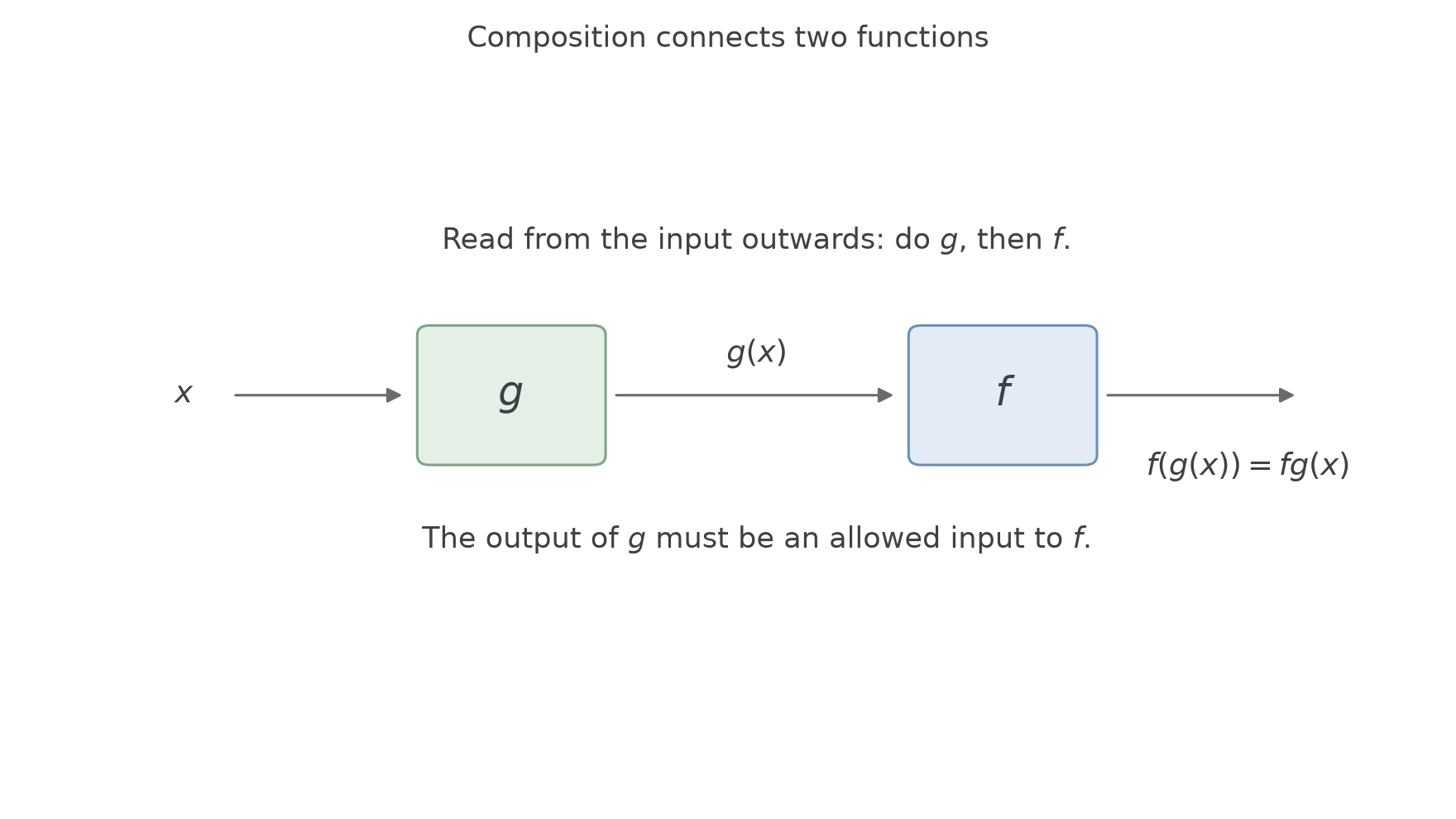
The pipeline notation is not a multiplication rule; replacing a whole input by brackets keeps that distinction clear.
Worked example 1: compose two rules
Question. For and , both on , find .
Plan. Substitute the complete expression into the input position of .
Why the brackets? Everything produced by is the input multiplied by .
Answer. , for .
Check. At , , , and .
Change only the order. The same two rules now carry out the operations in reverse sequence.
Worked example 2: reverse the composition order
Question. For the same and , find .
Plan. Put into the rule for .
Why is it different? Squaring after adding creates a cross term; adding after squaring does not.
Answer. , for .
Check. At , , , agreeing with the expression.
Domains can limit a composite even when its algebra looks simple. For and , needs ; needs .
Watch out
The wrong line treats composition as multiplication. The correct line is .
Now change the linear rule and evaluate both orders at one input.
Inverse functions
An inverse reverses the direction of a one-one function. If sends to , then sends back to . The inverse's inputs therefore come from the original range.
Inverse identities
For a one-one function ,
Not in the formula booklet: learn it.
To find the reverse rule, solve for the original input , then name the inverse's input again.
Worked example 3: invert a rational function
Question. Find the inverse of , .
Plan. Rearrange , collecting all terms containing the original input.
Why collect before dividing? The input occurs in both numerator and denominator; it must be isolated as one factor.
Answer. , . The range of excludes , since .
Check. and .
Change only the numerator's constant, from to . The rearrangement is unchanged, but the inverse's rule changes.
Worked example 4: track a changed constant
Question. Find the inverse of , .
Plan. Clear the denominator and factorise the input terms.
Why exclude again? never equals .
Answer. , .
Check. and .
The superscript is notation for reversal, not an instruction to take a reciprocal.
Watch out
in general. For , the inverse is , whereas the reciprocal is .
Change the numerator's constant once more and show the reverse rule.
Domains, ranges, and graphs of inverses
Swapping input and output swaps domain and range. It also swaps coordinates: a point on becomes on . Geometrically, that is reflection in .
[DIAGRAM: asset_name: Reflection of an inverse graph; asset_slug: p1_2_8_understand_and_use_composite_functions_inverse_functions_and_their_graphs__diagram_03; caption: Reflect the non-negative branch of the square graph in y equals x; description: Equal-scale axes show y=x squared for x non-negative and its inverse y=square root of x, with reflection line y=x and swapped points (2,4) and (4,2). The excluded negative branch is faint and dashed.]
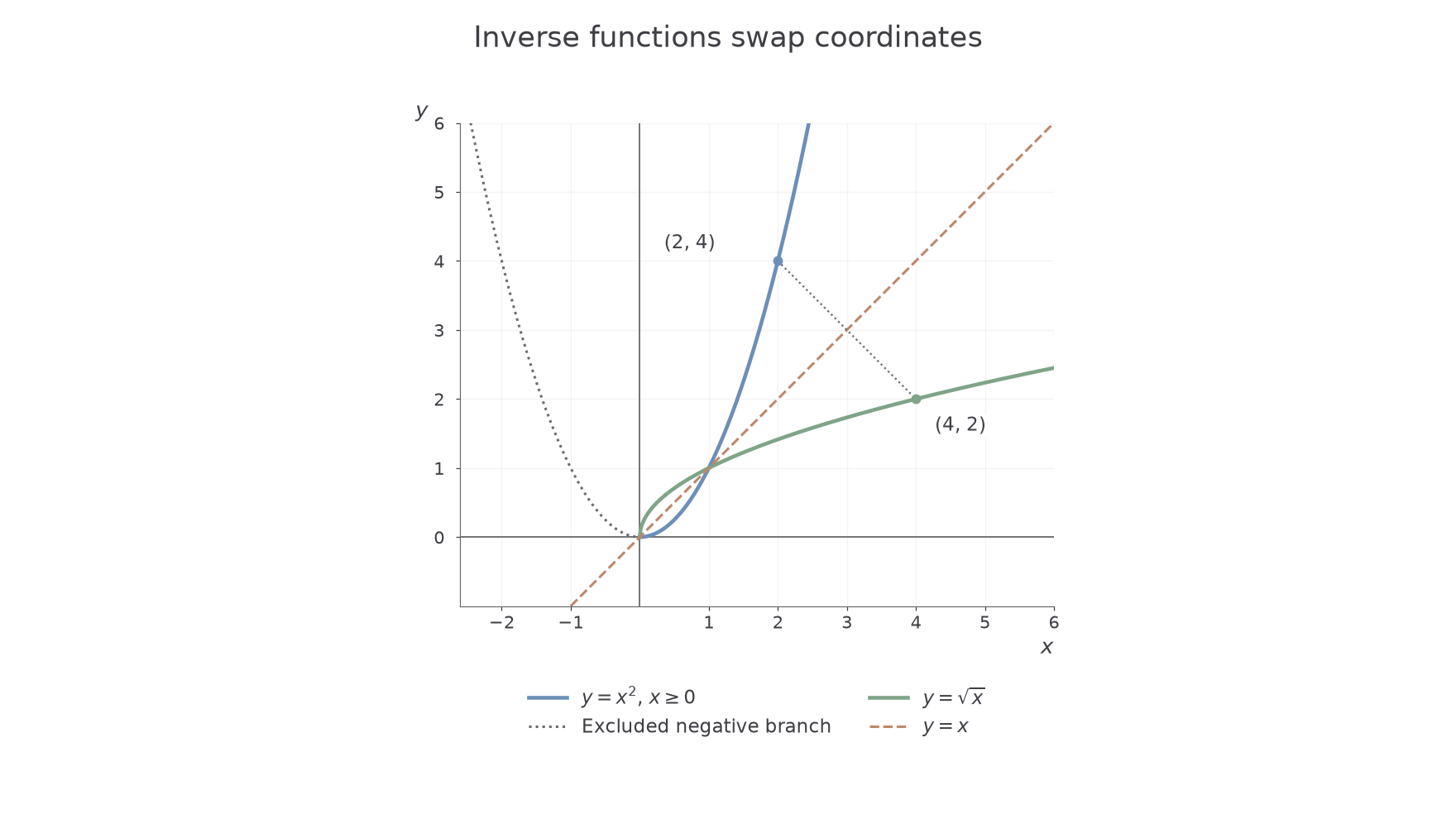
A quadratic must be restricted to one branch before it can be reversed. The branch determines which square root to choose.
Worked example 5: the increasing quadratic branch
Question. Find the inverse of , , stating its domain and range.
Plan. Rearrange, choosing the square root consistent with the original domain.
Why the positive root? The original function accepts no negative inputs.
Answer. , with domain and range . Its graph reflects the original branch in .
Check. The original point becomes , since .
Change only the domain to . The formula and original range stay the same, but the inverse must return negative inputs.
Worked example 6: the decreasing quadratic branch
Question. Find the inverse of , , stating its domain and range.
Plan. Use the negative square root when reversing the rule.
Why not write both signs? An inverse function must produce exactly one output for each input.
Answer. , domain , range .
Check. , and . Also when .
For a shifted quadratic, apply the same sign decision to the bracket rather than to alone. For example, on has inverse , domain .
Exam tip
State the inverse's domain as the original range. A correct rearrangement with the wrong branch is not a correct inverse.
Keep the negative branch and change the vertical shift.
Using composites and inverses together
Read a mixed expression from the input outwards. In , first undo , then apply . You do not undo the entire composite unless brackets say so.
Worked example 7: undo then apply
Question. Let , , and , . Find .
Plan. Find the permitted inverse of , then feed its output into .
Why start with the inverse? It is nearest to the input .
Answer. .
Check. , so is the correct recovered input; it lies in the domain of .
Change only the input from to . This lets you follow the same route without rebuilding it.
Worked example 8: a different input through the same pipeline
Question. For the same functions, find .
Plan. Undo the square-and-add rule first.
Why is the input allowed? , so it belongs to the domain of .
Answer. .
Check. , confirming the inverse step.
The cancellation identities also explain the opening puzzle. The machine can be undone only after a one-one domain is chosen: returns on , and on .
Problem-solving
Write a mixed expression as nested brackets, check the inner domain, and work outwards one function at a time.
A final input gives the same sequence with new numbers.
Quick Recap
- A function gives exactly one output for each allowed input; it may be many-one.
- means do first, then , checking both domains.
- A one-one function has an inverse that swaps its domain and range.
- Inverse graphs reflect in , so corresponding coordinates swap.
The machine displaying reveals its input only after we choose a one-one domain: non-negative inputs give ; non-positive inputs give .