Pure 5.1 - Unit-circle trigonometry, triangle rules and radians
Use a point on a circle to understand sine, cosine and tangent for any angle, then choose triangle rules and radian formulae to solve geometry problems. You will also learn why the sine rule can describe two different triangles, and how to separate a circular segment from its sector.
Sine, cosine and tangent on the unit circle
A curved window has radius and an arc of length : how much glass lies between the arc and its straight chord? We will answer that after building the circle and triangle tools. Start with the simplest circle, of radius , and a point reached by turning from the positive -axis.
You already know
In a right-angled triangle, sine is opposite over hypotenuse, cosine is adjacent over hypotenuse and tangent is opposite over adjacent. Pythagoras' theorem gives on a circle of radius .
The right-triangle ratios give the coordinates . A coordinate can be negative, even though an ordinary side length cannot: that is how the circle extends trigonometry beyond acute angles. Positive angles turn anticlockwise; negative angles turn clockwise.
Unit-circle definitions
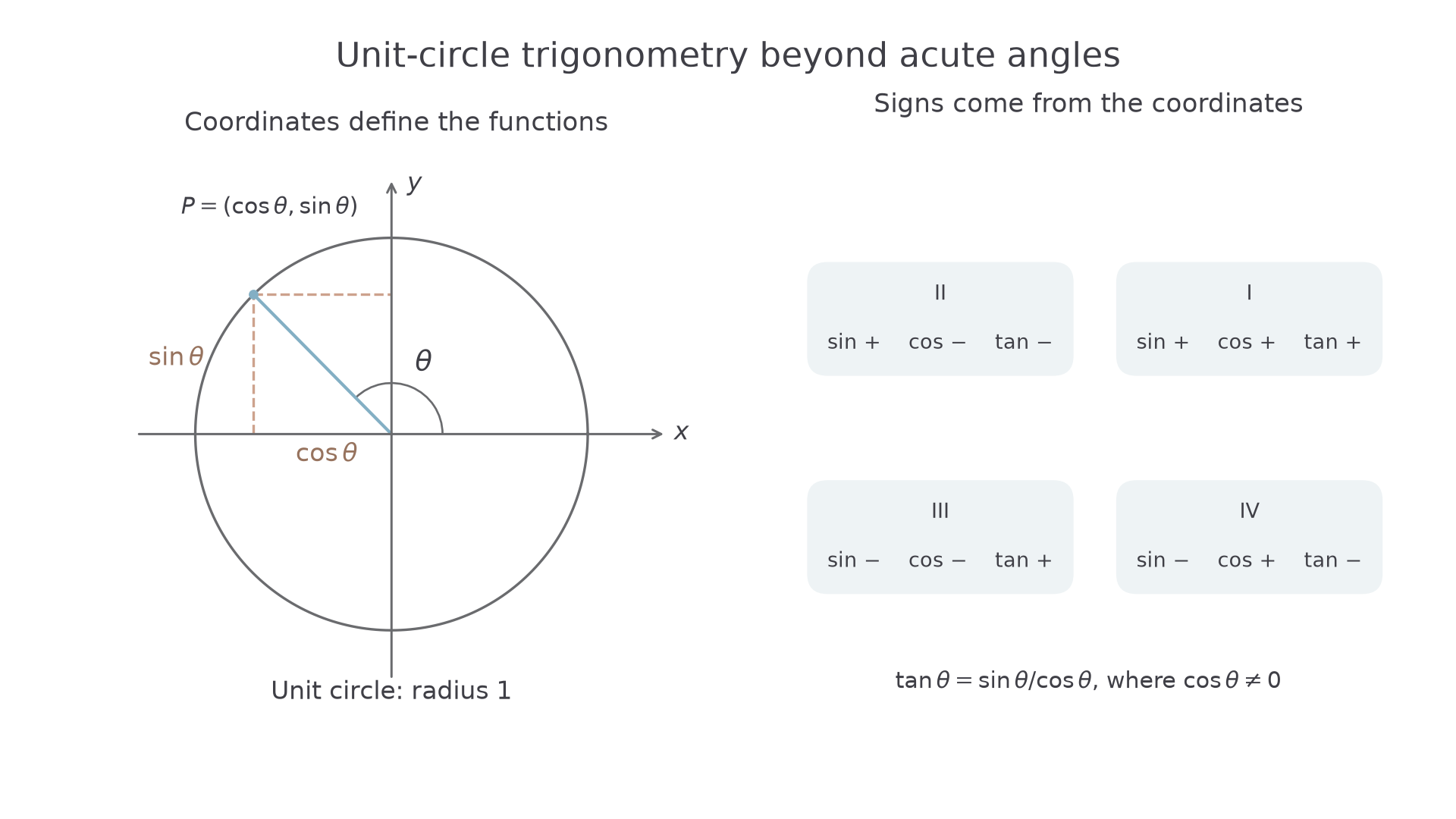
For the point on the unit circle reached at angle ,
For example, quadrant II gives positive sine and negative cosine. At , tangent is undefined because ; it is not zero.
Use the coordinates to decide signs before calculating the ratio.
[DIAGRAM: asset_slug: p1_5_1_understand_and_use_the_definitions_of_sine_cosine_and_tangent__diagram_01; asset_name: Unit-circle coordinates and quadrant signs; caption: Cosine is horizontal, sine is vertical, and tangent is their ratio; description: A unit-circle point in quadrant II has negative horizontal coordinate and positive vertical coordinate. A second panel shows the signs in all four quadrants.]
Worked example 1: reading a quadrant-II point
Question. Find the exact sine, cosine and tangent of .
Plan. Use the reference triangle, then read the coordinate signs.
Why this step? The reference triangle supplies magnitudes; the quadrant supplies signs.
Answer. , , .
Check. , so the point is on the unit circle; its tangent is negative as expected.
Change only the quadrant in the next example: the reference angle stays , but both coordinates become negative.
Worked example 2: the same reference angle in quadrant III
Question. Find the exact sine, cosine and tangent of .
Plan. Place the reference triangle in quadrant III and divide the coordinates.
Why this step? Tangent depends on the ratio, so two negative coordinates give a positive tangent.
Answer. , , .
Check. The squared coordinates still sum to , and tangent has the quadrant-III sign.
At opposite points of the circle, both coordinates reverse but their ratio stays the same. That surprising little fact explains why tangent repeats after half a turn, while sine and cosine need a full turn.
Watch out
Wrong: . Cosine is the horizontal coordinate, so the correct ratio is , with .
Try another point, this time with a different reference triangle.
Radians, arc length and sector area
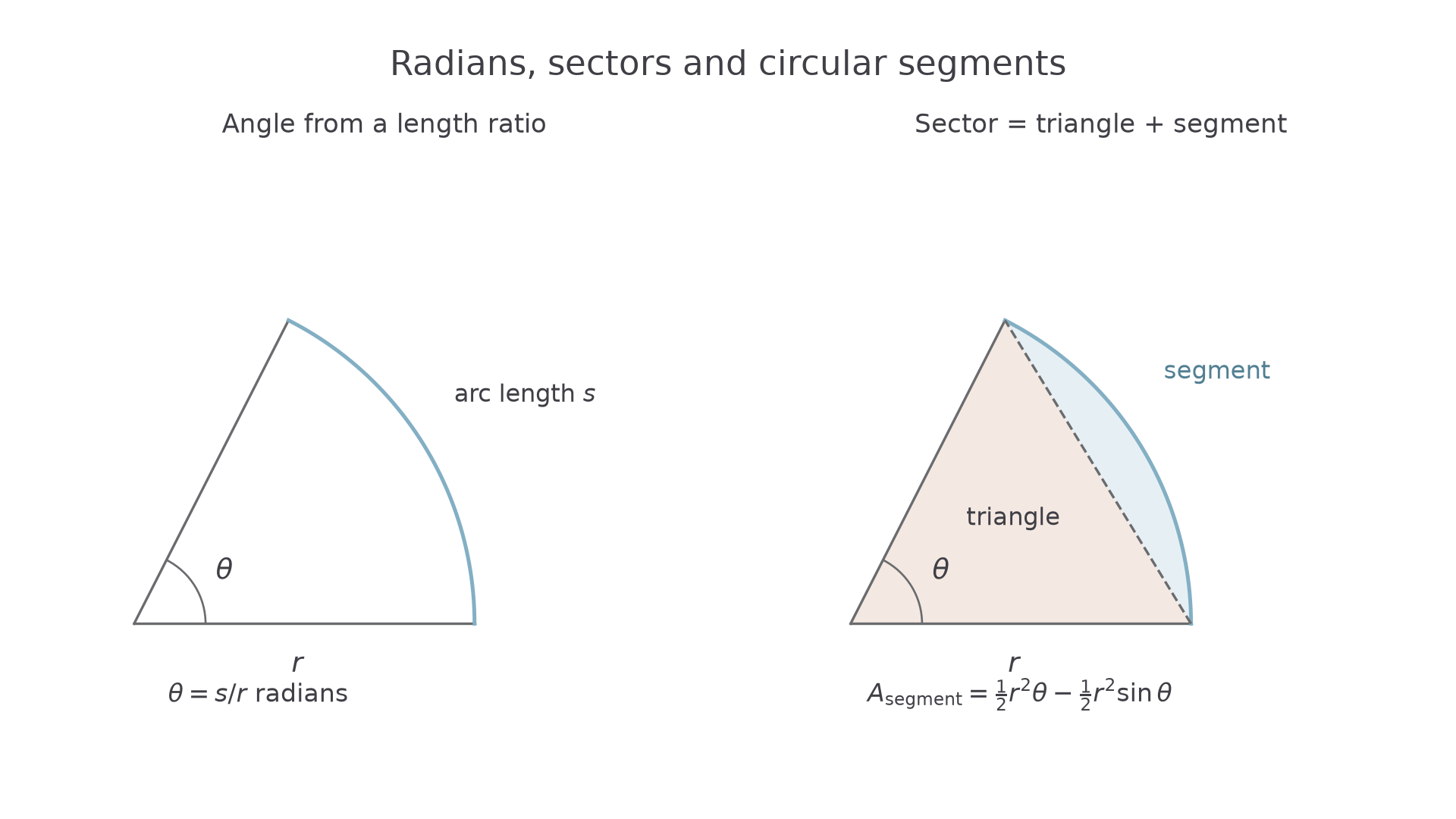
A radius of and an arc of give an angle of radians. Radians measure angle by a length ratio, so changing the circle's size does not change the angle.
Radian
One radian is the angle at the centre of a circle subtended by an arc equal in length to the radius. In general, , with and in the same length units. A full turn is radians, so radians equals .
A sector is the region between two radii and their joining arc. It occupies the fraction of the circle, so multiplying that fraction by gives its area.
Arc length and sector area
For radius and central angle in radians,
Convert degrees by multiplying by . Not in the formula booklet: learn it.
The curved length and the enclosed area use the same angle but have different units.
[DIAGRAM: asset_slug: p1_5_1_understand_and_use_the_definitions_of_sine_cosine_and_tangent__diagram_03; asset_name: Sector and segment; caption: A sector contains a triangle and a circular segment; description: One panel labels the radius, arc and radian angle of a sector. The other separates its triangle from the segment between chord and arc.]
Worked example 3: a radian sector
Question. A sector has radius and angle radians. Find its arc length and area.
Plan. Substitute the radian angle directly into the two formulae.
Why this step? The angle is already in radians, so no conversion factor is needed.
Answer. , .
Check. , agreeing with the calculation.
Now change only how the angle is given. A degree angle must be converted before using the same method.
Worked example 4: a degree sector
Question. A sector has radius and angle . Find its exact arc length and area.
Plan. Convert to radians, then substitute.
Why this step? Substituting directly would treat the angle as radians.
Answer. , .
Check. The sector is of the circle, and .
The formulas are compact because radians already contain the circle's length scale.
Watch out
Wrong: for a angle. Correct: . A calculator's degree setting does not convert a number in .
Keep the answer exact when the question gives an exact angle.
The sine and cosine rules
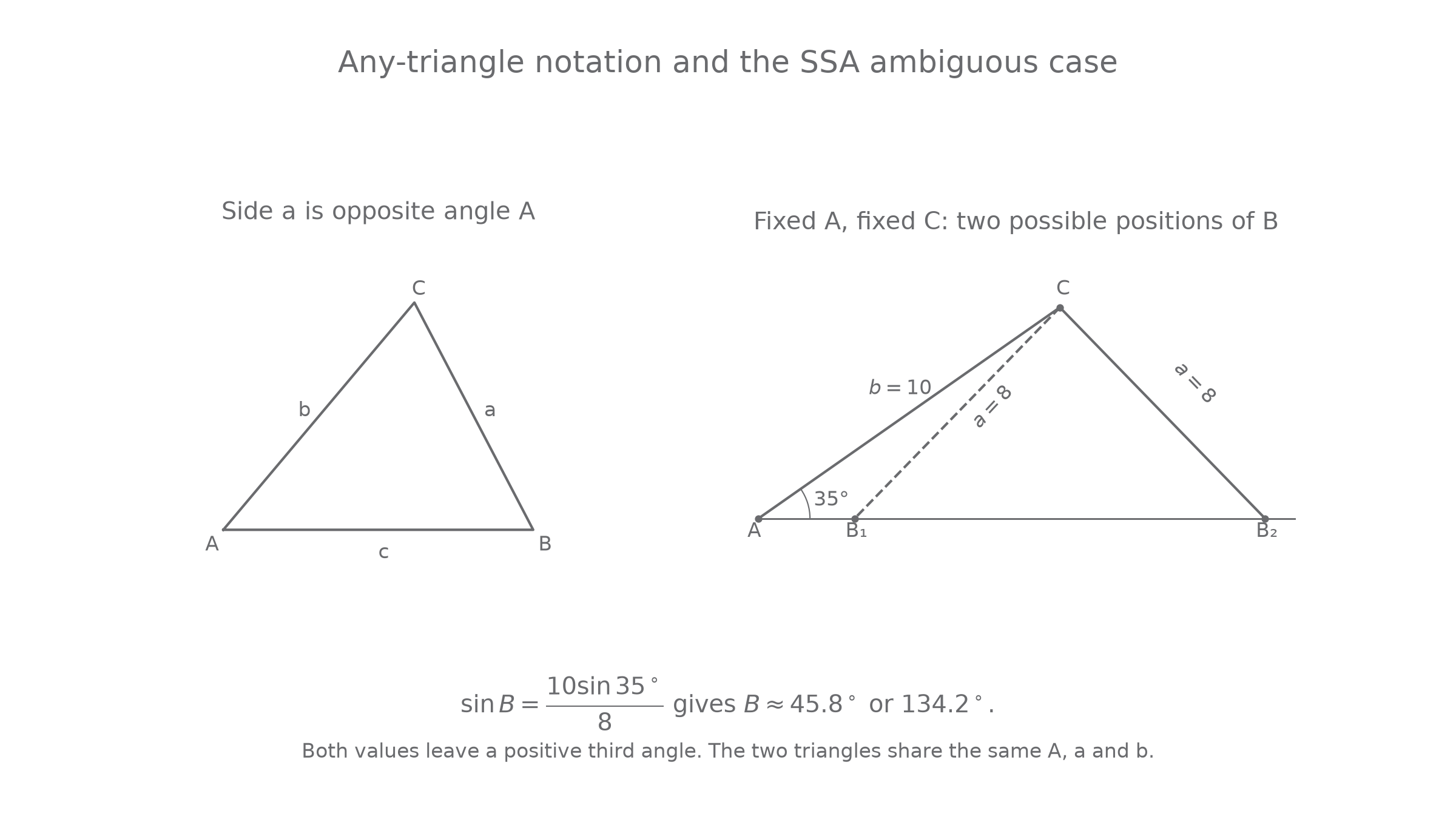
In a triangle with , and , an opposite side–angle pair is known. That is the clue for the sine rule. Use capital letters for angles and matching lower-case letters for their opposite sides.
[DIAGRAM: asset_slug: p1_5_1_understand_and_use_the_definitions_of_sine_cosine_and_tangent__diagram_02; asset_name: Triangle notation and the ambiguous case; caption: Match each side to its opposite angle; two triangles can share SSA data; description: A labelled triangle shows opposite side-angle pairs. A second panel shows two possible positions of B for A equal to 35 degrees, a equal to 8 and b equal to 10.]
Dropping a perpendicular gives the same height as and ; equating them gives the sine rule. A coordinate or Pythagoras calculation for two sides with an included angle gives the cosine rule.
Triangle rules
For a non-degenerate triangle with opposite pairs , , ,
Use the sine rule with an opposite pair; use the cosine rule with two sides and their included angle, or three sides. Not in the formula booklet: learn it.
First see the opposite-pair method in action.
Worked example 5: finding a side with the sine rule
Question. In triangle , , , . Find to significant figures.
Plan. Match with , using the known pair .
Why this step? The known angle is opposite the known side; the cosine rule would require another side.
Answer. .
Check. , so the opposite side should exceed , as it does.
Change only the requested side: finding now needs the third angle first.
Worked example 6: a missing angle before the sine rule
Question. For the same triangle, find to significant figures.
Plan. Find from the angle sum, then use the pair .
Why this step? Side must be paired with its own opposite angle, not with .
Answer. .
Check. , so , consistent with both calculations.
If the angle is between two known sides, use the cosine rule instead. It reduces to Pythagoras when that angle is , since its cosine is zero.
Worked example 7: finding a side with the cosine rule
Question. A triangle has , , . Find .
Plan. Use the included angle in the cosine rule, then take the positive square root.
Why this step? No complete opposite pair is known, so the sine rule cannot start the calculation.
Answer. to significant figures.
Check. , satisfying the triangle inequality.
Continue this lesson.
You’re previewing NovaLearn without an account. Create a free account to read the rest.
Create free account