Pure 3.2 - Coordinate geometry of the circle
A circle's equation records one fixed distance from one centre. You will uncover that centre by completing the square, use chord properties to find circumcircles, and find tangents from perpendicular radii.
The circle equation as distance
Can three points tell you the centre of a circle even when none is the centre? Try , and . We will find their circle and explain why its centre lies halfway along .
Start with a known centre and radius . A point is on the circle because its horizontal and vertical separations from the centre are and : .
You already know
Pythagoras gives squared distance . A midpoint is ; perpendicular non-vertical lines have gradient product .
Every point on the circle must satisfy the same distance condition.
Circle
A circle is the set of points in a plane at a fixed positive distance, the radius, from one point, the centre. The circumference is the boundary; a point inside the circle is not on its circumference.
The right triangle in the diagram turns this definition into an equation.
[DIAGRAM: asset_slug: p1_3_2_understand_and_use_the_coordinate_geometry_of_the_circle__diagram_01; asset_name: Circle equation from distance; caption: Horizontal and vertical separations determine the radius by Pythagoras; description: Circle with centre (-2, 3), radius 5 and point (1, 7), showing horizontal separation 3 and vertical separation 4]
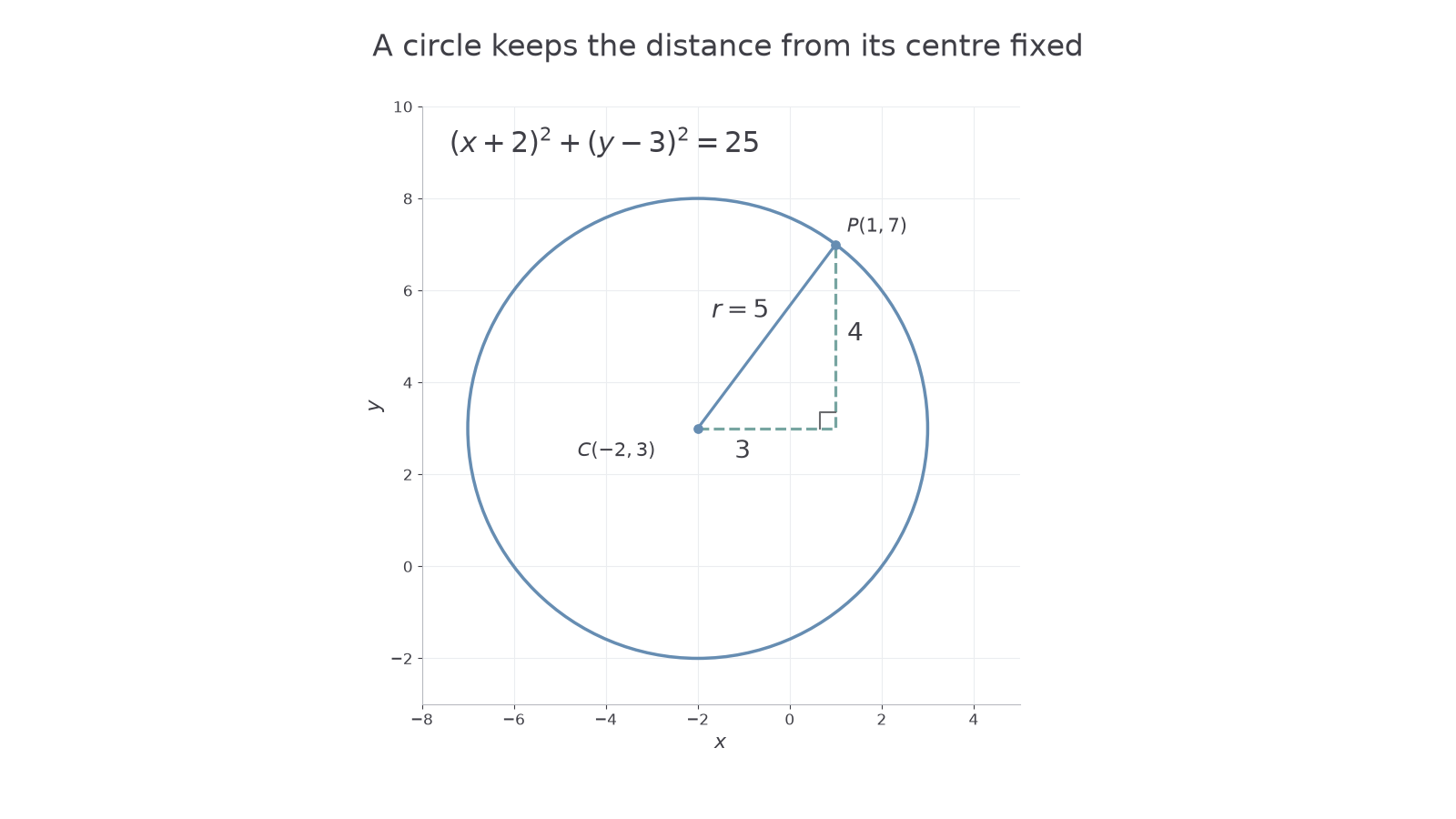
Equation of a circle
For centre and radius ,
Not in the formula booklet: learn it.
Subtraction from the centre explains the bracket signs. The equation , for instance, has centre and radius .
Worked example 1: centre and radius to equation
Question. Find the equation of the circle with centre and radius .
Plan. Substitute the centre coordinates and square the radius.
Why this step? The coordinates measure distance from the centre, so the centre values are subtracted.
Answer. .
Check. The rightmost point gives .
Change only the radius to . This time the squared radius is an integer even though the radius is not.
Worked example 2: an exact surd radius
Question. Find the circle with centre and radius .
Plan. Keep the same centre and calculate the new squared radius exactly.
Why this step? The equation needs , so there is no need to round .
Answer. .
Check. lies on it because .
The centre is not on a genuine circle's circumference: substituting it gives zero on the left while .
Watch out
Wrong: “ has centre and radius .” Right: centre , radius . Reverse the bracket signs and take the positive square root.
Change the radius again, retaining the centre and exact arithmetic.
Completing the square
The expanded equation hides the centre. Group the terms and terms, then turn each pair into a square.
You already know
. The subtracted balances the extra constant introduced by expanding the bracket.
Apply that identity once to each coordinate in Pearson's expanded form.
Expanded circle form
For
completing the square gives
The centre is ; a real circle requires . Equality gives one point, and a negative value gives no real points. Not in the formula booklet: learn it.
The coefficient rule is a useful check, but writing the squares shows exactly where every constant goes.
Worked example 3: revealing the centre
Question. Find the centre and radius of .
Plan. Complete the square separately in and , then collect constants.
Why this step? Keeping and visible prevents the radius from being changed accidentally.
Answer. Centre , radius .
Check. Expanding the final equation returns constant .
Change only the original constant from to . The centre stays fixed while the radius changes.
Worked example 4: changing the constant
Question. Find the centre and radius of .
Plan. Use the same completed squares and recalculate the right-hand side.
Why this step? The linear coefficients locate the centre; the constant also affects the radius.
Answer. Centre , radius .
Check. At , the expanded expression is .
For comparison, becomes , with centre and radius . Positive and negative centre coordinates follow the same rule.
Watch out
Wrong: . Expanding would give . Right: .
Try one more constant. The unchanged linear terms should make your centre predictable.
Finding a circumcircle
Three non-collinear points fix exactly one circle. Its centre must be the same distance from all three, which is a stronger condition than simply averaging their coordinates.
Chord and circumcircle
A chord joins two points on a circle; a diameter is a chord through the centre. A triangle's circumcircle passes through its three vertices. Collinear distinct points cannot be the vertices of such a triangle or lie on one finite circle.
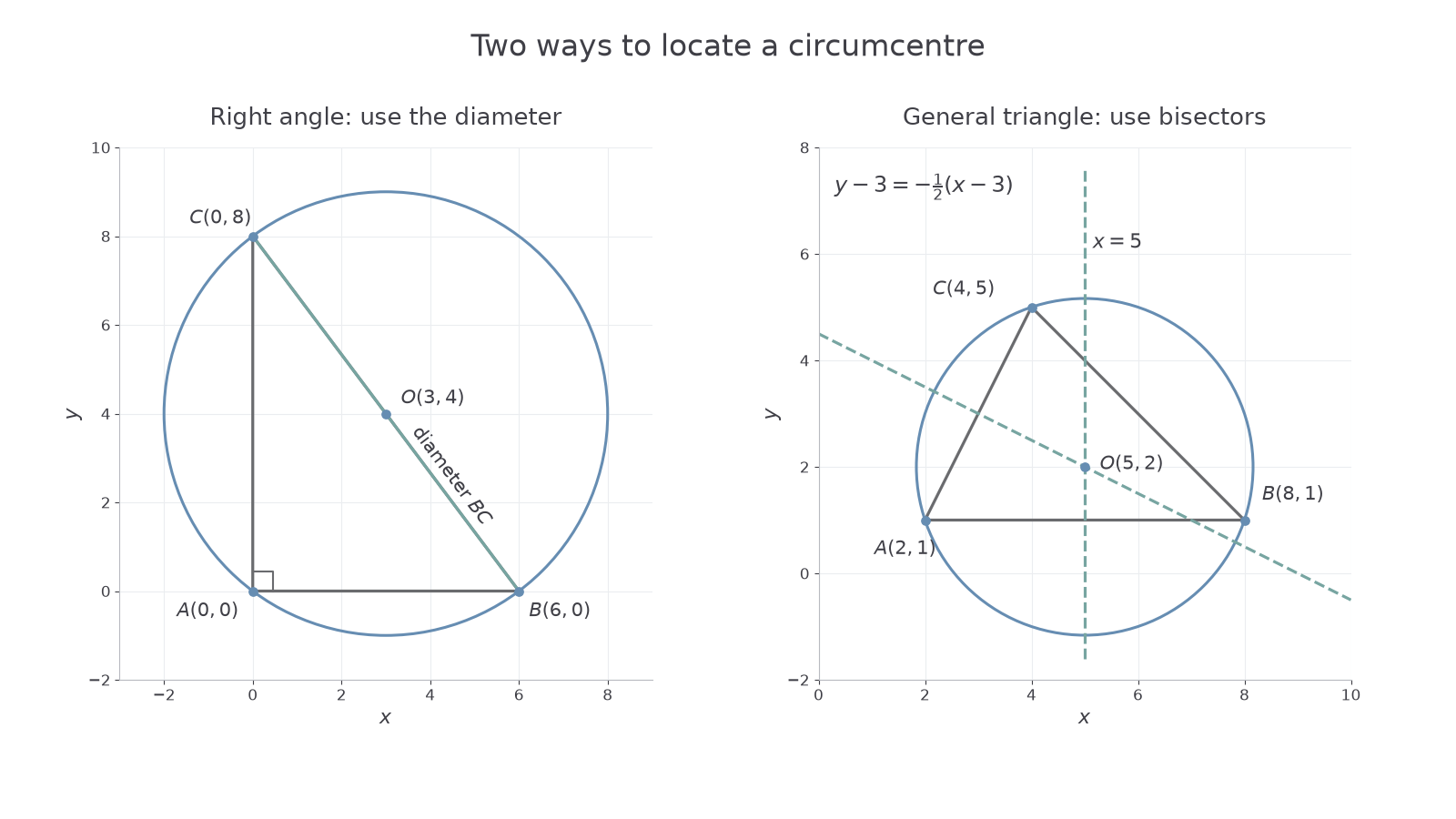
Two circle properties locate the centre. First, an angle in a semicircle is a right angle. To see why, join a point on the circle to the ends , of a diameter and the centre . Equal radii make and isosceles. If their base angles at are and , the triangle's angle sum gives , so . Conversely, a right-angled triangle has its hypotenuse as a diameter of its circumcircle.
Second, the perpendicular from a centre to a chord bisects that chord. If it meets chord at , the right triangles and have equal hypotenuses (radii) and common side , so . Thus the centre lies on each chord's perpendicular bisector. For a diameter, the midpoint is the centre itself.
[DIAGRAM: asset_slug: p1_3_2_understand_and_use_the_coordinate_geometry_of_the_circle__diagram_02; asset_name: Locating a circumcentre; caption: A right triangle gives a diameter and general triangles give perpendicular bisectors; description: Two panels show a right triangle on its circumcircle with hypotenuse as diameter, and the circumcircle through (2, 1), (8, 1), (4, 5) with two perpendicular bisectors meeting at (5, 2)]
These circle properties, and the midpoint and perpendicular-gradient rules used with them, are not in the formula booklet: learn them.
Worked example 5: a right-angled triangle
Question. Find the circumcircle of , , .
Plan. Recognise the right angle at , so is a diameter.
Why this step? The semicircle property identifies the diameter, avoiding two simultaneous bisector equations.
Answer. .
Check. At , , , the left sides are respectively , , , all .
Change only the horizontal coordinate of , from to . The right-angle shortcut disappears, so use perpendicular bisectors instead.
Worked example 6: a triangle without the shortcut
Question. Find the circumcircle of , , .
Plan. Intersect the perpendicular bisectors of and , then find a radius.
Why this step? Every possible centre equidistant from and is on their bisector; the second bisector picks the unique centre also equidistant from .
Answer. .
Check. At , .
The same construction for , , gives bisectors and . They meet at , and . This is the second diagram's circle.
Watch out
Wrong: “The circumcentre is the average of the three vertices.” That gives the centroid, which need not be equidistant from them. Right: use a diameter when justified, otherwise intersect perpendicular bisectors.
Change 's horizontal coordinate again. The same two-bisector method works.
Tangents from radius gradients
A radius tells you where a tangent must point: it meets the tangent at a right angle at the point of contact. First check that the specified point is actually on the circle.
Tangent to a circle
A tangent is a straight line meeting a circle at exactly one point. It is perpendicular to the radius at that point. A chord's line normally meets the circle twice, so it is not a tangent.
For centre and point , the radius has direction changes . A tangent must therefore have gradient , not .
[DIAGRAM: asset_slug: p1_3_2_understand_and_use_the_coordinate_geometry_of_the_circle__diagram_03; asset_name: Radius perpendicular to tangent; caption: The tangent at (5, 5) is perpendicular to the radius from (1, 2); description: Circle (x minus 1) squared plus (y minus 2) squared equals 25, radius to (5, 5), tangent 4x plus 3y equals 35 and right-angle marker]
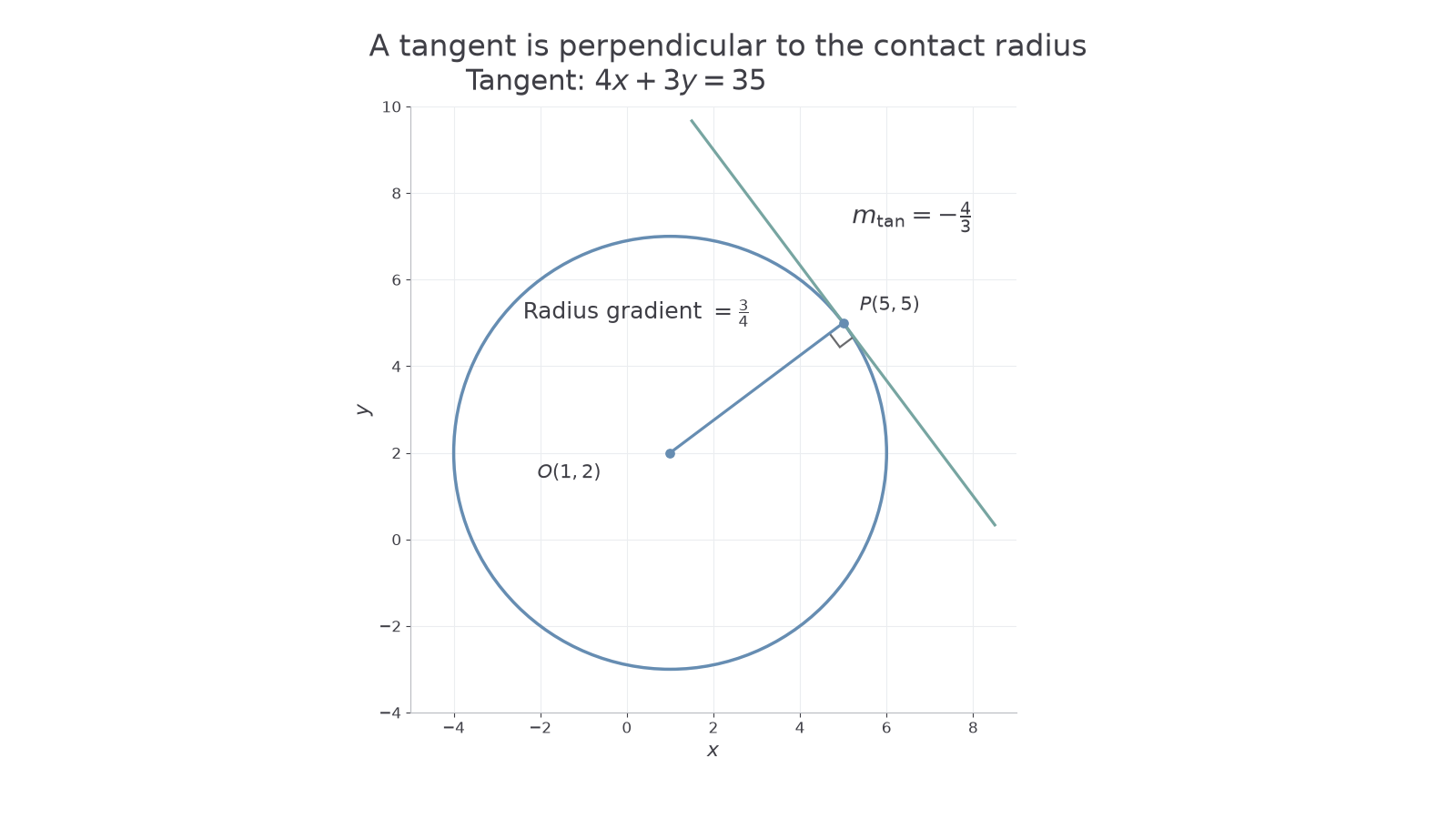
The radius-tangent property is not in the formula booklet: learn it. Combine it with the straight-line methods you already know.
Worked example 7: tangent with a finite gradient
Question. Find the tangent to at .
Plan. Find the radius gradient and use its negative reciprocal through .
Why this step? The tangent passes through the contact point, rather than through the centre.
Answer. .
Check. satisfies the circle because , and satisfies the line because . The gradient product is .
Change only the contact point to the circle's rightmost point. The geometry still works, but the tangent now has no finite gradient.
Worked example 8: a vertical tangent
Question. Find the tangent to at .
Plan. Recognise the horizontal radius and use a vertical line through .
Why this step? Trying is unnecessary; perpendicular to horizontal means vertical.
Answer. .
Check. Substituting into the circle gives , hence the unique contact .
A vertical radius similarly gives a horizontal tangent. For the expanded circle , completing the square gives centre and radius ; its tangent at is , by the same finite-gradient method.
Watch out
Wrong: “The tangent gradient is the radius gradient.” Right: the two are perpendicular. Also, a line perpendicular to the radius but through the centre is not the required tangent.
Change the contact point from the rightmost to the topmost point on the circle used in the worked examples.
Choosing the method
A circle equation, a triangle and a point of contact offer different information. Choose the geometric fact that turns the given information into the unknown.
| Unknown | Useful information | Starting idea |
|---|---|---|
| Centre and radius | Expanded circle equation | Complete both squares |
| Circumcircle | A verified right angle | Hypotenuse is a diameter |
| Circumcircle | General triangle | Intersect perpendicular bisectors |
| Tangent | Centre and contact point | Radius is perpendicular to tangent |
For example, , , form a right triangle at . The midpoint of is , and . Its circumcircle is ; no simultaneous bisectors are needed.
Here is a surprising feature: a triangle's circumcentre need not be inside the triangle. For , , , equal squared distances give , so the centre is , below all three vertices. It still lies on the perpendicular bisectors. A sketch is a guide, not permission to assume an acute triangle.
The opening triangle has a right angle at , so its centre is the midpoint of , and its radius is . Three points really can reveal a fourth point that none of them names.
Key idea
A circumcentre is characterised by equal distances from the vertices, not by being visually central inside the triangle.
The next diagnostic distinguishes the centre from another familiar triangle point.
Quick Recap
- A circle's equation is a fixed-distance statement, with a positive radius.
- Complete both squares to recover its centre and squared radius.
- The angle in a semicircle is right; a perpendicular from the centre bisects a chord.
- A circumcentre lies on perpendicular bisectors; a tangent is perpendicular to its contact radius.
The opening points lie on , centred at the midpoint of their hypotenuse.