Pure 5.9 - Trigonometric functions in context
Read and build sinusoidal models for repeating motion and changing quantities, solve their equations in meaningful time intervals, and resolve vectors, velocities and forces. You will connect each parameter to its units and judge what a model can reasonably predict.
Read a trig model
A wheel's lowest point is above the ground. How can a sine or cosine model tell us when a marked point rises above ? We need its centre height, radius, period and starting position. A formula becomes useful when each number has a physical meaning.
Begin with a simple hypothetical daylight model,
where is daylight duration in hours and is time in months. This is a mathematical model, rather than measured data for a named location. At , cosine is , giving hours; at , it is , giving hours.
You already know
Sine and cosine range from to . Each repeats after radians, or . A negative coefficient reflects a wave in its midline.
A wave's amplitude measures distance from its middle, rather than its total height from bottom to top.
Amplitude, midline and period
The amplitude is half the difference between a sinusoid's maximum and minimum. The midline is their mean. The period is the shortest positive input increase over which the entire non-constant pattern repeats. For a range from to , the amplitude is and the midline is , not .
The coefficient inside the trig function is a rate of change of angle, not a time period.
Reading a sinusoidal model
For or , where , ,
The period is for a radian input, or when the input's numerical value is in degrees. The period's unit is the unit of .
Not in the formula booklet: learn it.
A shift of tells you where a standard cosine has input zero. Whether that is a maximum or minimum also depends on the sign of .
[DIAGRAM: asset_slug: p1_5_9_use_trigonometric_functions_to_solve_problems_in_context__diagram_01; asset_name: Reading a daylight-duration model; caption: Midline 12, amplitude 4 and period 12 months describe different features; description: Graph of H equal to 12 plus 4 cos pi over 6 times t minus 6, from 0 to 12 months. The maximum 16 occurs at 6 months, minima 8 at both ends, and guides identify the midline and the amplitude.]
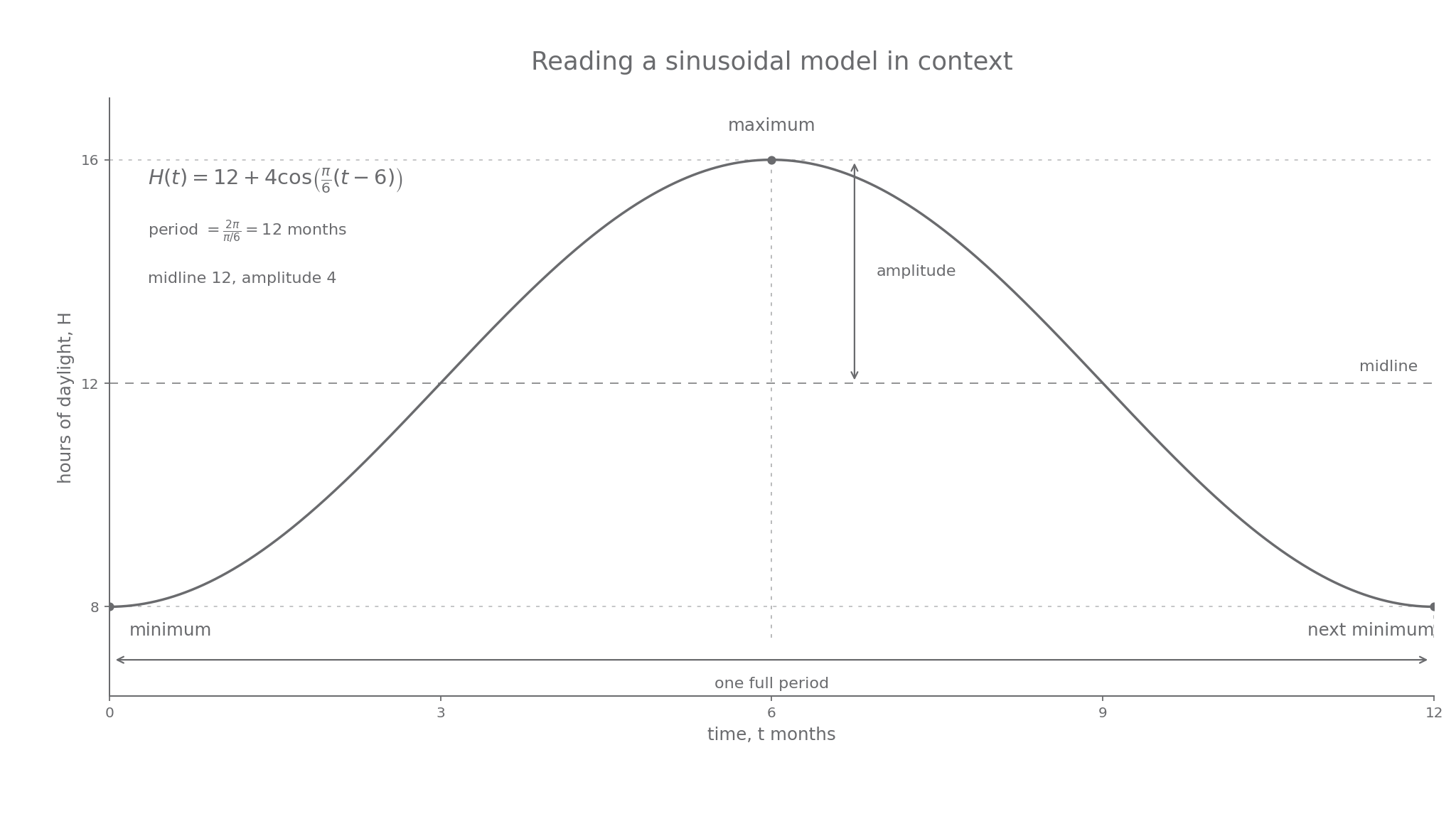
Use those features together rather than identifying one coefficient in isolation.
Worked example 1: read the daylight model
Question. Find the range and period of , and state when its maximum first occurs for .
Plan. Read the vertical shift and amplitude, then make the cosine input zero.
Why use radians? The model explicitly uses in its angle; a full turn is , not .
Answer. The range is hours, the period is months, and the maximum occurs at months.
Check. Inputs at and are and , both giving the minimum .
Change only the amplitude coefficient from to . The timing stays the same.
Worked example 2: change the amplitude
Question. Give the same features for .
Plan. Recalculate the extreme values and retain the unchanged input's period and phase.
Why does the maximum time stay fixed? Changing the amplitude alters height, not the angle at which cosine is .
Answer. The range is hours; the period is months and the maximum is at months.
Check. At , the cosine input is ; both models are on the same midline .
Always attach output units to amplitude and midline, and input units to period.
Watch out
Wrong: the period is months. Right: is the angular rate in radians per month, so the period is months.
Read a pressure model with a different time scale.
Build a periodic model
For a wheel, the centre height is the midline and the radius is the amplitude. If it rotates uniformly, its angle changes at a constant rate. Starting at the bottom suggests negative cosine; starting at the top suggests positive cosine.
Building from extrema and a period
If the maximum is , the minimum is , and the period is , then
for a radian model. Choose the function, phase and coefficient sign to match the starting position and direction.
Not in the formula booklet: learn it.
You can derive the wheel's height directly: a radius at angle above the horizontal has vertical component , so . Measuring time from a lowest point gives the equivalent negative-cosine model.
[DIAGRAM: asset_slug: p1_5_9_use_trigonometric_functions_to_solve_problems_in_context__diagram_02; asset_name: A wheel and its height-time curve; caption: The vertical radius component creates a sinusoid about the centre height; description: A wheel geometry panel shows H equal to c plus r sin theta. A separate example graph H equal to 9 minus 7 cos pi t over 20 starts at 2 metres, reaches 16 metres at 20 seconds and completes its cycle at 40 seconds.]
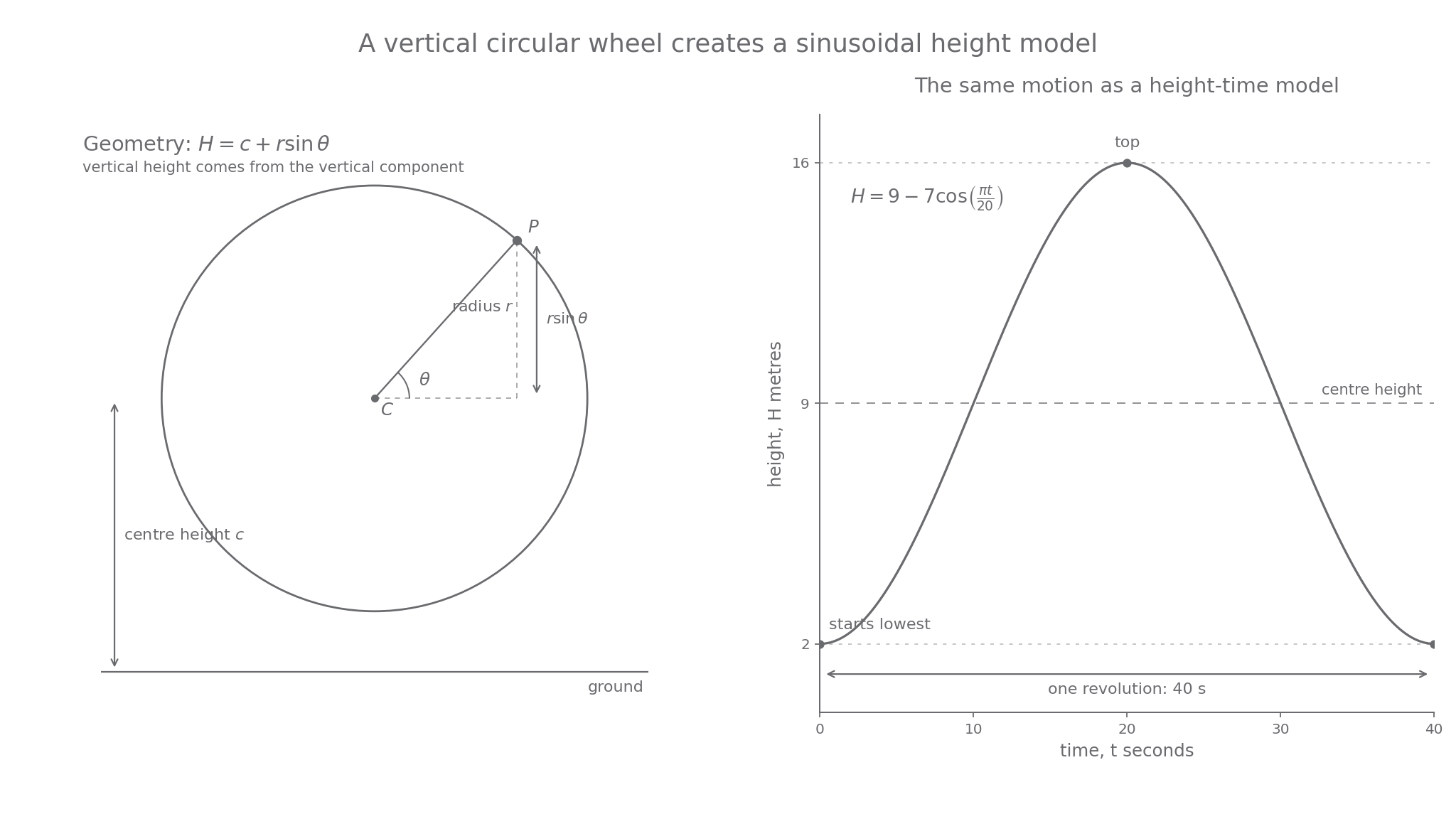
Here is a useful geometrical surprise: diametrically opposite points always have heights adding to . Their vertical displacements are equal and opposite. For a wheel centred at , the opposite heights add to at every angle.
Worked example 3: start at the bottom
Question. A point is on a wheel of radius with centre above the ground. It starts lowest at , and one revolution takes . Find its height model.
Plan. Use the centre height as midline, the radius as amplitude, and negative cosine for the lowest start.
Why negative cosine? At , it subtracts the full radius from the centre height.
Answer. , with in metres and in seconds.
Check. , and , matching bottom, top and bottom again.
Change only the starting position from bottom to top. The wheel's size and speed are unchanged.
Worked example 4: start at the top
Question. Find a model for the same wheel point if it starts at its highest position at .
Plan. Keep the midline and angular rate, but use positive cosine.
Why change just the sign? It swaps maxima and minima without changing the period or radius.
Answer. .
Check. , , and , as required.
A point starting level with the centre and moving upwards is often simpler in sine form. For example, has radius and period . Its first arrival at solves , giving , so .
Watch out
Wrong: choose cosine simply because the motion is circular. Right: choose the phase and sign from the starting height and direction. Sine and cosine can describe the same motion with different time origins.
Build a model after changing the wheel radius.
Use single-function form
If a model combines sine and cosine of the same input, their coefficients are not separate amplitudes. Rewrite their sum as one function to expose its actual range.
You already know
Expand the requested shifted form and match coefficients. For , the amplitude is . This result is derived from supplied compound-angle formulae but is not itself printed in the formula booklet.
A constant added outside the wave changes the midline, leaving that amplitude unchanged.
Worked example 5: recover an unknown midline
Question. A population index is modelled by , where is in months. Its maximum during a full year is . Find , a single-function form, and the minimum.
Plan. Combine the oscillating terms, then use maximum equals midline plus amplitude.
With , expand :
Why can the wave reach both extremes during a year? Its input advances by in months, one complete cycle.
Answer. , with exact . The minimum is .
Check. At , the original is , and the new form gives .
Change only the sine coefficient's sign. The range stays fixed, while the peak occurs at a different time.
Worked example 6: the phase changes, the range stays
Question. Replace the negative sine term by a positive one, keeping the full-year maximum . Find the single-function model and minimum.
Plan. Expand cosine difference to match the positive sine coefficient.
Why does the sign affect timing? It changes the phase from to , rather than the size of the vertical excursion.
Answer. , with the same exact ; the minimum remains .
Check. At , the input is : the new model gives , matching .
The full-cycle condition matters. On a shorter time interval, the wave may never reach its theoretical maximum.
Watch out
Wrong: has maximum . Right: its full-cycle maximum is , because makes the added term positive.
Match a negative cosine form and interpret its range.
Continue this lesson.
You’re previewing NovaLearn without an account. Create a free account to read the rest.
Create free account