Pure 8.4 - Integration as the limit of a sum
How can rectangles with flat tops give the exact area beneath a curved graph? You will connect a sum of thin strips to a definite integral, read Pearson's limiting-sum notation and evaluate the result exactly. The crucial distinction is between a finite approximation and the value it approaches as the widths tend to zero.
From rectangles to a limiting sum
What exact value do thinner and thinner rectangles approach beneath from to ? The curve's height changes continuously, while a rectangle holds one height across its width. A finite collection therefore leaves small gaps or overhangs.
You already know
A rectangle's area is height times width. A definite integral is signed accumulation; for a non-negative continuous function and increasing limits, it equals the area beneath its graph.
Start with an easier graph, on . Four equal strips have width . Using the left endpoint heights gives
Using the right endpoint heights gives
The true triangular area lies between them. With equal strips the bounds are and . The gap has shrunk from to .
Limiting rectangle sum
A rectangle sum adds quantities : a sampled height times a strip width. For continuous on a closed interval, making the largest strip width tend to zero makes these sums approach the definite integral. A sum with a fixed positive strip width is a finite approximation, rather than this limit.
The square-root graph is increasing too. Left endpoint rectangles lie below it; right endpoint rectangles lie above it. Either choice approaches the same integral as all widths tend to zero.
[DIAGRAM: asset_slug: p1_8_4_understand_integration_as_the_limit_of_a_sum__diagram_01; asset_name: Thinner rectangles approach an integral; caption: Both panels use left endpoints; narrower strips leave smaller gaps below the increasing curve; description: Two panels plot y=root x from x=4 to x=9 with four and twenty left endpoint rectangles, respectively, and clearly labelled strip widths and interval endpoints]
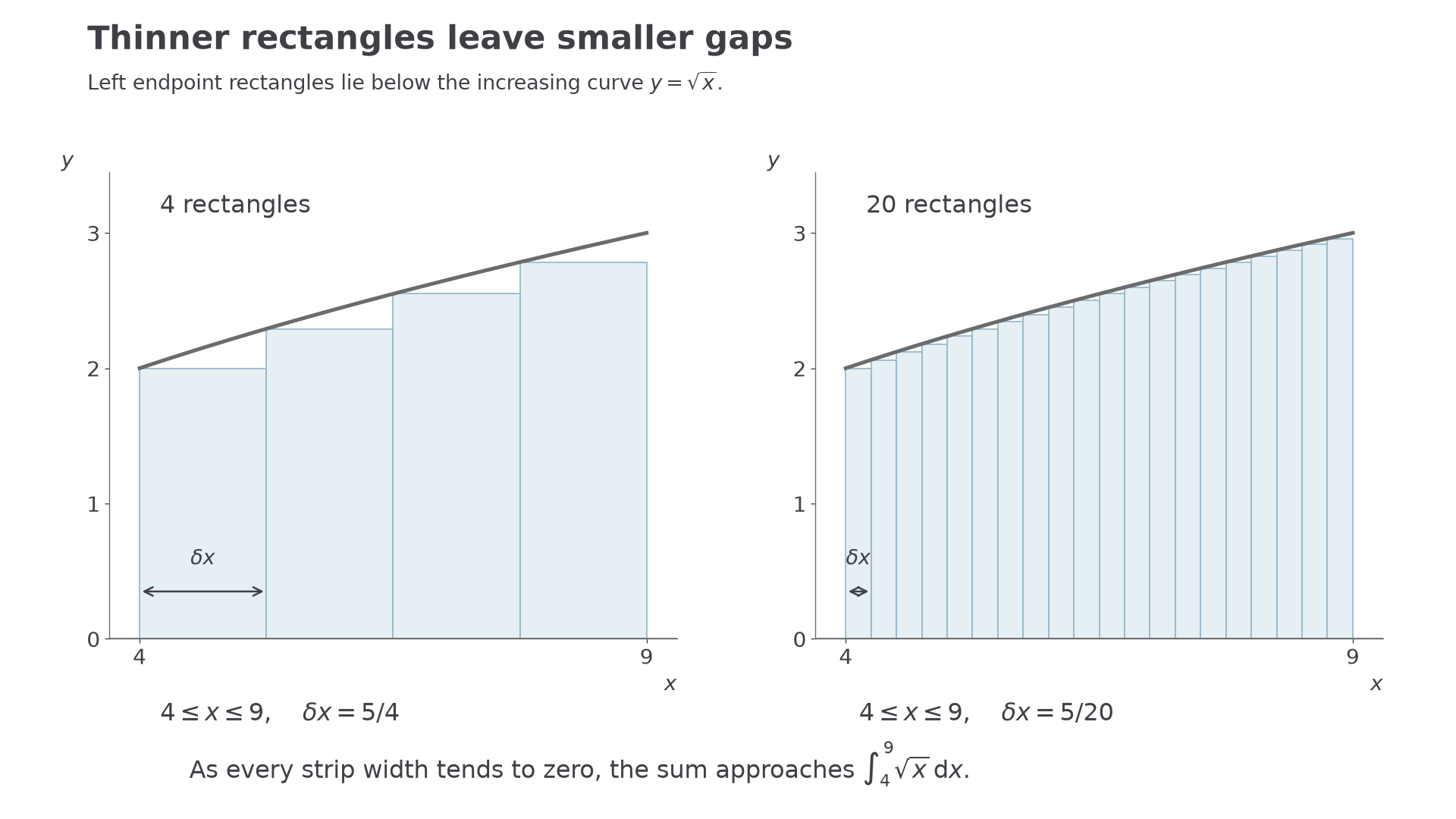
For with equal strips, : the missing uncertainty can be made smaller than any positive amount. That is the surprising power of a limit; exactness does not require a final rectangle of width zero.
Key idea
The integral is the value approached by increasingly fine sums, rather than a finite sum made from zero-width rectangles.
Explain the mechanism using the concrete straight-line case before applying it to a curve.
Reading the Edexcel notation
Pearson writes the whole strip process compactly. The function supplies a height, supplies a width, and the sigma tells you to add across the interval.
Integral as a limiting sum
For continuous on , where , the specification's notation is
The sum represents strips across the interval, with their widths tending to zero.
Not in the formula booklet: learn it.
This is compact partition notation, rather than a sum only over integer values of . For equal widths, , so increasing makes smaller. Left endpoints would use ; right endpoints use . Both describe the same limit for continuous functions.
| Feature | What to read |
|---|---|
| and | The interval's endpoints |
| The sampled height, including its sign | |
| The strip width | |
| Add the strip contributions | |
| Take the exact limiting value |
For example, becomes . The factor becomes the differential ; it is not an extra factor of in the integrand.
Key idea
Carry the height function and the two endpoints unchanged into the definite integral; the strip width becomes its differential.
Read the symbols before doing any integration.
Convert then evaluate
Once you recognise the definite integral, your usual integration rules finish the question. Keep the interpretation line visible before the calculation.
You already know
For , . In a definite integral, subtract the two antiderivative values and omit from the numerical result.
For square roots at square-number endpoints, retaining powers exactly makes the final answer straightforward.
Worked example 1: answering the opening question
Question. Find the exact value of .
Plan. Identify the integral, write the root as a power and evaluate at both endpoints.
Why this step? The limit asks for an exact integral; no choice of a finite number of strips is needed.
Answer. .
Check. Heights range from to across width , so the area lies between and . The value does.
Change only the upper endpoint from to . The same power rule applies over a wider interval.
Continue this lesson.
You’re previewing NovaLearn without an account. Create a free account to read the rest.
Create free account