Pure 3.3 - Parametric equations and Cartesian form
Parametric equations generate both coordinates from one shared input. You will read those coordinate pairs, convert familiar curves between parametric and Cartesian forms, and retain the domain that decides how much of a curve is actually traced.
What a parameter does
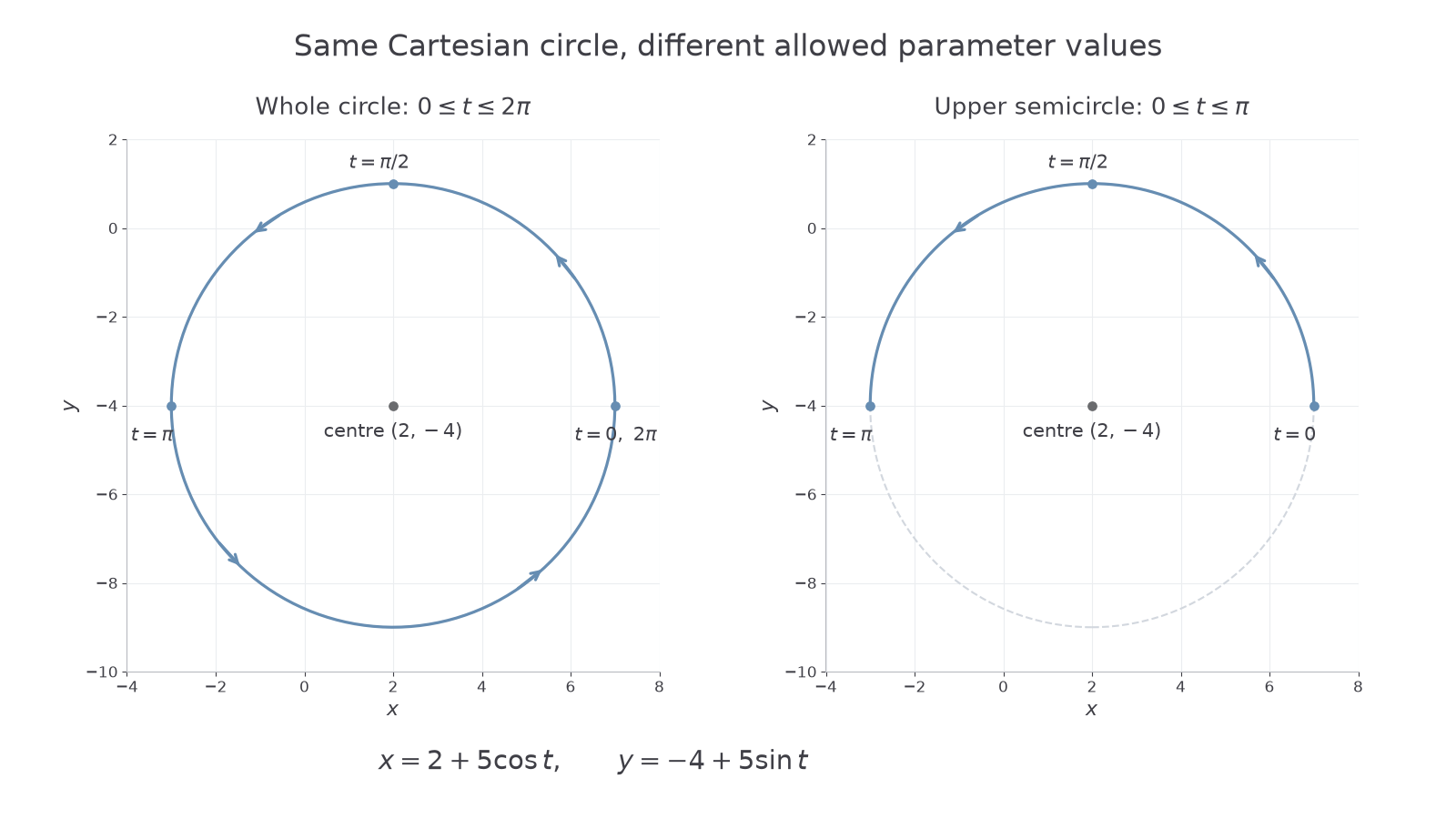
Can the same circle equation describe a whole loop and only half a loop? Consider , : at you get , while at you get . The allowed inputs decide how far around you travel. We will make that distinction precise.
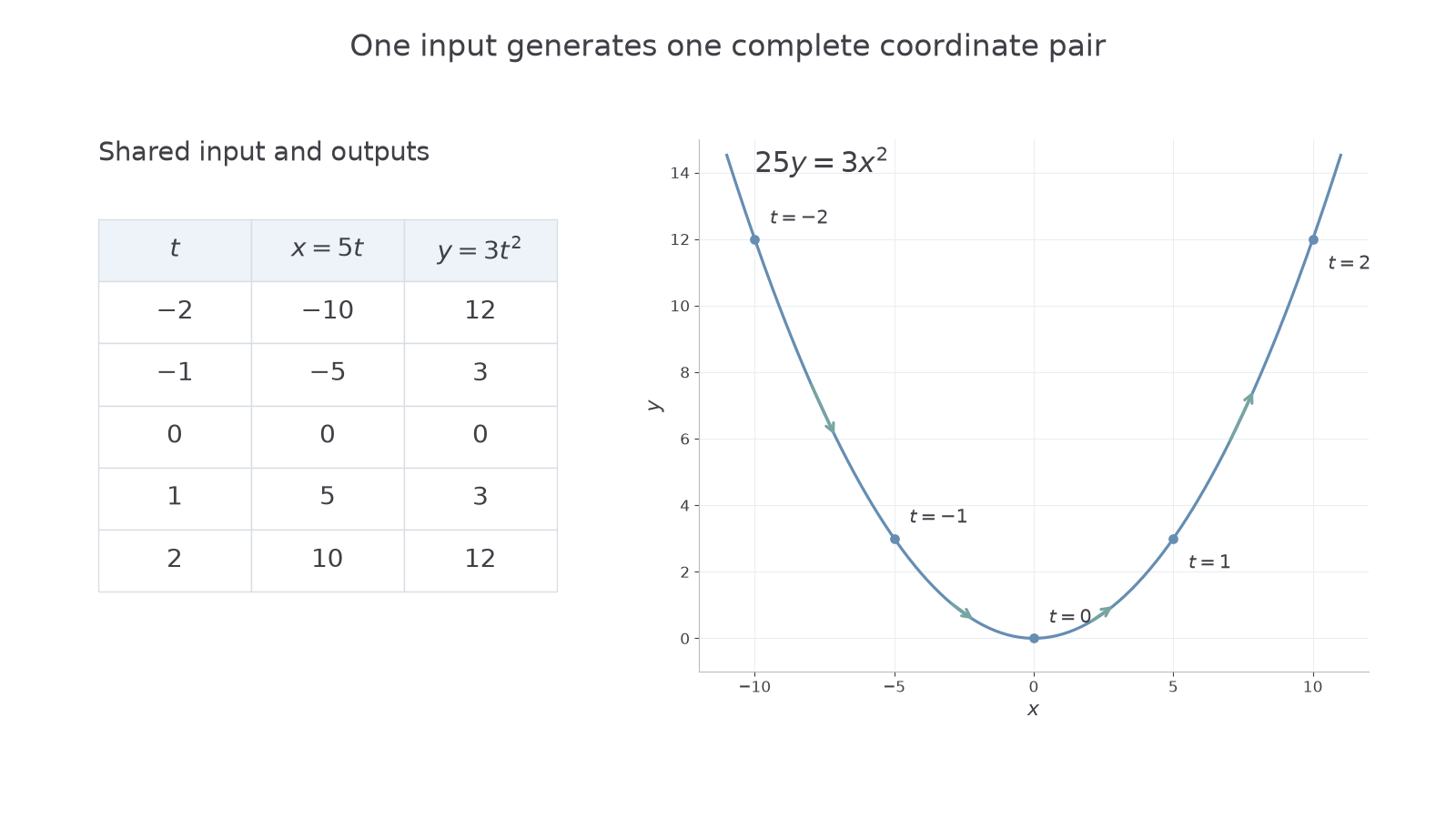
Begin without trigonometry. For , , the input gives , gives , and gives . Both coordinates use the same value of .
You already know
A function turns an input into an output. Substituting a negative input into a square needs brackets: . The circle identity will link trigonometric coordinates later.
A table shows separate coordinates; plotting each pair turns them into a curve.
[DIAGRAM: asset_slug: p1_3_3_understand_and_use_the_parametric_equations_of_curves_and_conversion_between_cartesian_and_parametric_forms__diagram_01; asset_name: One parameter generates two coordinates; caption: Increasing the same parameter traces successive points of a parabola; description: Parameter inputs minus 2, minus 1, 0, 1 and 2 beside the points generated by x equals 5t and y equals 3t squared, with direction arrows]
Parametric equations
Parametric equations give coordinates as , , for allowed values of a parameter . Each allowed input gives one coordinate pair. The parameter is not a third coordinate, and it need not represent time.
For , , the values and give and . Combining the first point's with the second point's has no justification: one input must generate the whole pair.
There is a useful surprise: , and , , with real parameters, trace the same parabola. Since takes every real value, writing changes the labelling and spacing of inputs, not the set of points. A curve does not have just one possible parametrisation.
Key idea
One shared input gives one whole point; increasing inputs also give an order for tracing those points.
Check that distinction before eliminating any parameter.
Eliminating a non-trigonometric parameter
To obtain a Cartesian equation, remove the parameter while keeping the relationship between the two coordinates. For , , write , then , giving .
Eliminating a parameter
Eliminating the parameter means obtaining an equation involving only and . It must be accompanied by any restrictions needed to describe exactly the original set of points. An unrestricted equation that includes extra points is not a complete conversion.
Usually isolate the parameter in whichever equation makes it easiest. All conversions in this part are derived by substitution; no conversion recipe is supplied in the formula booklet.
Worked example 1: a quadratic Cartesian equation
Question. Convert , , , to Cartesian form.
Plan. Isolate in the linear equation and substitute into the quadratic.
Why this step? Solving the linear equation avoids an unnecessary square-root choice.
Answer. , for all real .
Check. At , ; the Cartesian expression gives .
Change only the rule by adding a reciprocal term. The excluded parameter value must now be carried into the answer.
Worked example 2: a reciprocal term and an exclusion
Question. Convert , , , to Cartesian form.
Plan. Use the same expression for , substituting it into every term.
Why this step? becomes ; losing that condition would change the curve's domain.
Answer. , .
Check. At , ; the Cartesian expression gives .
The same substitution handles more algebraic expressions. For the useful form , , , take . Then
For the simple reciprocal pair , , multiplication gives , with .
Watch out
Wrong: . Right: divide by a fraction by multiplying by its reciprocal, giving .
Change just the reciprocal coefficient in the second example.
Trigonometric parameters and circles
For , , the familiar identity says . The point stays exactly units from the origin.
Circle parametrisation
For radius and centre ,
implies . The interval traces the whole circle once anticlockwise without repeating the starting point. This uses . Not in the formula booklet: learn it.
Subtract each centre coordinate before using the identity. The translation matters just as much as the radius.
Worked example 3: a translated circle
Question. Convert , , , to Cartesian form.
Plan. Isolate the sine and cosine, square, then add.
Why this step? Squaring and adding removes the shared angle without introducing a sign choice for a square root.
Answer. A whole circle, centre , radius .
Check. gives , which is units above the centre.
Change only the parameter interval, to half a turn. The Cartesian relationship stays the same, but its allowed points change.
Worked example 4: the upper semicircle
Question. Convert the same equations for , describing exactly the arc traced.
Plan. Retain the circle equation and use the sign of on this interval.
Why this step? The circle equation alone also includes the lower half, which no allowed reaches.
Answer. , , the upper semicircle from through to .
Check. At , these three points occur in that order, with both endpoints included.
A different translation works the same way: , , for a full turn, gives , centre , radius .
Watch out
Wrong: for the translated examples. Right: subtract the centre first, giving .
Change only the interval again. Use the sign of the appropriate trigonometric function.
Creating parametric forms
You can introduce a parameter as well as remove one. For a graph , choosing gives . Thus can be written , , .
A different choice gives . Both cover the whole parabola because both choices let take every real value. A valid parametrisation must satisfy the equation and reach the intended points; satisfaction alone is not enough.
Worked example 5: choosing a helpful scale
Question. Give parametric equations for the whole curve , choosing .
Plan. Substitute the chosen and let the real parameter cover all real .
Why this step? The scale cancels the denominator that would appear with .
Answer. , , .
Check. , and each real is obtained by taking .
Change only the curve's coefficient from to . Keep the same parameter scale.
Worked example 6: changing the curve coefficient
Question. Give parametric equations for , choosing .
Plan. Substitute the scale and solve for .
Why this step? The chosen rule is free, but the rule is then forced by the Cartesian equation.
Answer. , , .
Check. for every real ; reaches every real .
Other familiar shapes suggest other choices. For , take , , : their product is , and each allowed has . For , take , , for one full turn. No new formula is supplied in the booklet: these are constructions from the Cartesian equations.
Watch out
Wrong: “, covers the whole graph .” The equation is satisfied, but misses its left half. Right: , , , covers the whole graph.
Change the coefficient once more and check coverage of the whole curve.
The parameter domain matters
A curve's relationship and its allowed section are separate pieces of information. Return to the opening circle: one full turn reaches every point, while half a turn reaches only the upper semicircle.
[DIAGRAM: asset_slug: p1_3_3_understand_and_use_the_parametric_equations_of_curves_and_conversion_between_cartesian_and_parametric_forms__diagram_02; asset_name: Same equation different parameter domains; caption: A full turn gives a circle and a half turn gives its upper semicircle; description: Two equally scaled panels for x equals 2 plus 5 cos t and y equals minus 4 plus 5 sin t, comparing 0 to 2 pi with 0 to pi and labelled endpoints]
For a non-trigonometric example, , , , gives only for . Its height rises from to . If instead , the correct horizontal restriction is . The unrestricted parabola would include many extra points.
Worked example 7: a decreasing coordinate rule
Question. Convert , , , to Cartesian form with its exact restriction.
Plan. Solve for , substitute, and evaluate the endpoint -values.
Why this step? Since decreases as increases, the endpoint order reverses.
Answer. , .
Check. The endpoints are and , both satisfying the equation and included.
Change only whether the upper parameter endpoint is included. That tiny symbol changes one endpoint of the arc.
Worked example 8: an excluded endpoint
Question. Describe the same curve when .
Plan. Keep the equation but translate the strict endpoint through the decreasing rule.
Why this step? can occur only at the forbidden value .
Answer. , .
Check. is included; is excluded even though it satisfies the unrestricted Cartesian equation.
Do not assume every coordinate is monotonic in the parameter. For , , , the -range is , not : the minimum occurs at . The exact curve is , .
Watch out
Wrong: “After eliminating , its domain is irrelevant.” Right: transfer its restrictions and check turning points when a coordinate is not monotonic. The relationship alone can describe too much.
Change the lower endpoint in the decreasing-coordinate example; retain the strict upper endpoint.
Quick Recap
- Use the same parameter value in both coordinate rules.
- Eliminate by substitution or an appropriate identity, retaining all restrictions.
- A parametrisation must reach the intended points as well as satisfy their equation.
- Endpoints, exclusions and non-monotonic coordinate rules need explicit checks.
The opening equations give the whole circle for a full turn, but only on that circle when .