Pure 6.4 - Laws of logarithms
Use the three logarithm laws in both directions, and understand why they follow from the laws of indices. Expand expressions, handle reciprocals and roots, and condense logarithms to solve equations while keeping their original domain restrictions.
Logs as exponent labels
Can adding two logarithms turn a product into a manageable equation? For a concrete start, , and . Adding the exponent labels has multiplied the original numbers. Later, this will let you combine before solving.
You already know
For , , means . The index laws give , , and .
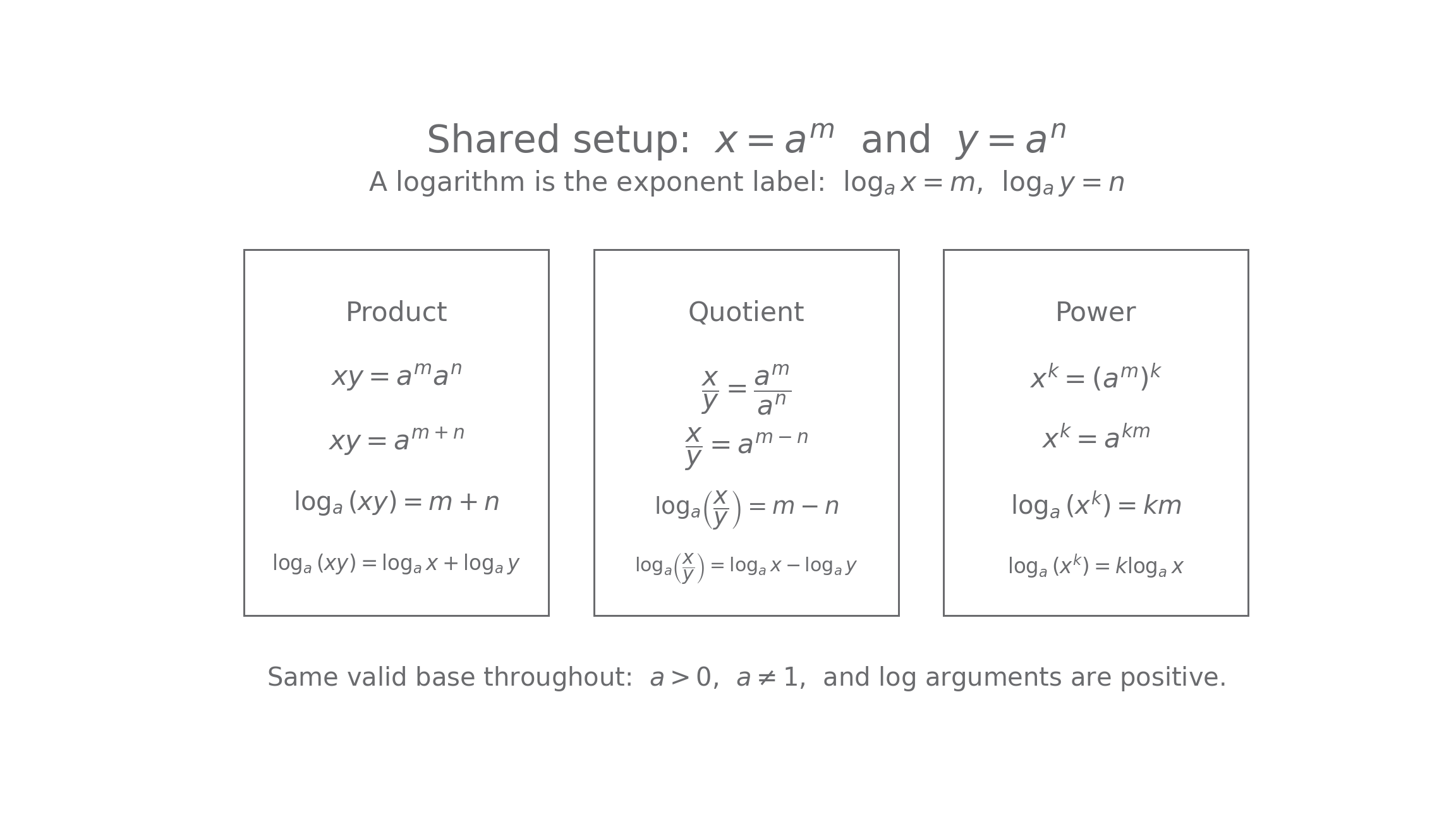
Here is the reason for all three log laws. Let and , where . Then
Taking the exponent label of each result gives , , and . Those labels are precisely the logarithms of the product, quotient and power.
[DIAGRAM: asset_slug: p1_6_4_understand_and_use_laws_of_logarithms__diagram_01; asset_name: Logarithm laws from index laws; caption: Products, quotients and powers change exponent labels; description: Three panels start with x equals a to the power m and y equals a to the power n. The product has exponent m plus n, the quotient m minus n and the kth power km. All bases are positive and not 1, and all original logarithm arguments are positive.]
A common logarithm base
A common base means that every logarithm being combined uses the same valid base , . For example, uses base throughout; does not have a common base.
Two useful special values are and , because and . These definitions and the three log laws are not in the formula booklet: learn them. The supplied change-of-base formula is a different result.
A surprising scale change is exact: , although . A logarithm can turn a huge product into an ordinary sum of exponent labels; it is no wonder this operation makes long calculations easier.
Key idea
Logarithm laws are index laws read backwards. Check the common base and positive original arguments before you combine anything.
Check that interpretation with a negative logarithm value.
Product and quotient laws
A sum of logarithms combines a product; a difference combines a quotient. You can use either direction: expand to simplify constants, or condense to get one logarithm.
Product and quotient laws
For , , and ,
Not in the formula booklet: learn it.
Keep brackets around an argument containing several factors.
Worked example 1: expanding a product and quotient
Question. Expand , where , simplifying constants.
Plan. Split the product , then evaluate .
Why this step? The factor is an exact power of the base, so splitting it off simplifies the expression.
Answer. . As a single logarithm, it is .
Check. With , , both forms give .
Change only the numerical factor from to . The variable terms need no new method.
Worked example 2: a different exact power
Question. Expand , where , simplifying constants.
Plan. Separate the product and evaluate the constant logarithm.
Why this step? Doubling the constant factor adds to its base- exponent label.
Answer. .
Check. With , , the result is , matching .
For an equation, condensing can expose ordinary algebra. For example, with ,
by the quotient law and the definition of a logarithm. Hence , so , which satisfies .
Watch out
Wrong: . Right: it is . The outside addition turns into inside multiplication.
Reverse the laws to combine a new pair of logarithms.
Power law, reciprocals and roots
A multiplier outside a logarithm becomes an exponent inside it. This works with negative and fractional multipliers too, provided the original argument is positive.
Power law
For , , and real ,
In particular,
Not in the formula booklet: learn it.
Writing roots as powers makes their role much easier to see.
Worked example 3: a square root in the denominator
Question. Expand , where .
Plan. Split products and quotients, then bring each exponent in front.
Why this step? Division supplies the minus sign; the square root supplies the factor .
Answer. .
Check. At , , the original argument is ; the expanded result is .
Change only the denominator's power from to . Its coefficient outside the logarithm changes accordingly.
Continue this lesson.
You’re previewing NovaLearn without an account. Create a free account to read the rest.
Create free account