Pure 7.3 - Gradients, tangents, normals, maxima and minima
Use derivatives to make decisions about a curve: find its tangent and normal, locate its turning points, and identify where it rises, falls or changes concavity. Then turn a practical maximum or minimum problem into a function, with a sensible domain and a justified answer.
The derivative as local gradient information
With of fencing and a straight wall, what rectangular enclosure gives the largest area? A width of leaves for the length and gives . A width of leaves and gives . We need a reason why no other width does better.
You already know
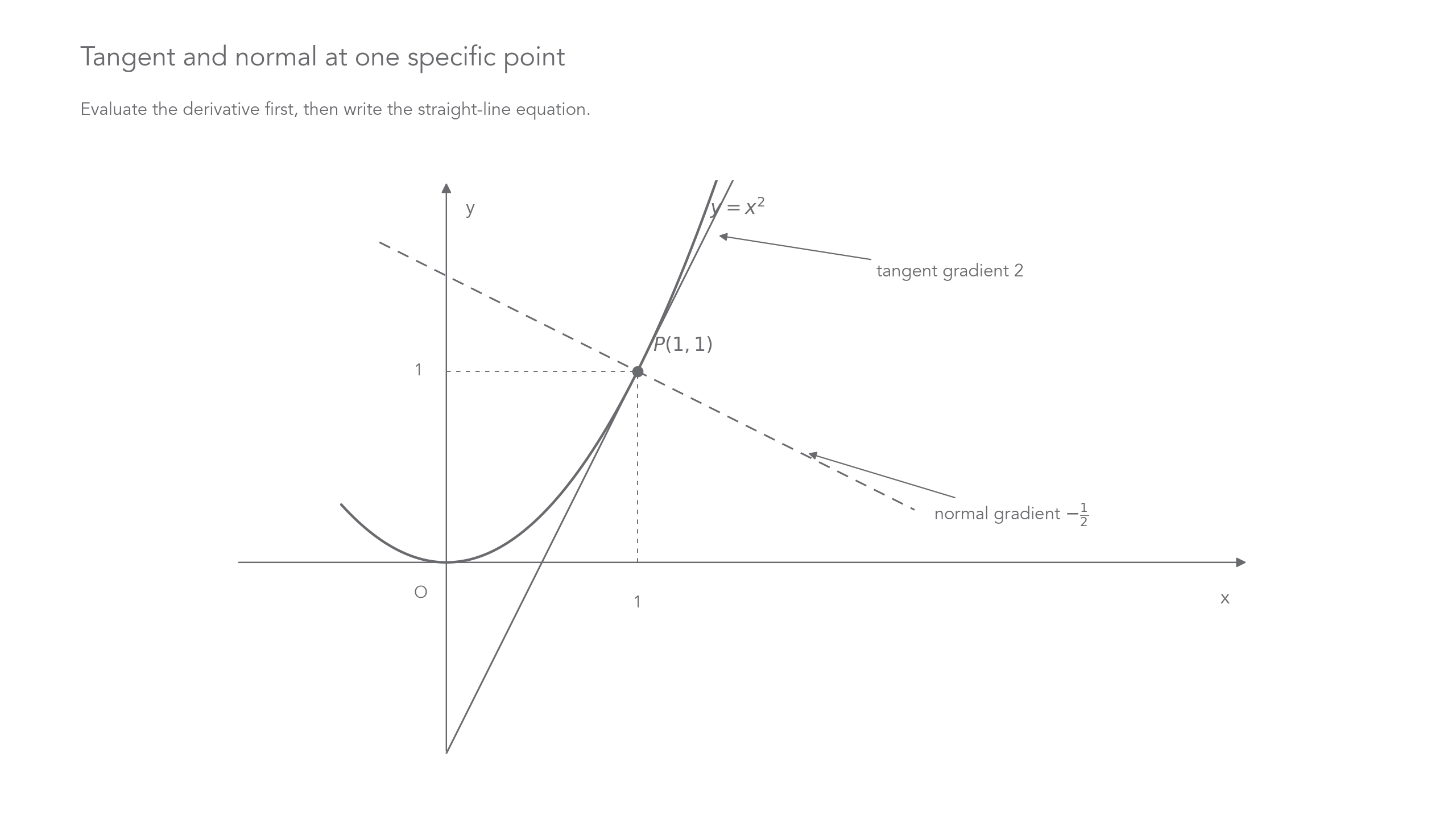
The derivative gives the gradient of at . Differentiate first, then evaluate at the chosen point. For example, has tangent gradient at .
The gradient expression describes a whole family of slopes. A tangent at one specified point has a constant gradient . Keeping these jobs separate will also help when we set the gradient of an area function equal to zero.
Normal
The normal to a smooth curve at a point is the line perpendicular to its tangent at that point.
The normal is a line through the curve point, not a second curve. If the tangent has finite non-zero gradient , the normal has gradient . If the tangent is horizontal, the normal is vertical.
[DIAGRAM: asset_slug: p1_7_3_apply_differentiation_to_find_gradients_tangents_normals_maxima_and_minima__diagram_01; asset_name: A tangent and its normal; caption: Both lines pass through P, but their gradients are negative reciprocals; description: Equal-scale axes show y=x squared, P(1,1), tangent y=2x-1 and normal y=-x/2+3/2 with labels placed clear of the lines.]
Key idea
At , the tangent gradient is the number ; the normal uses the perpendicular direction through the same point.
A zero gradient has an ordinary geometric meaning even though its negative reciprocal is undefined.
Equations of tangents and normals
Find the curve point and tangent gradient separately, then bring them together in a line equation. For a normal, change the direction before writing the equation.
Tangent and normal equations
For and finite ,
is the tangent. If , the normal is
If , the normal is .
Not in the formula booklet: learn it.
The point-gradient form automatically makes the line pass through the correct point.
Worked example 1: tangent and normal to a cubic
Question. Find the tangent and normal to at .
Plan. Find the point, evaluate the derivative, then use the tangent and perpendicular gradients.
Why this step? A line has one gradient; use , not the variable expression .
Answer. Tangent ; normal .
Check. Both contain , and their gradients have product .
Change only the point of contact to the point where .
Worked example 2: the same curve, another point
Question. Find the tangent and normal to at .
Plan. Use the same derivative, but evaluate both the height and gradient at the new input.
Why this step? Moving the contact point changes both the gradient and the point the line must pass through.
Answer. Tangent ; normal .
Check. The two lines meet at , and their gradients are perpendicular.
For comparison, the quadratic at has point and gradient , giving tangent and normal .
Watch out
Wrong: use for a normal. Reflection in gives reciprocal slopes, but perpendicular lines need the negative reciprocal .
Change the contact point of the worked cubic once more.
Stationary points and their nature
A stationary point has a horizontal tangent, so its first derivative is zero. That identifies a candidate, but does not yet tell you its nature.
Stationary point
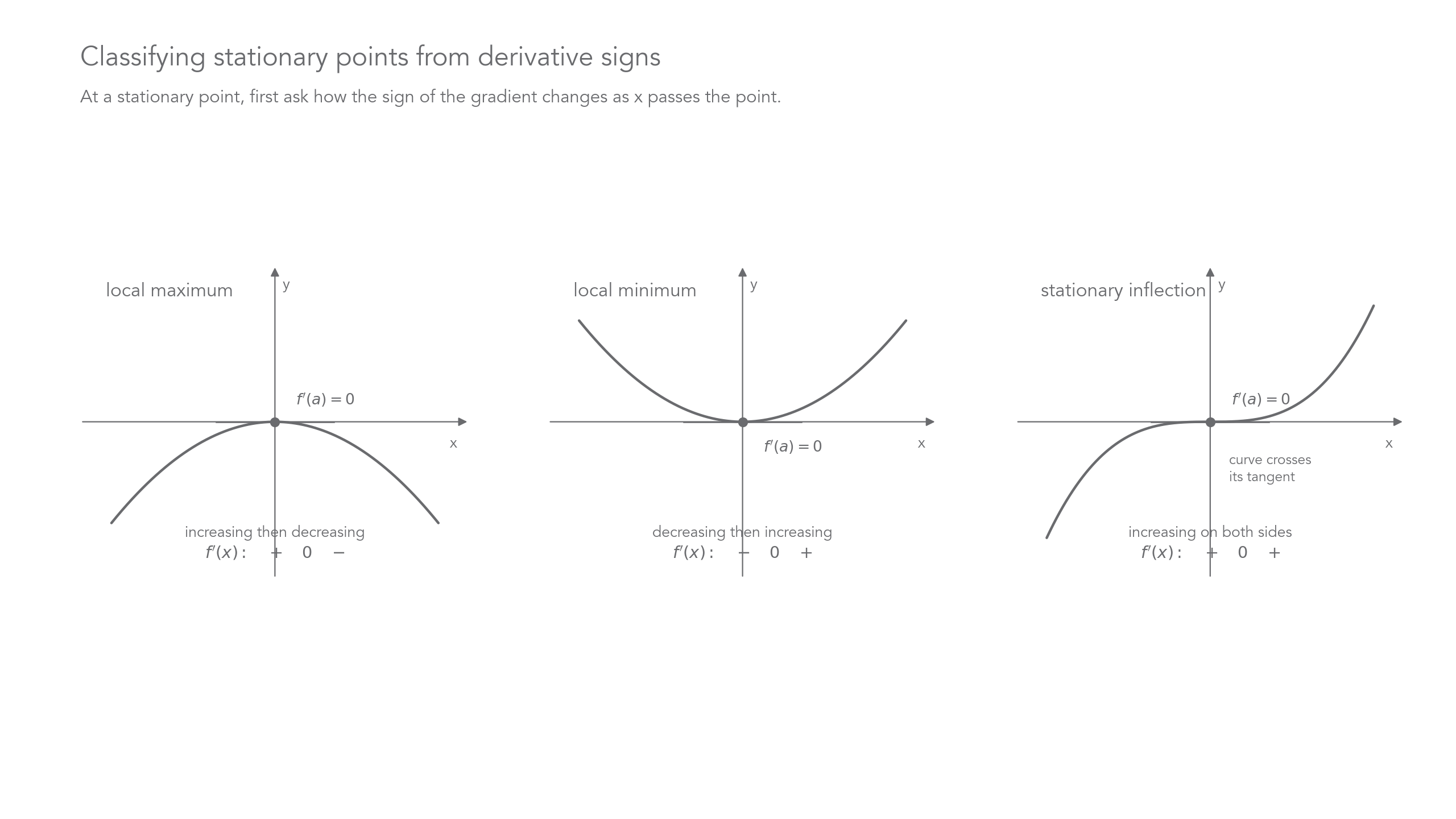
A stationary point of is a point where . It may be a local maximum, a local minimum or a stationary point of inflection.
A maximum changes from uphill to downhill; a minimum changes from downhill to uphill. The second derivative tests how the gradient moves through zero.
Classifying a stationary point
At , gives a local minimum and gives a local maximum. If , inspect the signs of either side or compare nearby values.
Not in the formula booklet: learn it.
A local maximum is only higher than nearby values; it need not be the largest value on the whole domain.
[DIAGRAM: asset_slug: p1_7_3_apply_differentiation_to_find_gradients_tangents_normals_maxima_and_minima__diagram_02; asset_name: Three stationary shapes; caption: A zero gradient can give a maximum, a minimum or a stationary inflection; description: Three panels show minus x squared, x squared and x cubed at zero, horizontal tangents, and derivative sign rows plus-zero-minus, minus-zero-plus and plus-zero-plus.]
Worked example 3: locating and classifying
Question. Find and classify the stationary points of .
Plan. Solve , return to for the heights, and use for the nature.
Why this step? Substitution into gives zero at both points; only substitution into gives their heights.
Answer. Local maximum ; local minimum .
Check. The derivative's signs are positive, negative, positive across and .
Change only the constant term from to . The stationary heights change, but their positions and nature do not.
Worked example 4: shifting stationary heights
Question. Find and classify the stationary points of .
Plan. Reuse the derivative and classification, then evaluate the new function.
Why this step? A vertical translation preserves every tangent gradient.
Answer. Local maximum ; local minimum .
Check. Both heights are exactly above the previous example's heights.
When both derivatives vanish, do not guess. At zero, has a minimum, a maximum and a stationary inflection. Their first derivatives have signs , and , respectively.
Watch out
Wrong: “, therefore a maximum.” A horizontal tangent alone does not tell you which way the curve moves either side. State a valid second-derivative or sign-test reason.
Change the constant again and keep the nature linked to its mathematical reason.
Continue this lesson.
You’re previewing NovaLearn without an account. Create a free account to read the rest.
Create free account